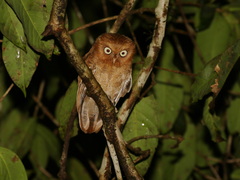
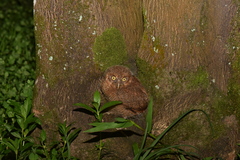
Mountain Scops-Owl

Mountain Scops-Owl

Otus spilocephalus

Silhouette: Armelle Ansart (photograph), Maxime Dahirel (digitisation) · PhyloPic

LCLeast ConcernNTVUENCR Endemic
Daily sighting probability ~10% · With luck
at Kerinci Seblat National Park

In 3 days ~20% in a week ~30%

34 Verified sightings at Kerinci Seblat National Park From 2019 to 2026
556 In all 10 parks
November Best month
🌙 Nocturnal When it's spotted

About the Mountain Scops-Owl

The mountain scops owl (Otus spilocephalus), sometimes referred to as the spotted scops owl, is a species of owl in the family Strigidae. Its range extends across much of south and southeast Asia, from Pakistan and the Himalayas in the northwest, through Taiwan, Thailand and Malaysia in the east and south.

The nominate subspecies of the eastern Himalayas has a distinct more russet plumage. It is an altitudinal migrant. The owls have a short high-pitched call like a two-note whistle, "plew-plew" or "he-he", although the female's songs are rarely heard. Their calls also differ between geographic population.

BirdLife Species Factsheet http://www.owlpages.com/owls.php?genus=Otus&species=spilocephalus "Otus spilocephalus media". Internet Bird Collection. Wikipedia →

Sounds

Call1:10

Vietnam · 2026

© Tim Dinh / Annambirding · XC1178661 · CC BY-NC-SA 4.0

Song0:41

India · 2024

© Lars Lachmann · XC892429 · CC BY-NC-SA 4.0

Duet0:15

China · 2022

© Oriental Stork · XC742662 · CC BY-NC-SA 4.0

Global Distribution

Parks Where Found

# Park Country Daily sighting probability
1 Cuc Phuong National Park 🇻🇳 Vietnam
~10%
2 Taroko National Park 🇹🇼 Taiwan
~10%
3 Kinabalu Park 🇲🇾 Malaysia
~10%
4 Namdapha National Park 🇮🇳 India
~10%
5 Kerinci Seblat National Park 🇮🇩 Indonesia
~10%
6 Langtang National Park 🇳🇵 Nepal
<5%
7 Royal Manas National Park 🇧🇹 Bhutan
<5%
8 Doi Inthanon National Park 🇹🇭 Thailand
<5%
9 Khao Yai National Park 🇹🇭 Thailand
<5%
10 Kaeng Krachan National Park 🇹🇭 Thailand
<5%

Cities Where Found

# City Country Daily sighting probability
1 Taipei 🇹🇼 Taiwan
<5%

Zoos & Centres Where Found

# Zoo / Centre Country
1 Fonghuanggu Bird and Ecology Park 🇹🇼 Taiwan In captivity

Before you go

What are the chances of seeing a Mountain Scops-Owl in Kerinci Seblat National Park?

With luck

About 10% of wildlife watchers report a Mountain Scops-Owl sighting in Kerinci Seblat National Park on a given day, based on 34 verified sightings from GBIF citizen-science data from 2019 to 2026. It is the 106th most-seen of the 203 birds we can rate there. Over three days the chance rises to about 20%, and over a week to about 30%, if each day is a fresh chance.

When is the best time to see a Mountain Scops-Owl in Kerinci Seblat National Park?

November

In that month about 20% of wildlife watchers report a Mountain Scops-Owl in Kerinci Seblat National Park on a given day, against under 5% in February–May, July–August and October, the lowest months. January has too few records to rate.

What time of day is best to see a Mountain Scops-Owl?

Between 7 and 10 pm

Across all the parks we cover, that three-hour window holds the most Mountain Scops-Owl sightings with a recorded time, and about 9 in 10 of them come between 6 pm and 6 am: it is mostly seen at night.

Is Kerinci Seblat National Park the best place to see a Mountain Scops-Owl?

Among the best

Of the 10 parks where we can rate Mountain Scops-Owl sightings, Kerinci Seblat National Park ranks 5th at about 10%, level with the leaders once rounded. The best odds are in Cuc Phuong National Park (Vietnam, about 10%), Taroko National Park (Taiwan, about 10%) and Kinabalu Park (Malaysia, about 10%).

Where does the Mountain Scops-Owl sighting chance come from?

GBIF citizen-science records

It is estimated from how often the Mountain Scops-Owl is recorded against all the birds logged in Kerinci Seblat National Park (34 verified sightings from 2019 to 2026), calibrated against known sighting rates. Figures are rounded to the nearest 10% because citizen-science data supports honest approximations, not decimals, and months with records from fewer than five people show "—". How it works.

← Back to Kerinci Seblat National Park