Eastern Barn Owl

Eastern Barn Owl

Tyto javanica

Silhouette: Sharon Wegner-Larsen · PhyloPic

Daily sighting probability ~20% · Possible
at Kerinci Seblat National Park

In 3 days ~50% in a week ~80%

9 Verified sightings at Kerinci Seblat National Park From 2019 to 2026
246 In all 12 parks
May Best month
☀️🌙 Day & Night When it's spotted

About the Eastern Barn Owl

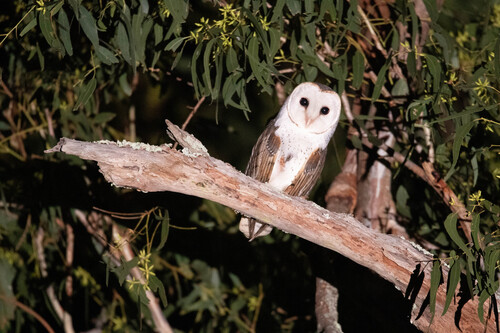
The Eastern barn owl (Tyto javanica) is usually considered a subspecies group and together with the American barn owl group, the western barn owl group, and sometimes the Andaman masked owl make up the genus Tyto. The cosmopolitan barn owl is recognized by most taxonomic authorities. A few (including the International Ornithologists' Union) separate them into distinct species, as is done here. The eastern barn owl is native to southeastern Asia, New Zealand, and Australasia.

The eastern barn owl is nocturnal over most of its range, but in some Pacific islands, it also hunts by day. They specialise in hunting animals on the ground, and nearly all of their food consists of small mammals which they locate by sound, their hearing being very acute. They mate for life unless one of the pair is killed, after which a new pair bond may be formed. Breeding takes place at varying times of year according to locality, with a clutch, averaging about four eggs, being laid in a nest in a tree hollow, old building or fissure in a cliff. The female does all the incubation, and she and the young chicks are reliant on the male for food. When large numbers of small prey are readily available, barn owl populations can expand rapidly. Wikipedia →
Sounds

Call0:15

Australia · 2024

© Tom Cooney · XC1103327 · CC BY-NC-SA 4.0

Alarm call0:11

Australia · 2014

© Chris Harrison · XC1043069 · CC BY-NC-SA 4.0

Nocturnal flight call0:06

Malaysia · 2021

© Lim Ying Hien · XC808122 · CC BY-NC-ND 4.0

Global Distribution

Parks Where Found

# Park Country Daily sighting probability
1 Kerinci Seblat National Park 🇮🇩 Indonesia
~20%
2 Sundarbans National Park 🇮🇳 India
~10%
3 Hattah-Kulkyne National Park 🇦🇺 Australia
<5%
4 Ranthambore National Park 🇮🇳 India
<5%
5 Satpura National Park 🇮🇳 India
<5%
6 Bandhavgarh National Park 🇮🇳 India
<5%
7 Nagarhole National Park 🇮🇳 India
<5%
8 Kakadu National Park 🇦🇺 Australia
<5%
9 Great Otway National Park 🇦🇺 Australia
<5%
10 Kanha National Park 🇮🇳 India
<5%
11 Lamington National Park 🇦🇺 Australia
<5%
12 Kaeng Krachan National Park 🇹🇭 Thailand
<5%

Cities Where Found

# City Country Daily sighting probability
1 Kollam 🇮🇳 India
~10%
2 Patna 🇮🇳 India
~10%
3 Kathmandu 🇳🇵 Nepal
~10%
4 Nashik 🇮🇳 India
~10%
5 Thiruvananthapuram 🇮🇳 India
<5%
6 Prayagraj 🇮🇳 India
<5%
7 Thrissur 🇮🇳 India
<5%
8 Tiruchirappalli 🇮🇳 India
<5%
9 Karachi 🇵🇰 Pakistan
<5%
10 Pune 🇮🇳 India
<5%

Zoos & Centres Where Found

# Zoo / Centre Country
1 Nandankanan Zoological Park 🇮🇳 India In captivity
2 Territory Wildlife Park 🇦🇺 Australia In captivity
3 Kadoorie Farm and Botanic Garden 🇭🇰 Hong Kong SAR China In captivity
4 Chiang Mai Night Safari 🇹🇭 Thailand In captivity
5 Kyabram Fauna Park 🇦🇺 Australia In captivity
6 Alice Springs Desert Park 🇦🇺 Australia In captivity
7 Parc zoologique et forestier Michel-Corbasson 🇫🇷 France In captivity
8 Taronga Zoo 🇦🇺 Australia In captivity
9 Currumbin Wildlife Sanctuary 🇦🇺 Australia In captivity
10 Lone Pine Koala Sanctuary 🇦🇺 Australia In captivity
11 Auckland Zoo 🇳🇿 New Zealand In captivity
12 Bandung Zoo 🇮🇩 Indonesia In captivity
13 Thiruvananthapuram Zoo 🇮🇳 India In captivity
14 Sayaji Baug Zoo 🇮🇳 India In captivity
15 Moonlit Sanctuary Wildlife Conservation Park 🇦🇺 Australia In captivity
16 Sydney Zoo 🇦🇺 Australia In captivity
17 Kuala Lumpur Bird Park 🇲🇾 Malaysia In captivity
18 Byron Bay Wildlife Sanctuary 🇦🇺 Australia In captivity
19 Featherdale Sydney Wildlife Park 🇦🇺 Australia In captivity
20 Koala Park Sanctuary 🇦🇺 Australia In captivity
21 Penang Bird Park 🇲🇾 Malaysia In captivity
22 Greenough Wildlife & Bird Park 🇦🇺 Australia In captivity
23 Sea World Indonesia 🇮🇩 Indonesia In captivity
24 Thrissur Zoo 🇮🇳 India In captivity
25 Aquaria KLCC 🇲🇾 Malaysia In captivity
26 Cairns Tropical Zoo 🇦🇺 Australia In captivity
27 Jakarta Aquarium 🇮🇩 Indonesia In captivity
28 Kangaroo Island Wildlife Park 🇦🇺 Australia In captivity
29 Ranger Red’s Zoo & Conservation Park 🇦🇺 Australia In captivity
30 The Lair 🇦🇺 Australia In captivity
31 Vogelpark Bali 🇮🇩 Indonesia In captivity

Before you go

What are the chances of seeing an Eastern Barn Owl in Kerinci Seblat National Park?

Possible

About 20% of wildlife watchers report an Eastern Barn Owl sighting in Kerinci Seblat National Park on a given day, based on 9 verified sightings from GBIF citizen-science data from 2019 to 2026. It is the 52nd most-seen of the 203 birds we can rate there. Over three days the chance rises to about 50%, and over a week to about 80%, if each day is a fresh chance.

When is the best time to see an Eastern Barn Owl in Kerinci Seblat National Park?

May

In that month about 50% of wildlife watchers report an Eastern Barn Owl in Kerinci Seblat National Park on a given day, against under 5% in February–March, June and October–December, the lowest months.

What time of day is best to see an Eastern Barn Owl?

Between 6 and 9 pm

Across all the parks we cover, that three-hour window holds the most Eastern Barn Owl sightings with a recorded time, and about 6 in 10 of them come between 6 pm and 6 am: it is seen both by day and at night.

Is Kerinci Seblat National Park the best place to see an Eastern Barn Owl?

Yes

Of the 12 parks where we can rate Eastern Barn Owl sightings, Kerinci Seblat National Park has the highest daily chance: about 20%. Next come Sundarbans National Park (India, about 10%) and Hattah-Kulkyne National Park (Australia, under 5%).

Which relatives of the Eastern Barn Owl live in Kerinci Seblat National Park?

Same order: Strigiformes

The closest relatives of the Eastern Barn Owl that you can see in Kerinci Seblat National Park (order Strigiformes, Owls) are Collared Owlet (about 20%), Rajah Scops Owl (about 10%) and Mountain Scops-Owl (about 10%), with each one's daily chance of a sighting.

Where does the Eastern Barn Owl sighting chance come from?

GBIF citizen-science records

It is estimated from how often the Eastern Barn Owl is recorded against all the birds logged in Kerinci Seblat National Park (9 verified sightings from 2019 to 2026), calibrated against known sighting rates. Figures are rounded to the nearest 10% because citizen-science data supports honest approximations, not decimals, and months with records from fewer than five people show "—". How it works.

← Back to Kerinci Seblat National Park