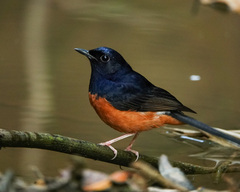
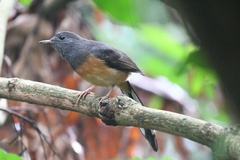
The white-rumped shama (Copsychus malabaricus) is a passerine bird in the Old World flycatcher family Muscicapidae. Native to densely vegetated habitats in the Indian subcontinent and Southeast Asia, its popularity as a cage-bird and songster has led to it being introduced elsewhere. The Larwo shama, the Kangean shama and the Sri Lanka shama were formerly considered to be conspecific with the white-rumped shama.
The white-rumped shama was formally described in 1786 by the Austrian naturalist Giovanni Antonio Scopoli under the binomial name Muscicapa malabarica. Scopoli based his account on "Le gobe-mouches à longue queue de Gingi" that had been described in 1782 by the French naturalist Pierre Sonnerat in the second volume of his book Voyage aux Indes orientales et à la Chine. Sonnerat mentioned that the bird was found on the Malabar Coast of India. The type locality is Mahé. The white-rumped shama is now one of 17 species placed in the genus Copsychus that was introduced in 1827 by the German naturalist Johann Georg Wagler.
Nine subspecies are recognised: