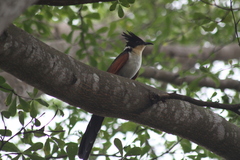

Chestnut-winged Cuckoo

Chestnut-winged Cuckoo

Clamator coromandus

Silhouette: Nicolas Huet le Jeune and Jean-Gabriel Prêtre (vectorized by T. Michael Keesey) · PhyloPic

LCLeast ConcernNTVUENCR
Daily sighting probability <5% · Rare
at Kinabatangan Wildlife Sanctuary

In 3 days <5% in a week ~10%

18 Verified sightings at Kinabatangan Wildlife Sanctuary From 2019 to 2026
354 In all 11 parks
January Best month
☀️ Diurnal When it's spotted

About the Chestnut-winged Cuckoo

The chestnut-winged cuckoo or red-winged crested cuckoo (Clamator coromandus) is a cuckoo found in Southeast Asia and parts of South Asia. It has dark glossy upperparts, a black head with long crest chestnut wings, a long graduated glossy black tail, rufous throat dusky underside and a narrow white nuchal half collar. They breed along the Himalayas and migrate south in winter to Sri Lanka, southern India and tropical Southeast Asia including parts of Indonesia, Thailand and the Philippines. It is about 47 cm (19 in) long.

This dark and crested cuckoo has chestnut wings, a glossy black crest and a graduated tail (the feathers shortening in steps from the center outwards) whose terminal edges are white and inconspicuous unlike the white tips of the Jacobin cuckoo which is found in parts of its range. The black capping on the head is broken from black of the back by a white collar that extends to the sides of the neck. The lower parts are rufous turning to dark grey towards the vent. Young birds are dusky with a scaly appearance to the wing feathers.

The species was first given its binomial name by Linnaeus in 1766. His description of what he called Cuculus... Wikipedia →

Sounds

Song0:25

China · 2025

© Penghui Lou · XC1004170 · CC BY-NC-SA 4.0

Flight call0:26

China · 2024

© 王自堃 · XC912954 · CC BY-NC-SA 4.0

Call0:46

Malaysia · 2024

© Lim Ying Hien · XC872901 · CC BY-NC-ND 4.0

Global Distribution

Parks Where Found

# Park Country Daily sighting probability
1 Royal Manas National Park 🇧🇹 Bhutan
~10%
2 Cat Tien National Park 🇻🇳 Vietnam
<5%
3 Kaeng Krachan National Park 🇹🇭 Thailand
<5%
4 Manas National Park 🇮🇳 India
<5%
5 Wilpattu National Park 🇱🇰 Sri Lanka
<5%
6 Yala National Park 🇱🇰 Sri Lanka
<5%
7 Periyar National Park 🇮🇳 India
<5%
8 Kinabatangan Wildlife Sanctuary 🇲🇾 Malaysia
<5%
9 Namdapha National Park 🇮🇳 India
<5%
10 Chitwan National Park 🇳🇵 Nepal
<5%
11 Doi Inthanon National Park 🇹🇭 Thailand
<5%

Cities Where Found

# City Country Daily sighting probability
1 Ho Chi Minh City 🇻🇳 Vietnam
~10%
2 Guangzhou 🇨🇳 China
<5%
3 Chennai 🇮🇳 India
<5%
4 Jakarta 🇮🇩 Indonesia
<5%
5 Kaohsiung 🇹🇼 Taiwan
<5%
6 Singapore 🇸🇬 Singapore
<5%
7 Shanghai 🇨🇳 China
<5%
8 Dhaka 🇧🇩 Bangladesh
<5%
9 Tuen Mun 🇨🇳 China
<5%
10 Hong Kong 🇨🇳 China
<5%

Before you go

What are the chances of seeing a Chestnut-winged Cuckoo in Kinabatangan Wildlife Sanctuary?

Rare

Under 5% of wildlife watchers report a Chestnut-winged Cuckoo sighting in Kinabatangan Wildlife Sanctuary on a given day, based on 18 verified sightings from GBIF citizen-science data from 2019 to 2026. It is the 185th most-seen of the 231 birds we can rate there. Over three days the chance rises to under 5%, and over a week to about 10%, if each day is a fresh chance.

When is the best time to see a Chestnut-winged Cuckoo in Kinabatangan Wildlife Sanctuary?

January

In that month about 10% of wildlife watchers report a Chestnut-winged Cuckoo in Kinabatangan Wildlife Sanctuary on a given day, against under 5% in February to December, the lowest months.

What time of day is best to see a Chestnut-winged Cuckoo?

Between 8 and 11 am

Across all the parks we cover, that three-hour window holds the most Chestnut-winged Cuckoo sightings with a recorded time, and nearly all of them come between 6 am and 6 pm: it is a daytime animal.

Is Kinabatangan Wildlife Sanctuary the best place to see a Chestnut-winged Cuckoo?

8th of 11

Of the 11 parks where we can rate Chestnut-winged Cuckoo sightings, Kinabatangan Wildlife Sanctuary ranks 8th at under 5%. The best odds are in Royal Manas National Park (Bhutan, about 10%), Cat Tien National Park (Vietnam, under 5%) and Kaeng Krachan National Park (Thailand, under 5%).

Which relatives of the Chestnut-winged Cuckoo live in Kinabatangan Wildlife Sanctuary?

Same family: Cuculidae

The closest relatives of the Chestnut-winged Cuckoo that you can see in Kinabatangan Wildlife Sanctuary (family Cuculidae, Cuckoos) are Greater Coucal (about 30%), Plaintive Cuckoo (about 10%) and Bornean Ground-Cuckoo (about 10%), with each one's daily chance of a sighting.

Where does the Chestnut-winged Cuckoo sighting chance come from?

GBIF citizen-science records

It is estimated from how often the Chestnut-winged Cuckoo is recorded against all the birds logged in Kinabatangan Wildlife Sanctuary (18 verified sightings from 2019 to 2026), calibrated against known sighting rates. Figures are rounded to the nearest 10% because citizen-science data supports honest approximations, not decimals, and months with records from fewer than five people show "—". How it works.

← Back to Kinabatangan Wildlife Sanctuary