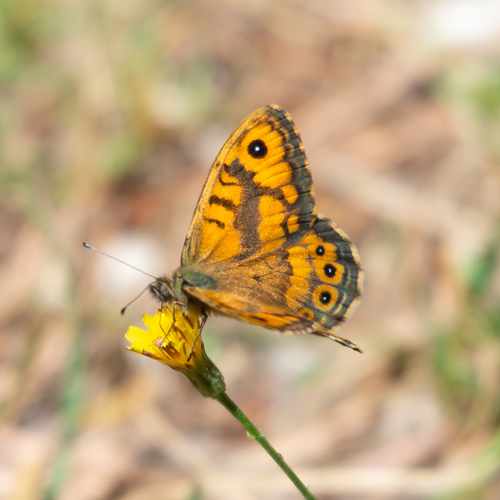
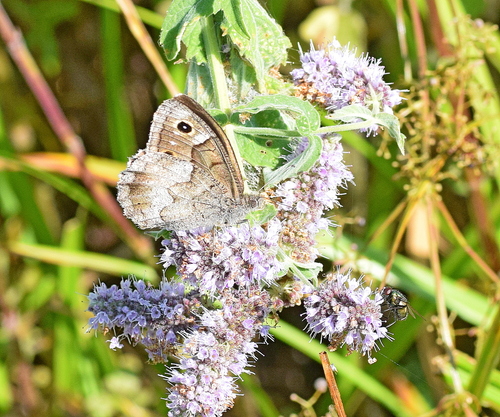
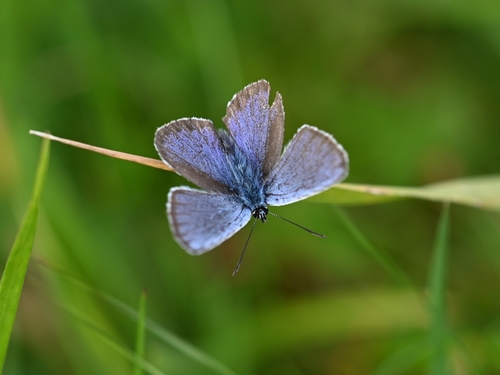
Glanville Fritillary

Glanville Fritillary

Melitaea cinxia

Daily sighting probability ~20% · Possible
at Kiskunság National Park

In 3 days ~50% in a week ~80%

7 Verified sightings at Kiskunság National Park From 2019 to 2026
380 In all 10 parks
May Best month
☀️ Diurnal When it's spotted

About the Glanville Fritillary

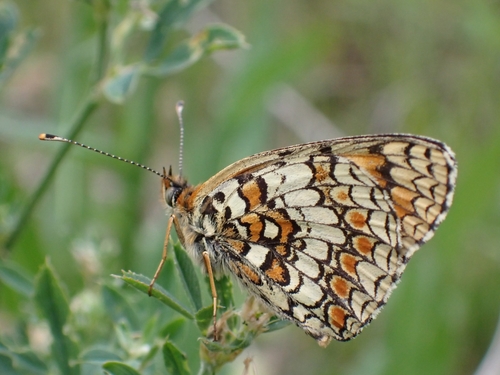
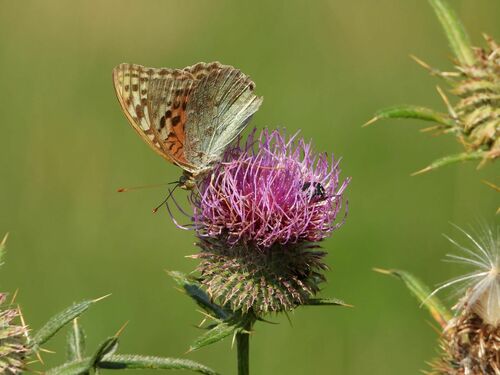
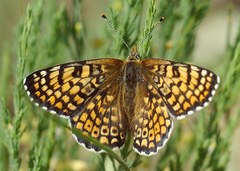
The Glanville fritillary (Melitaea cinxia) is a butterfly of the family Nymphalidae. It is named for Eleanor Glanville, the naturalist who discovered it, and the checkerboard pattern on its wings. These butterflies live in almost all of Europe, especially Finland, and in parts of northwest Africa. They are absent from the far north of Europe and parts of the Iberian Peninsula. To the east they are found across the Palearctic (in Turkey, Russia, northern Kazakhstan, and Mongolia).

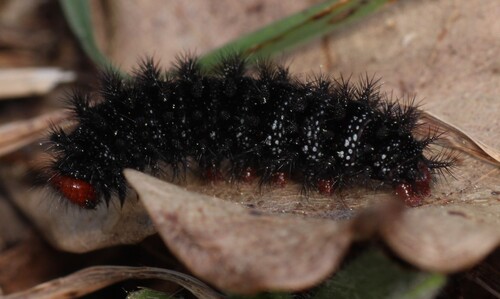
It has been discovered that this butterfly only mates one time in June or July and lays its eggs. It does not provide any protection to these eggs or care for the offspring. As adults, the Glanville fritillaries are short-lived; they spend most of their lives as caterpillars. As caterpillars, Glanville fritillaries enter a stage of diapause, which is a period of suspended development, during the winter time.

The spiked speedwell and ribwort plantain are the Glanville fritillary's preferred plants to lay eggs and to eat as larvae. Female butterflies will show a preference for one plant species over the other when deciding where to lay their eggs, but the caterpillars have no preference once they hatch. After entering the adult phase the fritillaries feed on nectar of the spiked speedwell and ribwort plantain, among others.

This species of butterfly is at risk of population decline because it is not a migratory species. Though widespread, populations in Finland are at risk because they are not able to travel great distances as easily as other species, such as monarchs, if their environment should suddenly become unsuitable. Wikipedia →
Global Distribution

Parks Where Found

# Park Country Daily sighting probability
1 Mercantour National Park 🇫🇷 France
~30%
2 Cévennes National Park 🇫🇷 France
~20%
3 Kiskunság National Park 🇭🇺 Hungary
~20%
4 Vanoise National Park 🇫🇷 France
~20%
5 Aigüestortes National Park 🇪🇸 Spain
~10%
6 Picos de Europa National Park 🇪🇸 Spain
~10%
7 Pyrénées National Park 🇫🇷 France
~10%
8 Ecrins National Park 🇫🇷 France
~10%
9 Sierra de Guadarrama National Park 🇪🇸 Spain
~10%
10 Wadden Sea National Park 🇩🇪 Germany
~10%

Cities Where Found

# City Country Daily sighting probability
1 Istanbul 🇹🇷 Turkey
~10%
2 Rome 🇮🇹 Italy
<5%
3 Lyon 🇫🇷 France
<5%

Before you go

What are the chances of seeing a Glanville Fritillary in Kiskunság National Park?

Possible

About 20% of wildlife watchers report a Glanville Fritillary sighting in Kiskunság National Park on a given day, based on 7 verified sightings from GBIF citizen-science data from 2019 to 2026. It is the 48th most-seen of the 95 insects we can rate there. Over three days the chance rises to about 50%, and over a week to about 80%, if each day is a fresh chance.

When is the best time to see a Glanville Fritillary in Kiskunság National Park?

May

In that month about 40% of wildlife watchers report a Glanville Fritillary in Kiskunság National Park on a given day, against under 5% in January–March and June–October, the lowest months. That is one of Kiskunság National Park's wettest months, with about 75 mm of rain against 35 mm in April.

What time of day is best to see a Glanville Fritillary?

Between 10 am and 1 pm

Across all the parks we cover, that three-hour window holds the most Glanville Fritillary sightings with a recorded time, and about 9 in 10 of them come between 6 am and 6 pm: it is a daytime animal.

Is Kiskunság National Park the best place to see a Glanville Fritillary?

3rd of 10

Of the 10 parks where we can rate Glanville Fritillary sightings, Kiskunság National Park ranks 3rd at about 20%. The best odds are in Mercantour National Park (France, about 30%) and Cévennes National Park (France, about 20%).

Where does the Glanville Fritillary sighting chance come from?

GBIF citizen-science records

It is estimated from how often the Glanville Fritillary is recorded against all the insects logged in Kiskunság National Park (7 verified sightings from 2019 to 2026), calibrated against known sighting rates. Figures are rounded to the nearest 10% because citizen-science data supports honest approximations, not decimals, and months with records from fewer than five people show "—". How it works.

← Back to Kiskunság National Park