Mediterranean Spotted Chafer

Mediterranean Spotted Chafer

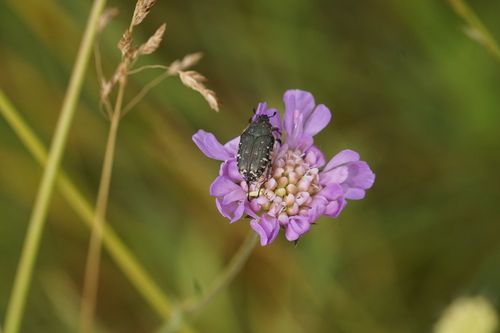
Oxythyrea funesta

Daily sighting probability ~20% · Possible
at Kiskunság National Park

In 3 days ~50% in a week ~80%

13 Verified sightings at Kiskunság National Park From 2019 to 2026
545 In all 15 parks
May Best month
☀️ Diurnal When it's spotted

About the Mediterranean Spotted Chafer

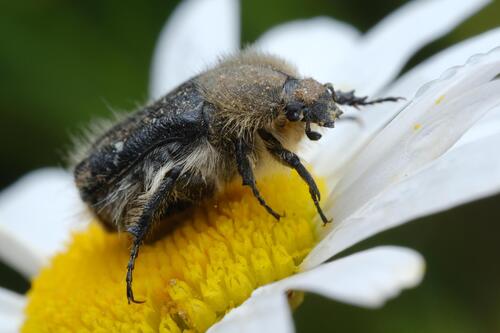
Oxythyrea funesta is a phytophagous beetle species belonging to the family Cetoniidae, subfamily Cetoniinae. Its common name is "white spotted rose beetle". This beetle is present in most of Europe, in the west Palearctic realm, and in the Near East. It is not present in North or South America.

Larvae are 16-22 mm long. They feed on dung, rotten wood, litter and soil and can remain until next spring in the soil. The adults appear early in the spring, they grow up to 8–12 millimetres (0.31–0.47 in) and can mostly be encountered from May through July. They can be considered a pest since they feed not only on pollen, but also on floral organs, especially those in light colors.

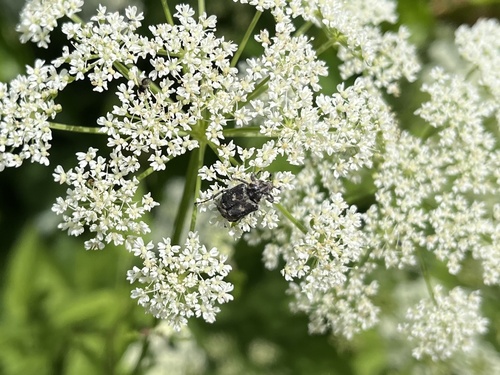
Their colour is black, more or less bronzed. Most of the specimens show six white spots in two longitudinal rows on the pronotum and many others on the elytra. They are completely covered with white pubescence (easily visible in profile). Older specimens usually have no hairs, as they are rubbed off with time.

The larva lives in the soil and feeds on plant roots, etc. When hatched, it is 4–5 mm long, quite dark blue and with minimal hair, which distinguishes it from other species... Wikipedia →
Global Distribution

Parks Where Found

# Park Country Daily sighting probability
1 Triglav National Park 🇸🇮 Slovenia
~20%
2 Bavarian Forest National Park 🇩🇪 Germany
~20%
3 Cévennes National Park 🇫🇷 France
~20%
4 Sierra Nevada National Park 🇪🇸 Spain
~20%
5 Kiskunság National Park 🇭🇺 Hungary
~20%
6 Monfragüe National Park 🇪🇸 Spain
~20%
7 Vanoise National Park 🇫🇷 France
~20%
8 Białowieża National Park 🇵🇱 Poland
~20%
9 Doñana National Park 🇪🇸 Spain
~10%
10 Fertő-Hanság National Park 🇭🇺 Hungary
~10%
11 Aigüestortes National Park 🇪🇸 Spain
~10%
12 Pyrénées National Park 🇫🇷 France
~10%
13 Camargue 🇫🇷 France
~10%
14 Ecrins National Park 🇫🇷 France
~10%
15 Sierra de Guadarrama National Park 🇪🇸 Spain
~10%

Cities Where Found

# City Country Daily sighting probability
1 Turin 🇮🇹 Italy
~30%
2 Algiers 🇩🇿 Algeria
~30%
3 Rome 🇮🇹 Italy
~30%
4 Casablanca 🇲🇦 Morocco
~30%
5 Milan 🇮🇹 Italy
~30%
6 Kyiv 🇺🇦 Ukraine
~30%
7 Vienna 🇦🇹 Austria
~30%
8 Naples 🇮🇹 Italy
~20%
9 Valencia 🇪🇸 Spain
~20%
10 Barcelona 🇪🇸 Spain
~20%

Before you go

What are the chances of seeing a Mediterranean Spotted Chafer in Kiskunság National Park?

Possible

About 20% of wildlife watchers report a Mediterranean Spotted Chafer sighting in Kiskunság National Park on a given day, based on 13 verified sightings from GBIF citizen-science data from 2019 to 2026. It is the 48th most-seen of the 95 insects we can rate there. Over three days the chance rises to about 50%, and over a week to about 80%, if each day is a fresh chance.

When is the best time to see a Mediterranean Spotted Chafer in Kiskunság National Park?

May

In that month about 40% of wildlife watchers report a Mediterranean Spotted Chafer in Kiskunság National Park on a given day, against under 5% in January–April and July–October, the lowest months. That is one of Kiskunság National Park's wettest months, with about 75 mm of rain against 35 mm in April.

What time of day is best to see a Mediterranean Spotted Chafer?

Between 10 am and 1 pm

Across all the parks we cover, that three-hour window holds the most Mediterranean Spotted Chafer sightings with a recorded time, and about 9 in 10 of them come between 6 am and 6 pm: it is a daytime animal.

Is Kiskunság National Park the best place to see a Mediterranean Spotted Chafer?

Among the best

Of the 15 parks where we can rate Mediterranean Spotted Chafer sightings, Kiskunság National Park ranks 5th at about 20%, level with the leaders once rounded. The best odds are in Triglav National Park (Slovenia, about 20%), Bavarian Forest National Park (Germany, about 20%) and Cévennes National Park (France, about 20%).

Which relatives of the Mediterranean Spotted Chafer live in Kiskunság National Park?

Same family: Scarabaeidae

The closest relatives of the Mediterranean Spotted Chafer that you can see in Kiskunság National Park (family Scarabaeidae, Scarabs) are Pentodon idiota (about 30%), Apple Blossom Beetle (about 30%) and Valgus hemipterus (about 20%), with each one's daily chance of a sighting.

Where does the Mediterranean Spotted Chafer sighting chance come from?

GBIF citizen-science records

It is estimated from how often the Mediterranean Spotted Chafer is recorded against all the insects logged in Kiskunság National Park (13 verified sightings from 2019 to 2026), calibrated against known sighting rates. Figures are rounded to the nearest 10% because citizen-science data supports honest approximations, not decimals, and months with records from fewer than five people show "—". How it works.

← Back to Kiskunság National Park