
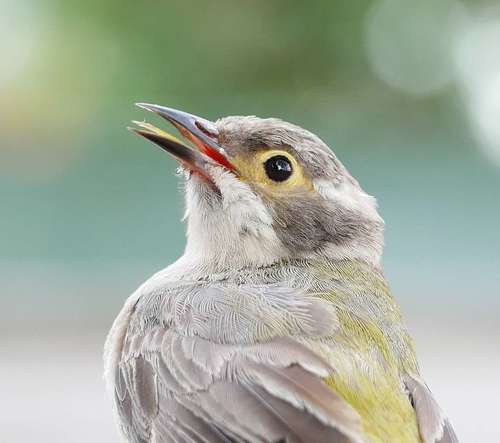
Scarlet Myzomela

Scarlet Myzomela

Myzomela sanguinolenta

Silhouette: Rachael Joakim · PhyloPic

LCLeast ConcernNTVUENCR Endemic
Daily sighting probability <5% · Rare
at Kosciuszko National Park

In 3 days <5% in a week ~10%

6 Verified sightings at Kosciuszko National Park From 2019 to 2026
1,428 In all 8 parks
December Best month
☀️ Diurnal When it's spotted

About the Scarlet Myzomela

The scarlet myzomela or scarlet honeyeater (Myzomela sanguinolenta) is a small passerine bird of the honeyeater family Meliphagidae native to Australia. It was first described by English ornithologist John Latham in 1801. At 9 to 11 cm (3.5 to 4.3 in) long, it is the smallest honeyeater in Australia. It has a short tail and relatively long down-curved bill. It is sexually dimorphic; the male is a striking bright red with black wings, while the female is entirely brown. The species is more vocal than most honeyeaters, and a variety of calls have been recorded, including a bell-like tinkling.

The scarlet myzomela is found along most of the eastern coastline, from Cape York in far north Queensland to Gippsland in Victoria. It is migratory in the southern parts of its range, with populations moving north in the winter. Its natural habitat is forest, where it forages mainly in the upper tree canopy. It is omnivorous, feeding on insects as well as nectar. Up to three broods may be raised over the course of a breeding season. The female lays two or rarely three flecked white eggs in a 5 cm (2 in) diameter cup-shaped nest high in a tree. The International Union for Conservation of Nature (IUCN) has assessed it as being of least concern on account of its large range and apparently stable population. Wikipedia →

Sounds

Call0:17

Australia · 2026

© Marc Anderson · XC1186717 · CC BY-NC-ND 4.0

Song0:24

Australia · 2023

© Romuald Mikusek · XC1169887 · CC BY-NC-SA 4.0

Recording0:23

Australia · 2017

© Nick Crosbie · XC859254 · CC BY-NC-SA 4.0

Global Distribution

Parks Where Found

# Park Country Daily sighting probability
1 Springbrook National Park 🇦🇺 Australia
~30%
2 Noosa National Park 🇦🇺 Australia
~20%
3 Royal National Park 🇦🇺 Australia
~10%
4 Blue Mountains National Park 🇦🇺 Australia
~10%
5 Lamington National Park 🇦🇺 Australia
~10%
6 Booderee National Park 🇦🇺 Australia
~10%
7 Kosciuszko National Park 🇦🇺 Australia
<5%
8 Daintree National Park 🇦🇺 Australia
<5%

Cities Where Found

# City Country Daily sighting probability
1 Brisbane 🇦🇺 Australia
~10%
2 Sydney 🇦🇺 Australia
<5%
3 Melbourne 🇦🇺 Australia
<5%

Zoos & Centres Where Found

# Zoo / Centre Country
1 Parc des oiseaux 🇫🇷 France In captivity
2 Taronga Zoo 🇦🇺 Australia In captivity
3 Birdworld Kuranda 🇦🇺 Australia In captivity
4 Kuranda Koala Gardens 🇦🇺 Australia In captivity

Before you go

What are the chances of seeing a Scarlet Myzomela in Kosciuszko National Park?

Rare

Under 5% of wildlife watchers report a Scarlet Myzomela sighting in Kosciuszko National Park on a given day, based on 6 verified sightings from GBIF citizen-science data from 2019 to 2026. It is the 119th most-seen of the 127 birds we can rate there. Over three days the chance rises to under 5%, and over a week to about 10%, if each day is a fresh chance.

When is the best time to see a Scarlet Myzomela in Kosciuszko National Park?

December

In that month about 10% of wildlife watchers report a Scarlet Myzomela in Kosciuszko National Park on a given day, against under 5% in January–May and July–November, the lowest months. June has too few records to rate.

What time of day is best to see a Scarlet Myzomela?

Between 8 and 11 am

Across all the parks we cover, that three-hour window holds the most Scarlet Myzomela sightings with a recorded time, and nearly all of them come between 6 am and 6 pm: it is a daytime animal.

Is Kosciuszko National Park the best place to see a Scarlet Myzomela?

7th of 8

Of the 8 parks where we can rate Scarlet Myzomela sightings, Kosciuszko National Park ranks 7th at under 5%. The best odds are in Springbrook National Park (Australia, about 30%), Noosa National Park (Australia, about 20%) and Royal National Park (Australia, about 10%).

Which relatives of the Scarlet Myzomela live in Kosciuszko National Park?

Same family: Meliphagidae

The closest relatives of the Scarlet Myzomela that you can see in Kosciuszko National Park (family Meliphagidae, Honeyeaters) are Yellow-faced Honeyeater (about 70%), Red Wattlebird (about 50%) and White-eared Honeyeater (about 30%), with each one's daily chance of a sighting.

Where does the Scarlet Myzomela sighting chance come from?

GBIF citizen-science records

It is estimated from how often the Scarlet Myzomela is recorded against all the birds logged in Kosciuszko National Park (6 verified sightings from 2019 to 2026), calibrated against known sighting rates. Figures are rounded to the nearest 10% because citizen-science data supports honest approximations, not decimals, and months with records from fewer than five people show "—". How it works.

← Back to Kosciuszko National Park