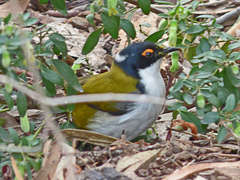

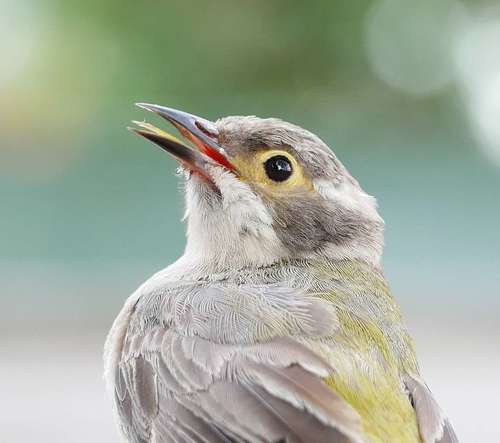
White-naped Honeyeater

White-naped Honeyeater

Melithreptus lunatus

Silhouette: Rachael Joakim · PhyloPic

LCLeast ConcernNTVUENCR Endemic
Daily sighting probability ~10% · With luck
at Kosciuszko National Park

In 3 days ~40% in a week ~70%

88 Verified sightings at Kosciuszko National Park From 2019 to 2026
2,273 In all 8 parks
September Best month
☀️ Diurnal When it's spotted

About the White-naped Honeyeater

The white-naped honeyeater (Melithreptus lunatus) is a passerine bird of the honeyeater family Meliphagidae native to eastern Australia. Birds from southwestern Australia have been shown to be a distinct species, Gilbert's honeyeater, and the eastern birds are more closely related to the black-headed honeyeater of Tasmania. One of several similar species of black-headed honeyeaters in the genus Melithreptus, it dwells in dry sclerophyll eucalypt woodland. Its diet consists of nectar from various flowers, and it also feeds on insects.

The white-naped honeyeater was originally described as Certhia lunata by French ornithologist Louis Pierre Vieillot in 1802. The specific epithet is derived from the Latin luna, meaning 'moon'; this refers to the crescent-shaped, white marking on its nape. It is a member of the genus Melithreptus, with several species of similar size and (apart from the brown-headed honeyeater) black-headed appearance, in the honeyeater family, Meliphagidae. The next closest relative outside the genus is the much larger, but similarly marked, blue-faced honeyeater. More recently, DNA analysis has shown honeyeaters to be related to the Pardalotidae (pardalotes... Wikipedia →

Sounds

Call0:19

Australia · 2024

© Romuald Mikusek · XC1173644 · CC BY-NC-SA 4.0

Song1:13

Australia · 2019

© Marc Anderson · XC460775 · CC BY-NC-ND 4.0

Call1:18

Australia · 2017

© Greg McLachlan · XC370067 · CC BY-NC-SA 4.0

Global Distribution

Parks Where Found

# Park Country Daily sighting probability
1 Grampians National Park 🇦🇺 Australia
~30%
2 Great Otway National Park 🇦🇺 Australia
~20%
3 Kosciuszko National Park 🇦🇺 Australia
~10%
4 Blue Mountains National Park 🇦🇺 Australia
~10%
5 Lamington National Park 🇦🇺 Australia
~10%
6 Booderee National Park 🇦🇺 Australia
~10%
7 Springbrook National Park 🇦🇺 Australia
~10%
8 Royal National Park 🇦🇺 Australia
<5%

Cities Where Found

# City Country Daily sighting probability
1 Melbourne 🇦🇺 Australia
<5%
2 Sydney 🇦🇺 Australia
<5%
3 Brisbane 🇦🇺 Australia
<5%

Zoos & Centres Where Found

# Zoo / Centre Country
1 Featherdale Sydney Wildlife Park 🇦🇺 Australia In captivity

Before you go

What are the chances of seeing a White-naped Honeyeater in Kosciuszko National Park?

With luck

About 10% of wildlife watchers report a White-naped Honeyeater sighting in Kosciuszko National Park on a given day, based on 88 verified sightings from GBIF citizen-science data from 2019 to 2026. It is the 50th most-seen of the 127 birds we can rate there. Over three days the chance rises to about 40%, and over a week to about 70%, if each day is a fresh chance.

When is the best time to see a White-naped Honeyeater in Kosciuszko National Park?

September

In that month about 30% of wildlife watchers report a White-naped Honeyeater in Kosciuszko National Park on a given day, against under 5% in May, the lowest month. June has too few records to rate.

What time of day is best to see a White-naped Honeyeater?

Between 10 am and 1 pm

Across all the parks we cover, that three-hour window holds the most White-naped Honeyeater sightings with a recorded time, and nearly all of them come between 6 am and 6 pm: it is a daytime animal.

Is Kosciuszko National Park the best place to see a White-naped Honeyeater?

3rd of 8

Of the 8 parks where we can rate White-naped Honeyeater sightings, Kosciuszko National Park ranks 3rd at about 10%. The best odds are in Grampians National Park (Australia, about 30%) and Great Otway National Park (Australia, about 20%).

Where does the White-naped Honeyeater sighting chance come from?

GBIF citizen-science records

It is estimated from how often the White-naped Honeyeater is recorded against all the birds logged in Kosciuszko National Park (88 verified sightings from 2019 to 2026), calibrated against known sighting rates. Figures are rounded to the nearest 10% because citizen-science data supports honest approximations, not decimals, and months with records from fewer than five people show "—". How it works.

← Back to Kosciuszko National Park