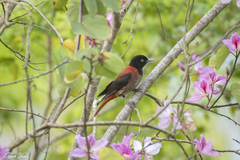

Maroon Oriole

Maroon Oriole

Oriolus traillii

Silhouette: L. Shyamal · PhyloPic

LCLeast ConcernNTVUENCR
Daily sighting probability ~10% · With luck
at Langtang National Park

In 3 days ~30% in a week ~50%

34 Verified sightings at Langtang National Park From 2019 to 2026
1,829 In all 10 parks
February Best month
🌅 Crepuscular When it's spotted

About the Maroon Oriole

The maroon oriole (Oriolus traillii) is a species of bird in the family Oriolidae. It is found in Southeast Asia. The maroon oriole was originally described in the genus Pastor. Along with the black, black-and-crimson and silver orioles, it belongs to a clade of red and black orioles.

Four subspecies are recognised: The silver oriole of southern China was originally described by Stresemann as another subspecies of maroon oriole, but is now treated as a separate species; it is very similar, except that the red in the body plumage of the maroon oriole is replaced by silvery white. Genetic evidence has now shown that Stresemann's original assessment was accurate, with silver oriole genetically embedded among the subspecies of maroon oriole; the nominate subspecies of maroon oriole is more closely related to silver oriole, than it is to any of the other maroon oriole subspecies. Wikipedia →

Sounds

Song0:23

Bhutan · 2026

© Sonam Dorji, Bhutan Quest Travel (www.bhutanbird.com) · XC1099394 · CC BY-NC-SA 4.0

Alarm call1:03

China · 2024

© Dave GUO · XC894883 · CC BY-NC-SA 4.0

Call0:47

Thailand · 2023

© FREDERIC Lionel · XC842959 · CC BY-NC-SA 4.0

Global Distribution

Parks Where Found

# Park Country Daily sighting probability
1 Namdapha National Park 🇮🇳 India
~30%
2 Royal Manas National Park 🇧🇹 Bhutan
~30%
3 Doi Inthanon National Park 🇹🇭 Thailand
~20%
4 Manas National Park 🇮🇳 India
~20%
5 Jim Corbett National Park 🇮🇳 India
~10%
6 Langtang National Park 🇳🇵 Nepal
~10%
7 Cuc Phuong National Park 🇻🇳 Vietnam
<5%
8 Taroko National Park 🇹🇼 Taiwan
<5%
9 Kaziranga National Park 🇮🇳 India
<5%
10 Chitwan National Park 🇳🇵 Nepal
<5%

Cities Where Found

# City Country Daily sighting probability
1 Dehradun 🇮🇳 India
<5%
2 Kathmandu 🇳🇵 Nepal
<5%
3 Taipei 🇹🇼 Taiwan
<5%

Zoos & Centres Where Found

# Zoo / Centre Country
1 新光動物園 🇹🇼 Taiwan In captivity

Before you go

What are the chances of seeing a Maroon Oriole in Langtang National Park?

With luck

About 10% of wildlife watchers report a Maroon Oriole sighting in Langtang National Park on a given day, based on 34 verified sightings from GBIF citizen-science data from 2019 to 2026. It is the 107th most-seen of the 225 birds we can rate there. Over three days the chance rises to about 30%, and over a week to about 50%, if each day is a fresh chance.

When is the best time to see a Maroon Oriole in Langtang National Park?

February

In that month about 20% of wildlife watchers report a Maroon Oriole in Langtang National Park on a given day, against about 10% in March to January, the lowest months. That is one of Langtang National Park's driest months, with about 45 mm of rain against 390 mm in July.

What time of day is best to see a Maroon Oriole?

Between 5 and 8 am

Across all the parks we cover, that three-hour window holds the most Maroon Oriole sightings with a recorded time, and about half of them come between 6 pm and 6 am: it is most active around dawn and dusk.

Which relatives of the Maroon Oriole live in Langtang National Park?

Same order: Passeriformes

The closest relatives of the Maroon Oriole that you can see in Langtang National Park (order Passeriformes, Perching Birds) are Large-billed Crow (about 70%), Blue Whistling-Thrush (about 70%) and Streaked Laughingthrush (about 60%), with each one's daily chance of a sighting.

Where does the Maroon Oriole sighting chance come from?

GBIF citizen-science records

It is estimated from how often the Maroon Oriole is recorded against all the birds logged in Langtang National Park (34 verified sightings from 2019 to 2026), calibrated against known sighting rates. Figures are rounded to the nearest 10% because citizen-science data supports honest approximations, not decimals, and months with records from fewer than five people show "—". How it works.

← Back to Langtang National Park