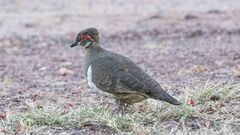
Partridge Pigeon

Partridge Pigeon

Geophaps smithii

Silhouette: Jarrad Barnes · PhyloPic

LCLeast ConcernNTVUENCR Endemic
Daily sighting probability ~10% · With luck
at Litchfield National Park

In 3 days ~20% in a week ~40%

23 Verified sightings at Litchfield National Park From 2019 to 2026
301 In all 2 parks
April Best month
☀️ Diurnal When it's spotted

About the Partridge Pigeon

The partridge pigeon (Geophaps smithii) is a species of bird in the family Columbidae. It is endemic to Australia. Its natural habitats are subtropical or tropical dry shrubland and subtropical or tropical dry lowland grassland.

It is threatened by habitat loss. The partridge pigeon is one of three species in the genus Geophaps. Within the genus, the partridge pigeon is most closely related to the squatter pigeon, with these two species forming a clade that is sister to the spinifex pigeon. These three are most closely related to the crested pigeon.

Alternative names for the partridge pigeon include bare-eyed bronzewing, bare-eyed partridge bronzewing, and bare-eyed partridge pigeon. There are two subspecies, differing mainly in the colour of their orbital skin. Wikipedia →

Global Distribution

Parks Where Found

# Park Country Daily sighting probability
1 Kakadu National Park 🇦🇺 Australia
~10%
2 Litchfield National Park 🇦🇺 Australia
~10%

Before you go

What are the chances of seeing a Partridge Pigeon in Litchfield National Park?

With luck

About 10% of wildlife watchers report a Partridge Pigeon sighting in Litchfield National Park on a given day, based on 23 verified sightings from GBIF citizen-science data from 2019 to 2026. It is the 78th most-seen of the 110 birds we can rate there. Over three days the chance rises to about 20%, and over a week to about 40%, if each day is a fresh chance.

When is the best time to see a Partridge Pigeon in Litchfield National Park?

April

In that month about 20% of wildlife watchers report a Partridge Pigeon in Litchfield National Park on a given day, against under 5% in June–July and October–March, the lowest months. That is one of Litchfield National Park's driest months, with about 50 mm of rain against 400 mm in January.

What time of day is best to see a Partridge Pigeon?

Between 8 and 11 am

Across all the parks we cover, that three-hour window holds the most Partridge Pigeon sightings with a recorded time, and about 8 in 10 of them come between 6 am and 6 pm: it is a daytime animal.

Is Litchfield National Park the best place to see a Partridge Pigeon?

Among the best

Of the 2 parks where we can rate Partridge Pigeon sightings, Litchfield National Park ranks 2nd at about 10%, level with the leaders once rounded. The best odds are in Kakadu National Park (Australia, about 10%).

Which relatives of the Partridge Pigeon live in Litchfield National Park?

Same family: Columbidae

The closest relatives of the Partridge Pigeon that you can see in Litchfield National Park (family Columbidae, Pigeons and Doves) are Bar-shouldered Dove (about 60%), Peaceful Dove (about 50%) and Torresian Imperial-Pigeon (about 20%), with each one's daily chance of a sighting.

Where does the Partridge Pigeon sighting chance come from?

GBIF citizen-science records

It is estimated from how often the Partridge Pigeon is recorded against all the birds logged in Litchfield National Park (23 verified sightings from 2019 to 2026), calibrated against known sighting rates. Figures are rounded to the nearest 10% because citizen-science data supports honest approximations, not decimals, and months with records from fewer than five people show "—". How it works.

← Back to Litchfield National Park