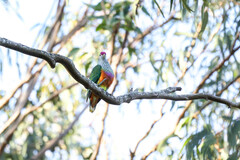
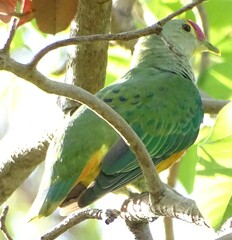
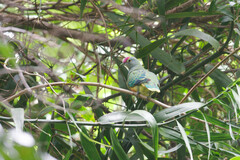
Rose-crowned Fruit-Dove

Rose-crowned Fruit-Dove

Ptilinopus regina

Silhouette: L. Shyamal · PhyloPic

LCLeast ConcernNTVUENCR
Daily sighting probability ~10% · With luck
at Litchfield National Park

In 3 days ~40% in a week ~70%

44 Verified sightings at Litchfield National Park From 2019 to 2026
451 In all 6 parks
September Best month
☀️ Diurnal When it's spotted

About the Rose-crowned Fruit-Dove

The rose-crowned fruit dove (Ptilinopus regina), also known as pink-capped fruit dove or Swainson's fruit dove, is a medium-sized fruit dove that is found in parts of southern Indonesia, northern Australia and eastern Australia.

The rose-crowned fruit dove was formally described in 1825 by the English naturalist William Swainson. He considered his specimens as a variant of the grey-green fruit dove (Ptilinopus purpuratus) and specified the scientific name as Ptilinopus purpuratus var. Regina.

The type locality is New South Wales. Five subspecies are recognised: Wikipedia →

Sounds

Song0:15

Australia · 2025

© Peter Boesman · XC1066874 · CC BY-NC-ND 4.0

Call0:44

Australia · 2016

© Greg McLachlan · XC353634 · CC BY-NC-SA 4.0

Uncertain0:04

Australia · 2021

© nick talbot · XC618603 · CC BY-NC-SA 4.0

Global Distribution

Parks Where Found

# Park Country Daily sighting probability
1 Litchfield National Park 🇦🇺 Australia
~10%
2 Kakadu National Park 🇦🇺 Australia
~10%
3 Noosa National Park 🇦🇺 Australia
~10%
4 Lamington National Park 🇦🇺 Australia
~10%
5 Springbrook National Park 🇦🇺 Australia
~10%
6 Daintree National Park 🇦🇺 Australia
<5%

Cities Where Found

# City Country Daily sighting probability
1 Brisbane 🇦🇺 Australia
<5%

Zoos & Centres Where Found

# Zoo / Centre Country
1 California Academy of Sciences 🇺🇸 United States In captivity
2 Australia Zoo 🇦🇺 Australia In captivity
3 Territory Wildlife Park 🇦🇺 Australia In captivity
4 Sedgwick County Zoo 🇺🇸 United States In captivity
5 Phoenix Zoo 🇺🇸 United States In captivity
6 Louisville Zoo 🇺🇸 United States In captivity
7 Warsaw Zoo 🇵🇱 Poland In captivity
8 Healesville Sanctuary 🇦🇺 Australia In captivity
9 Oregon Zoo 🇺🇸 United States In captivity
10 Taronga Zoo 🇦🇺 Australia In captivity
11 Currumbin Wildlife Sanctuary 🇦🇺 Australia In captivity
12 Melbourne Zoo 🇦🇺 Australia In captivity
13 Honolulu Zoo 🇺🇸 United States In captivity
14 Adelaide Zoo 🇦🇺 Australia In captivity
15 Australian Reptile Park 🇦🇺 Australia In captivity
16 Featherdale Sydney Wildlife Park 🇦🇺 Australia In captivity
17 National Aviary 🇺🇸 United States In captivity
18 herpetarium warszawskiego ZOO 🇵🇱 Poland In captivity
19 akwarium warszawskiego ZOO 🇵🇱 Poland In captivity
20 Caversham Wildlife Park 🇦🇺 Australia In captivity

Before you go

What are the chances of seeing a Rose-crowned Fruit-Dove in Litchfield National Park?

With luck

About 10% of wildlife watchers report a Rose-crowned Fruit-Dove sighting in Litchfield National Park on a given day, based on 44 verified sightings from GBIF citizen-science data from 2019 to 2026. It is the 47th most-seen of the 110 birds we can rate there. Over three days the chance rises to about 40%, and over a week to about 70%, if each day is a fresh chance.

When is the best time to see a Rose-crowned Fruit-Dove in Litchfield National Park?

May and September

In those months about 30% of wildlife watchers report a Rose-crowned Fruit-Dove in Litchfield National Park on a given day, against about 10% in June, August and October–April, the lowest months. Those are among Litchfield National Park's driest months, with about 15 mm of rain a month against 400 mm in January.

What time of day is best to see a Rose-crowned Fruit-Dove?

Between 8 and 11 am

Across all the parks we cover, that three-hour window holds the most Rose-crowned Fruit-Dove sightings with a recorded time, and about 9 in 10 of them come between 6 am and 6 pm: it is a daytime animal.

Is Litchfield National Park the best place to see a Rose-crowned Fruit-Dove?

Yes

Of the 6 parks where we can rate Rose-crowned Fruit-Dove sightings, Litchfield National Park has the highest daily chance: about 10%. Next come Kakadu National Park (Australia, about 10%) and Noosa National Park (Australia, about 10%).

Which relatives of the Rose-crowned Fruit-Dove live in Litchfield National Park?

Same family: Columbidae

The closest relatives of the Rose-crowned Fruit-Dove that you can see in Litchfield National Park (family Columbidae, Pigeons and Doves) are Bar-shouldered Dove (about 60%), Peaceful Dove (about 50%) and Torresian Imperial-Pigeon (about 20%), with each one's daily chance of a sighting.

Where does the Rose-crowned Fruit-Dove sighting chance come from?

GBIF citizen-science records

It is estimated from how often the Rose-crowned Fruit-Dove is recorded against all the birds logged in Litchfield National Park (44 verified sightings from 2019 to 2026), calibrated against known sighting rates. Figures are rounded to the nearest 10% because citizen-science data supports honest approximations, not decimals, and months with records from fewer than five people show "—". How it works.

← Back to Litchfield National Park