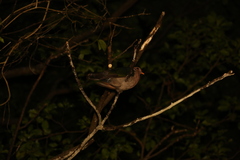
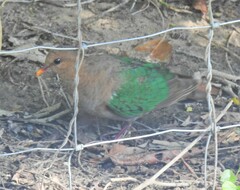
Pacific Emerald Dove

Pacific Emerald Dove

Chalcophaps longirostris

Silhouette: Sheatherius · PhyloPic

LCLeast ConcernNTVUENCR
Daily sighting probability <5% · Rare
at Litchfield National Park

In 3 days ~10% in a week ~20%

13 Verified sightings at Litchfield National Park From 2019 to 2026
611 In all 5 parks
May Best month
☀️ Diurnal When it's spotted

About the Pacific Emerald Dove

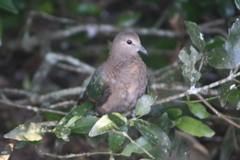
The Pacific emerald dove or brown-capped emerald dove (Chalcophaps longirostris) is a pigeon which is a widespread resident breeding bird in the tropical and sub-tropical parts of Indonesia, northern and eastern Australia, Timor-Leste, and Papua New Guinea. It was formerly conspecific with the common emerald dove.

This is a common species in rainforest and similar dense wet woodlands, farms, gardens, mangroves, and coastal heaths. It builds a scant stick nest in a tree up to five metres and lays two cream-coloured eggs. Breeding tends to occur in Australia in spring or early summer in southeastern Australia and late in the dry season in northern Australia.

Its flight is fast and direct, with the regular beats and an occasional sharp flick of the wings which are characteristic of pigeons in general. It often flies low between the patches of dense forest it prefers, but when disturbed will frequently walk away rather than fly. They are particularly good weavers when flying through forests. When flying they expose a buff underwing and a chestnut colour of their flight feathers.

The Pacific emerald dove is a stocky, medium-sized pigeon, typically 23 to 28 centimetres... Wikipedia →

Sounds

Song0:35

Australia · 2020

© Marc Anderson · XC525958 · CC BY-NC-ND 4.0

Call0:11

Australia · 2017

© Greg McLachlan · XC354645 · CC BY-NC-SA 4.0

Uncertain0:23

Australia · 2023

© nick talbot · XC815826 · CC BY-NC-SA 4.0

Global Distribution

Parks Where Found

# Park Country Daily sighting probability
1 Kakadu National Park 🇦🇺 Australia
~10%
2 Springbrook National Park 🇦🇺 Australia
~10%
3 Daintree National Park 🇦🇺 Australia
~10%
4 Lamington National Park 🇦🇺 Australia
~10%
5 Litchfield National Park 🇦🇺 Australia
<5%

Zoos & Centres Where Found

# Zoo / Centre Country
1 Australia Zoo 🇦🇺 Australia In captivity
2 Healesville Sanctuary 🇦🇺 Australia In captivity
3 Parc zoologique et forestier Michel-Corbasson 🇫🇷 France In captivity
4 National Zoo & Aquarium 🇦🇺 Australia In captivity
5 Taronga Zoo 🇦🇺 Australia In captivity
6 Houston Zoo 🇺🇸 United States In captivity
7 Currumbin Wildlife Sanctuary 🇦🇺 Australia In captivity
8 Santillana Zoo 🇪🇸 Spain In captivity
9 Byron Bay Wildlife Sanctuary 🇦🇺 Australia In captivity
10 Featherdale Sydney Wildlife Park 🇦🇺 Australia In captivity
11 Ipswich Nature Centre 🇦🇺 Australia In captivity
12 Sea Life Sydney Aquarium 🇦🇺 Australia In captivity
13 Wild Life Sydney 🇦🇺 Australia In captivity
14 Fauna Reserve 🇦🇺 Australia In captivity
15 Caversham Wildlife Park 🇦🇺 Australia In captivity
16 Ranger Red’s Zoo & Conservation Park 🇦🇺 Australia In captivity

Before you go

What are the chances of seeing a Pacific Emerald Dove in Litchfield National Park?

Rare

Under 5% of wildlife watchers report a Pacific Emerald Dove sighting in Litchfield National Park on a given day, based on 13 verified sightings from GBIF citizen-science data from 2019 to 2026. It is the 93rd most-seen of the 110 birds we can rate there. Over three days the chance rises to about 10%, and over a week to about 20%, if each day is a fresh chance.

When is the best time to see a Pacific Emerald Dove in Litchfield National Park?

May and October

In those months about 10% of wildlife watchers report a Pacific Emerald Dove in Litchfield National Park on a given day, against under 5% in June–September and November–April, the lowest months. Those are among Litchfield National Park's driest months, with about 40 mm of rain a month against 400 mm in January.

What time of day is best to see a Pacific Emerald Dove?

Between 3 and 6 pm

Across all the parks we cover, that three-hour window holds the most Pacific Emerald Dove sightings with a recorded time, and about 9 in 10 of them come between 6 am and 6 pm: it is a daytime animal.

Is Litchfield National Park the best place to see a Pacific Emerald Dove?

5th of 5

Of the 5 parks where we can rate Pacific Emerald Dove sightings, Litchfield National Park ranks 5th at under 5%. The best odds are in Kakadu National Park (Australia, about 10%), Springbrook National Park (Australia, about 10%) and Daintree National Park (Australia, about 10%).

Which relatives of the Pacific Emerald Dove live in Litchfield National Park?

Same family: Columbidae

The closest relatives of the Pacific Emerald Dove that you can see in Litchfield National Park (family Columbidae, Pigeons and Doves) are Bar-shouldered Dove (about 60%), Peaceful Dove (about 50%) and Torresian Imperial-Pigeon (about 20%), with each one's daily chance of a sighting.

Where does the Pacific Emerald Dove sighting chance come from?

GBIF citizen-science records

It is estimated from how often the Pacific Emerald Dove is recorded against all the birds logged in Litchfield National Park (13 verified sightings from 2019 to 2026), calibrated against known sighting rates. Figures are rounded to the nearest 10% because citizen-science data supports honest approximations, not decimals, and months with records from fewer than five people show "—". How it works.

← Back to Litchfield National Park