
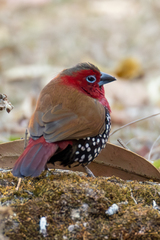
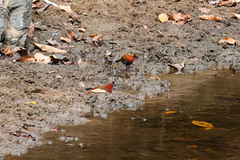

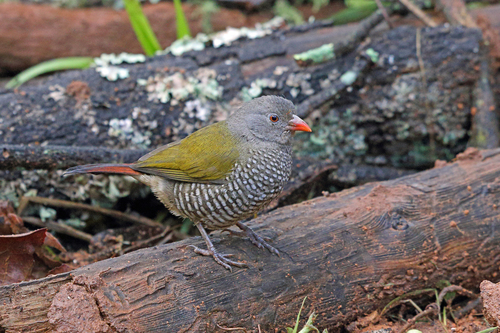
Peters's Twinspot

Peters's Twinspot

Hypargos niveoguttatus

Silhouette: Sheatherius · PhyloPic

LCLeast ConcernNTVUENCR
Daily sighting probability <5% · Rare
at Liwonde National Park

In 3 days ~10%

8 Verified sightings at Liwonde National Park From 2019 to 2026
300 In all 12 parks
September Best month
☀️ Diurnal When it's spotted

About the Peters's Twinspot

The red-throated twinspot (Hypargos niveoguttatus) or Peters's twinspot is a common species of bird found in sub-saharan Africa. This species has a large range, with an estimated global extent of occurrence of 2,000,000 km2 (770,000 sq mi).

It is commonly seen in Angola, Burundi, The Democratic Republic of the Congo, Kenya, Malawi, Mozambique, Namibia, Rwanda, Somalia, South Africa, Tanzania, Zambia & Zimbabwe. The status of the species is evaluated as Least Concern.

BirdLife Species Factsheet http://www.phthiraptera.org/Birds/Passeriformes/Estrildidae.html Image at ADW Redthroated Twinspot - Species text in The Atlas of Southern African Birds. Wikipedia →

Sounds

Song0:26

Tanzania · 2022

© isaac kilusu · XC763309 · CC BY-NC-SA 4.0

Call0:40

Zambia · 2021

© Hans Matheve · XC699728 · CC BY-NC-ND 4.0

Song0:50

Zambia · 2020

© Dries Van de Loock · XC552080 · CC BY-NC-SA 4.0

Global Distribution

Parks Where Found

# Park Country Daily sighting probability
1 Meru National Park 🇰🇪 Kenya
~10%
2 Mikumi National Park 🇹🇿 Tanzania
~10%
3 Mana Pools National Park 🇿🇼 Zimbabwe
~10%
4 Lower Zambezi National Park 🇿🇲 Zambia
~10%
5 Kafue National Park 🇿🇲 Zambia
~10%
6 South Luangwa National Park 🇿🇲 Zambia
~10%
7 Gorongosa National Park 🇲🇿 Mozambique
<5%
8 Mkomazi National Park 🇹🇿 Tanzania
<5%
9 Arusha National Park 🇹🇿 Tanzania
<5%
10 Lake Manyara National Park 🇹🇿 Tanzania
<5%
11 Liwonde National Park 🇲🇼 Malawi
<5%
12 Ngorongoro Conservation Area 🇹🇿 Tanzania
<5%

Cities Where Found

# City Country Daily sighting probability
1 Lilongwe 🇲🇼 Malawi
~10%
2 Harare 🇿🇼 Zimbabwe
<5%

Zoos & Centres Where Found

# Zoo / Centre Country
1 Tierpark Hagenbeck 🇩🇪 Germany In captivity

Before you go

What are the chances of seeing a Peters's Twinspot in Liwonde National Park?

Rare

Under 5% of wildlife watchers report a Peters's Twinspot sighting in Liwonde National Park on a given day, based on 8 verified sightings from GBIF citizen-science data from 2019 to 2026. It is the 257th most-seen of the 267 birds we can rate there. Over three days the chance rises to about 10%, if each day is a fresh chance.

When is the best time to see a Peters's Twinspot in Liwonde National Park?

July and September

In those months about 10% of wildlife watchers report a Peters's Twinspot in Liwonde National Park on a given day, against under 5% in August and October–June, the lowest months. Those are among Liwonde National Park's driest months, with almost no rain against 300 mm in January.

What time of day is best to see a Peters's Twinspot?

Between 8 and 11 am

Across all the parks we cover, that three-hour window holds the most Peters's Twinspot sightings with a recorded time, and about 9 in 10 of them come between 6 am and 6 pm: it is a daytime animal.

Is Liwonde National Park the best place to see a Peters's Twinspot?

11th of 12

Of the 12 parks where we can rate Peters's Twinspot sightings, Liwonde National Park ranks 11th at under 5%. The best odds are in Meru National Park (Kenya, about 10%), Mikumi National Park (Tanzania, about 10%) and Mana Pools National Park (Zimbabwe, about 10%).

Which relatives of the Peters's Twinspot live in Liwonde National Park?

Same family: Estrildidae

The closest relatives of the Peters's Twinspot that you can see in Liwonde National Park (family Estrildidae, Waxbills and Allies) are Blue-breasted Cordonbleu (about 50%), Red-billed Firefinch (about 20%) and Bronze Mannikin (about 10%), with each one's daily chance of a sighting.

Where does the Peters's Twinspot sighting chance come from?

GBIF citizen-science records

It is estimated from how often the Peters's Twinspot is recorded against all the birds logged in Liwonde National Park (8 verified sightings from 2019 to 2026), calibrated against known sighting rates. Figures are rounded to the nearest 10% because citizen-science data supports honest approximations, not decimals, and months with records from fewer than five people show "—". How it works.

← Back to Liwonde National Park