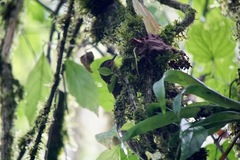

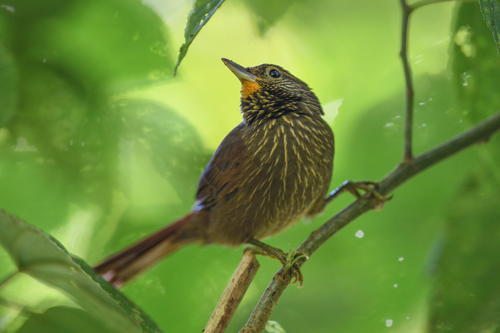
Spotted Barbtail

Spotted Barbtail

Premnoplex brunnescens

Silhouette: Sheatherius · PhyloPic

LCLeast ConcernNTVUENCR
Daily sighting probability <5% · Rare
at Los Quetzales National Park

In 3 days ~10% in a week ~30%

365 Verified sightings at Los Quetzales National Park From 2019 to 2026
4,986 In all 15 parks
July Best month
☀️ Diurnal When it's spotted

About the Spotted Barbtail

The spotted barbtail (Premnoplex brunnescens) is a species of bird in the family Furnariidae. Its natural habitat is subtropical or tropical moist montane forest. The spotted barbtail was described in 1856 from a type specimen collected in Bogotá, Colombia. It was previously considered to be the same species as the white-throated barbtail (Premnoplex tatei) of Venezuela, and is now classified as a sister species to that bird. Five subspecies are recognized within P. brunnescens, although they are considerably differentiated genetically, and may constitute separate species.

The spotted barbtail ranges from 13 to 15 centimetres (5.1 to 5.9 in) in length, and from 14 to 19 grams... Wikipedia →

Sounds

Call0:10

Ecuador · 2025

© Manuel Sánchez-Nivicela · XC1162559 · CC BY-NC-ND 4.0

Song0:06

Ecuador · 2025

© Marc Anderson · XC1034064 · CC BY-NC-ND 4.0

Uncertain0:11

Ecuador · 2021

© Ma. Cristina Ríos · XC626047 · CC BY-NC-SA 4.0

Global Distribution

Parks Where Found

# Park Country Daily sighting probability
1 Monteverde Cloud Forest Reserve 🇨🇷 Costa Rica
~20%
2 Chirripó National Park 🇨🇷 Costa Rica
~10%
3 Volcán Barú National Park 🇵🇦 Panama
~10%
4 Braulio Carrillo National Park 🇨🇷 Costa Rica
~10%
5 Los Nevados National Natural Park 🇨🇴 Colombia
~10%
6 Farallones de Cali National Natural Park 🇨🇴 Colombia
~10%
7 Los Quetzales National Park 🇨🇷 Costa Rica
<5%
8 Tapantí-Macizo de la Muerte National Park 🇨🇷 Costa Rica
<5%
9 La Amistad International Park (Panama) 🇵🇦 Panama
<5%
10 Arenal Volcano National Park 🇨🇷 Costa Rica
<5%
11 Henri Pittier National Park 🇻🇪 Venezuela
<5%
12 Podocarpus National Park 🇪🇨 Ecuador
<5%
13 Darién National Park 🇵🇦 Panama
<5%
14 Poás Volcano National Park 🇨🇷 Costa Rica
<5%
15 Tenorio Volcano National Park 🇨🇷 Costa Rica
<5%

Cities Where Found

# City Country Daily sighting probability
1 San José 🇨🇷 Costa Rica
<5%

Before you go

What are the chances of seeing a Spotted Barbtail in Los Quetzales National Park?

Rare

Under 5% of wildlife watchers report a Spotted Barbtail sighting in Los Quetzales National Park on a given day, based on 365 verified sightings from GBIF citizen-science data from 2019 to 2026. It is the 100th most-seen of the 252 birds we can rate there. Over three days the chance rises to about 10%, and over a week to about 30%, if each day is a fresh chance.

When is the best time to see a Spotted Barbtail in Los Quetzales National Park?

March, May–August and October

In those months about 10% of wildlife watchers report a Spotted Barbtail in Los Quetzales National Park on a given day, against under 5% in April, September and November–February, the lowest months.

What time of day is best to see a Spotted Barbtail?

Between 8 and 11 am

Across all the parks we cover, that three-hour window holds the most Spotted Barbtail sightings with a recorded time, and about 9 in 10 of them come between 6 am and 6 pm: it is a daytime animal.

Which relatives of the Spotted Barbtail live in Los Quetzales National Park?

Same family: Furnariidae

The closest relatives of the Spotted Barbtail that you can see in Los Quetzales National Park (family Furnariidae, Ovenbirds and Woodcreepers) are Ruddy Treerunner (about 40%), Spot-crowned Woodcreeper (about 40%) and Buffy Tuftedcheek (about 10%), with each one's daily chance of a sighting.

Where does the Spotted Barbtail sighting chance come from?

GBIF citizen-science records

It is estimated from how often the Spotted Barbtail is recorded against all the birds logged in Los Quetzales National Park (365 verified sightings from 2019 to 2026), calibrated against known sighting rates. Figures are rounded to the nearest 10% because citizen-science data supports honest approximations, not decimals, and months with records from fewer than five people show "—". How it works.

← Back to Los Quetzales National Park