African Mourning Dove

African Mourning Dove

Streptopelia decipiens

Silhouette: Andy Wilson · PhyloPic

LCLeast ConcernNTVUENCR
Daily sighting probability ~20% · Possible
at Lower Zambezi National Park

In 3 days ~50% in a week ~80%

61 Verified sightings at Lower Zambezi National Park From 2019 to 2026
6,758 In all 30 parks
August Best month
☀️ Diurnal When it's spotted

About the African Mourning Dove

The mourning collared dove or African mourning dove (Streptopelia decipiens) is a dove which is a widespread resident breeding bird in Africa south of the Sahara. This species is common or abundant near water. It often mingles peacefully with other doves. Despite its name, it is not closely related to the North American mourning dove (Zenaida macroura).

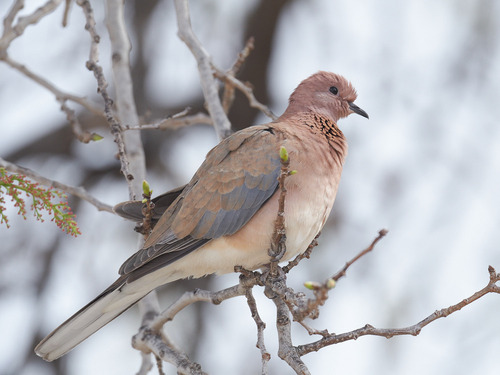
The mourning collared dove is a medium-sized, stocky pigeon, 28–30 cm in length. It has a pale grey head and pinkish-grey body, with a broad black half-collar finely edged in white on the back and sides of the neck. The wings are broad and pointed, pale brown with darker brown flight feathers. The legs, and a patch of bare skin around the eye, are red, and the iris is pale yellow to brownish. When flying, it shows dark flight feathers and extensive white in the tail, the latter being a distinction from the similar but slightly larger red-eyed dove; this also differs in having a red iris.

The sexes are similar, but immatures are duller than adults, and have scalloping on the body feathers. Six subspecies are accepted: Streptopelia decipiens shelleyi (Salvadori, AT, 1893) — Mauritania and Senegambia to... Wikipedia →

Sounds

Call0:31

Uganda · 2022

© Peter Boesman · XC740014 · CC BY-NC-ND 4.0

Song0:10

Gambia · 2021

© Joost van Bruggen · XC690022 · CC BY-NC-ND 4.0

Call0:27

Ethiopia · 2019

© Oscar Campbell · XC472382 · CC BY-NC-SA 4.0

Global Distribution

Parks Where Found

# Park Country Daily sighting probability
1 Niokolo-Koba National Park 🇸🇳 Senegal
~50%
2 Samburu National Reserve 🇰🇪 Kenya
~50%
3 Tarangire National Park 🇹🇿 Tanzania
~40%
4 Awash National Park 🇪🇹 Ethiopia
~40%
5 Amboseli National Park 🇰🇪 Kenya
~30%
6 Gonarezhou National Park 🇿🇼 Zimbabwe
~30%
7 Murchison Falls National Park 🇺🇬 Uganda
~30%
8 Tsavo West National Park 🇰🇪 Kenya
~30%
9 Meru National Park 🇰🇪 Kenya
~30%
10 Tsavo East National Park 🇰🇪 Kenya
~30%
11 Serengeti National Park 🇹🇿 Tanzania
~30%
12 Queen Elizabeth National Park 🇺🇬 Uganda
~20%
13 Ngorongoro Conservation Area 🇹🇿 Tanzania
~20%
14 Ruaha National Park 🇹🇿 Tanzania
~20%
15 Lower Zambezi National Park 🇿🇲 Zambia
~20%
16 Mkomazi National Park 🇹🇿 Tanzania
~20%
17 Mana Pools National Park 🇿🇼 Zimbabwe
~10%
18 Kruger National Park 🇿🇦 South Africa
~10%
19 Liwonde National Park 🇲🇼 Malawi
~10%
20 Moremi Game Reserve 🇧🇼 Botswana
~10%
21 Chobe National Park 🇧🇼 Botswana
~10%
22 Lake Manyara National Park 🇹🇿 Tanzania
~10%
23 Virunga National Park 🇨🇩 Democratic Republic of the Congo
~10%
24 South Luangwa National Park 🇿🇲 Zambia
~10%
25 Hwange National Park 🇿🇼 Zimbabwe
<5%
26 Arusha National Park 🇹🇿 Tanzania
<5%
27 Kidepo Valley National Park 🇺🇬 Uganda
<5%
28 Akagera National Park 🇷🇼 Rwanda
<5%
29 Lake Mburo National Park 🇺🇬 Uganda
<5%
30 Nyungwe National Park 🇷🇼 Rwanda
<5%

Cities Where Found

# City Country Daily sighting probability
1 Maiduguri 🇳🇬 Nigeria
~70%
2 Ouagadougou 🇧🇫 Burkina Faso
~60%
3 Serrekunda 🇬🇲 Gambia
~50%
4 N'Djamena 🇹🇩 Chad
~40%
5 Dakar 🇸🇳 Senegal
~30%
6 Abuja 🇳🇬 Nigeria
~10%
7 Addis Ababa 🇪🇹 Ethiopia
<5%
8 Kampala 🇺🇬 Uganda
<5%

Before you go

What are the chances of seeing an African Mourning Dove in Lower Zambezi National Park?

Possible

About 20% of wildlife watchers report an African Mourning Dove sighting in Lower Zambezi National Park on a given day, based on 61 verified sightings from GBIF citizen-science data from 2019 to 2026. It is the 103rd most-seen of the 241 birds we can rate there. Over three days the chance rises to about 50%, and over a week to about 80%, if each day is a fresh chance.

When is the best time to see an African Mourning Dove in Lower Zambezi National Park?

August

In that month about 50% of wildlife watchers report an African Mourning Dove in Lower Zambezi National Park on a given day, against under 5% in November, the lowest month. That is one of Lower Zambezi National Park's driest months, with almost no rain against 290 mm in January. February and March have too few records to rate.

What time of day is best to see an African Mourning Dove?

Between 8 and 11 am

Across all the parks we cover, that three-hour window holds the most African Mourning Dove sightings with a recorded time, and about 9 in 10 of them come between 6 am and 6 pm: it is a daytime animal.

Which relatives of the African Mourning Dove live in Lower Zambezi National Park?

Same genus: Streptopelia

The closest relatives of the African Mourning Dove that you can see in Lower Zambezi National Park (genus Streptopelia, Turtle-Doves and Collared-Doves) are Cape Turtle Dove (about 70%) and Red-eyed Dove (about 40%), with each one's daily chance of a sighting.

Where does the African Mourning Dove sighting chance come from?

GBIF citizen-science records

It is estimated from how often the African Mourning Dove is recorded against all the birds logged in Lower Zambezi National Park (61 verified sightings from 2019 to 2026), calibrated against known sighting rates. Figures are rounded to the nearest 10% because citizen-science data supports honest approximations, not decimals, and months with records from fewer than five people show "—". How it works.

← Back to Lower Zambezi National Park