Gilded Barbet

Gilded Barbet

Capito auratus

Silhouette: Sheatherius · PhyloPic

LCLeast ConcernNTVUENCR
Daily sighting probability ~10% · With luck
at Madidi National Park

In 3 days ~20% in a week ~40%

12 Verified sightings at Madidi National Park From 2019 to 2026
3,450 In all 8 parks
September Best month
☀️ Diurnal When it's spotted

About the Gilded Barbet

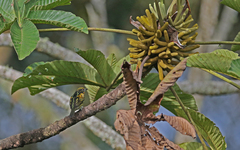
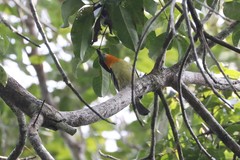
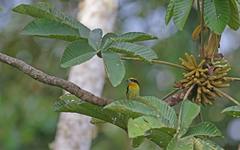
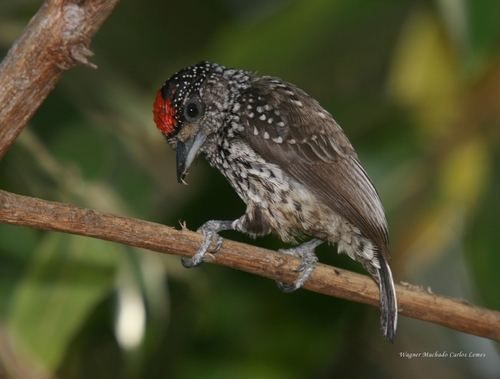
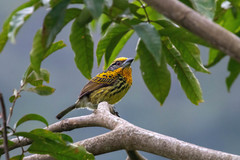
The gilded barbet (Capito auratus) is a species of bird in the family Capitonidae, the New World barbets, and a close relative of the toucans. It has a total length of c. 20 cm (8 in). Like other New World barbets, the gilded barbet is a thickset, relatively large-headed bird with a stubby bill. The upperparts, tail, wings, and mask are mainly black. The spotty bar over the greater wing coverts, narrow edging to the remiges, and tips to the tertials are yellow. Additionally, the narrow yellow eyebrows extend as two parallel lines over the mantle. The belly is mainly pale yellow with black streaking on the flanks. Depending on the subspecies, the throat ranges from red to orange, and the crown ranges from deep yellow to brownish-orange to reddish-orange. The female resembles the male but has extensive orange-yellow edging on the wing-coverts, yellowish streaking on the auriculars and back, and black streaking on the flanks that also extends over the chest. In females from the westernmost part of its range (subspecies punctatus), the throat is streaked black. Both sexes have dark maroon irides, greyish legs, and a broadly black-tipped grey bill.

Wikipedia →

Sounds

Song0:12

Brazil · 2026

© JAYRSON ARAUJO DE OLIVEIRA · XC1186205 · CC BY-NC-SA 4.0

Call0:25

Colombia · 2021

© Mauricio Cuellar Ramirez (@Birding.travel) · XC691298 · CC BY-NC-SA 4.0

Recording0:15

Colombia · 2001

© Mauricio Álvarez-Rebolledo (Colección de Sonidos Ambientales - Instituto Humboldt) · XC525491 · CC BY-NC-SA 4.0

Global Distribution

Parks Where Found

# Park Country Daily sighting probability
1 Yasuní National Park 🇪🇨 Ecuador
~50%
2 Amacayacu National Natural Park 🇨🇴 Colombia
~40%
3 Cuyabeno Wildlife Reserve 🇪🇨 Ecuador
~30%
4 Sierra de la Macarena National Park 🇨🇴 Colombia
~20%
5 Tambopata National Reserve 🇵🇪 Peru
~20%
6 Manu National Park 🇵🇪 Peru
~10%
7 Madidi National Park 🇧🇴 Bolivia
~10%
8 Anavilhanas National Park 🇧🇷 Brazil
<5%

Before you go

What are the chances of seeing a Gilded Barbet in Madidi National Park?

With luck

About 10% of wildlife watchers report a Gilded Barbet sighting in Madidi National Park on a given day, based on 12 verified sightings from GBIF citizen-science data from 2019 to 2026. It is the 166th most-seen of the 239 birds we can rate there. Over three days the chance rises to about 20%, and over a week to about 40%, if each day is a fresh chance.

When is the best time to see a Gilded Barbet in Madidi National Park?

September

In that month about 20% of wildlife watchers report a Gilded Barbet in Madidi National Park on a given day, against under 5% in January, April and June–August, the lowest months. That is one of Madidi National Park's driest months, with about 75 mm of rain against 290 mm in February. March and December have too few records to rate.

What time of day is best to see a Gilded Barbet?

Between 7 and 10 am

Across all the parks we cover, that three-hour window holds the most Gilded Barbet sightings with a recorded time, and about 9 in 10 of them come between 6 am and 6 pm: it is a daytime animal.

Which relatives of the Gilded Barbet live in Madidi National Park?

Same order: Piciformes

The closest relatives of the Gilded Barbet that you can see in Madidi National Park (order Piciformes, Woodpeckers and Allies) are Black-fronted Nunbird (about 40%), Rufous-tailed Jacamar (about 30%) and White-throated Toucan (about 20%), with each one's daily chance of a sighting.

Where does the Gilded Barbet sighting chance come from?

GBIF citizen-science records

It is estimated from how often the Gilded Barbet is recorded against all the birds logged in Madidi National Park (12 verified sightings from 2019 to 2026), calibrated against known sighting rates. Figures are rounded to the nearest 10% because citizen-science data supports honest approximations, not decimals, and months with records from fewer than five people show "—". How it works.

← Back to Madidi National Park