Little Woodpecker

Little Woodpecker

Veniliornis passerinus

Silhouette: Pepe Reigada · PhyloPic

LCLeast ConcernNTVUENCR
Daily sighting probability <5% · Rare
at Madidi National Park

In 3 days ~10% in a week ~30%

7 Verified sightings at Madidi National Park From 2019 to 2026
1,924 In all 13 parks
September Best month
☀️ Diurnal When it's spotted

About the Little Woodpecker

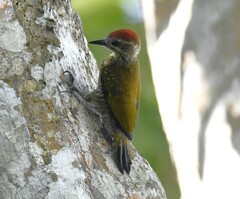
The little woodpecker (Veniliornis passerinus) is a species of bird in subfamily Picinae of the woodpecker family Picidae. It is found in every mainland South American country except Chile, Suriname, and Uruguay. In 1760 the French zoologist Mathurin Jacques Brisson included a description of the little woodpecker in his Ornithologie based on a specimen collected in Saint-Domingue (now Haiti). He used the French name Le petit pic de S. Domingue and the Latin name Picus dominicensis minor. Although Brisson coined Latin names, these do not conform to the binomial system and are not recognised by the International Commission on Zoological Nomenclature. When in 1766 the Swedish naturalist Carl Linnaeus updated his Systema Naturae for the twelfth edition he added 240 species that had been previously described by Brisson. One of these was the little woodpecker. Linnaeus included a terse description, coined the binomial name Picus passerinus and cited Brisson's work. Linnaeus mistakenly specified the type location as Dominica. This has been corrected to Cayenne in French Guiana. The specific name passerinus is from Latin and means "sparrow like".

The International...

Wikipedia →

Sounds

Call0:07

Brazil · 2026

© JAYRSON ARAUJO DE OLIVEIRA · XC1162218 · CC BY-NC-SA 4.0

Song0:05

Brazil · 2026

© Robson Silva e Silva · XC1084287 · CC BY-NC-SA 4.0

Canto0:10

Brazil · 2017

© Caio Brito · XC428137 · CC BY-NC-SA 4.0

Global Distribution

Parks Where Found

# Park Country Daily sighting probability
1 Parque Estadual Encontro das Águas 🇧🇷 Brazil
~20%
2 Chapada dos Guimarães National Park 🇧🇷 Brazil
~20%
3 Iberá National Park 🇦🇷 Argentina
~20%
4 Manu National Park 🇵🇪 Peru
~10%
5 Serra da Canastra National Park 🇧🇷 Brazil
~10%
6 Amacayacu National Natural Park 🇨🇴 Colombia
~10%
7 Yasuní National Park 🇪🇨 Ecuador
~10%
8 Emas National Park 🇧🇷 Brazil
~10%
9 Tambopata National Reserve 🇵🇪 Peru
<5%
10 Sierra de la Macarena National Park 🇨🇴 Colombia
<5%
11 Madidi National Park 🇧🇴 Bolivia
<5%
12 Chapada Diamantina National Park 🇧🇷 Brazil
<5%
13 Podocarpus National Park 🇪🇨 Ecuador
<5%

Cities Where Found

# City Country Daily sighting probability
1 Fortaleza 🇧🇷 Brazil
~20%
2 João Pessoa 🇧🇷 Brazil
~20%
3 Goiânia 🇧🇷 Brazil
~10%
4 Campo Grande 🇧🇷 Brazil
~10%
5 Recife 🇧🇷 Brazil
~10%
6 Santa Cruz de la Sierra 🇧🇴 Bolivia
~10%
7 Asuncion 🇵🇾 Paraguay
<5%
8 Belo Horizonte 🇧🇷 Brazil
<5%
9 Maceió 🇧🇷 Brazil
<5%
10 Brasilia 🇧🇷 Brazil
<5%

Before you go

What are the chances of seeing a Little Woodpecker in Madidi National Park?

Rare

Under 5% of wildlife watchers report a Little Woodpecker sighting in Madidi National Park on a given day, based on 7 verified sightings from GBIF citizen-science data from 2019 to 2026. It is the 188th most-seen of the 239 birds we can rate there. Over three days the chance rises to about 10%, and over a week to about 30%, if each day is a fresh chance.

When is the best time to see a Little Woodpecker in Madidi National Park?

September to November

In those months about 10% of wildlife watchers report a Little Woodpecker in Madidi National Park on a given day, against under 5% in January–February and April–August, the lowest months. March and December have too few records to rate.

What time of day is best to see a Little Woodpecker?

Between 8 and 11 am

Across all the parks we cover, that three-hour window holds the most Little Woodpecker sightings with a recorded time, and about 9 in 10 of them come between 6 am and 6 pm: it is a daytime animal.

Where does the Little Woodpecker sighting chance come from?

GBIF citizen-science records

It is estimated from how often the Little Woodpecker is recorded against all the birds logged in Madidi National Park (7 verified sightings from 2019 to 2026), calibrated against known sighting rates. Figures are rounded to the nearest 10% because citizen-science data supports honest approximations, not decimals, and months with records from fewer than five people show "—". How it works.

← Back to Madidi National Park