Chestnut-eared Aracari

Chestnut-eared Aracari

Pteroglossus castanotis

Silhouette: Edwin Price · PhyloPic

LCLeast ConcernNTVUENCR
Daily sighting probability ~10% · With luck
at Madidi National Park

In 3 days ~20% in a week ~40%

11 Verified sightings at Madidi National Park From 2019 to 2026
7,166 In all 14 parks
January Best month
☀️ Diurnal When it's spotted

About the Chestnut-eared Aracari

The chestnut-eared aracari or chestnut-eared araçari (Pteroglossus castanotis) is a near-passerine bird in the toucan family Ramphastidae. It is found in Argentina, Bolivia, Brazil, Colombia, Ecuador, Paraguay, and Peru.

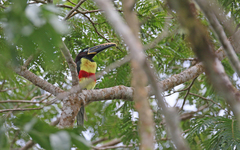
The chestnut-eared aracari is 43 to 47 cm (17 to 19 in) long and weighs 220 to 310 g (7.8 to 11 oz). Males and females have the same bill coloration, though the female's bill is shorter. The bills of nominate subspecies adults have a yellow line at the base and a mostly black mandible. The maxilla has a black stripe on the culmen, a triangle of black narrowing toward the tip, orange-yellow between them, and black and ivory markings on the edge that look like teeth. Adult males have a black crown and upper nape, a chestnut lower nape, a dark green back, and a red rump. They have blue facial skin and the sides of their face and their upper throat are brown to chestnut. Their lower throat is black, their breast yellow, their lower breast red and chestnut-black, their belly yellow, and their...

Wikipedia →

Sounds

Recording0:10

Paraguay · 2026

© Guillermo Menéndez (gmmv80) · XC1142690 · CC BY-NC-SA 4.0

Call0:27

Brazil · 2025

© Joost van Bruggen · XC1050463 · CC BY-NC-ND 4.0

Song1:05

Argentina · 2024

© Marcos E. Sosa · XC1018424 · CC BY-NC-SA 4.0

Global Distribution

Parks Where Found

# Park Country Daily sighting probability
1 Iguazú National Park 🇦🇷 Argentina
~40%
2 Iguaçu National Park 🇧🇷 Brazil
~40%
3 Sierra de la Macarena National Park 🇨🇴 Colombia
~40%
4 Amboró National Park 🇧🇴 Bolivia
~30%
5 Yasuní National Park 🇪🇨 Ecuador
~20%
6 Manu National Park 🇵🇪 Peru
~20%
7 Chapada dos Guimarães National Park 🇧🇷 Brazil
~20%
8 Amacayacu National Natural Park 🇨🇴 Colombia
~20%
9 Tambopata National Reserve 🇵🇪 Peru
~20%
10 Parque Estadual Encontro das Águas 🇧🇷 Brazil
~10%
11 Cuyabeno Wildlife Reserve 🇪🇨 Ecuador
~10%
12 Madidi National Park 🇧🇴 Bolivia
~10%
13 Anavilhanas National Park 🇧🇷 Brazil
<5%
14 Chingaza National Natural Park 🇨🇴 Colombia
<5%

Cities Where Found

# City Country Daily sighting probability
1 Campo Grande 🇧🇷 Brazil
~10%
2 Santa Cruz de la Sierra 🇧🇴 Bolivia
<5%
3 Asuncion 🇵🇾 Paraguay
<5%

Zoos & Centres Where Found

# Zoo / Centre Country
1 SeaWorld Abu Dhabi 🇦🇪 United Arab Emirates In captivity
2 Parque das Aves 🇧🇷 Brazil In captivity
3 Walsrode World Bird Park 🇩🇪 Germany In captivity
4 Hodonín Zoo 🇨🇿 Czechia In captivity
5 Singapore Zoo 🇸🇬 Singapore In captivity
6 Wilhelma 🇩🇪 Germany In captivity
7 Bird Paradise 🇸🇬 Singapore In captivity
8 Rainforest Wild Asia 🇸🇬 Singapore In captivity
9 Parque de las Leyendas 🇵🇪 Peru In captivity
10 Vogelpark Avifauna 🇳🇱 Netherlands In captivity
11 Bioparque Los Ocarros 🇨🇴 Colombia In captivity
12 Zoológico de Fauna Sudamericana 🇧🇴 Bolivia In captivity
13 Santacruz zoo 🇨🇴 Colombia In captivity
14 Selwo Marina 🇪🇸 Spain In captivity
15 Dallas World Aquarium 🇺🇸 United States In captivity
16 Amazon Rescue Center 🇵🇪 Peru In captivity
17 Cali Zoo 🇨🇴 Colombia In captivity
18 GüiráOga 🇦🇷 Argentina In captivity

Before you go

What are the chances of seeing a Chestnut-eared Aracari in Madidi National Park?

With luck

About 10% of wildlife watchers report a Chestnut-eared Aracari sighting in Madidi National Park on a given day, based on 11 verified sightings from GBIF citizen-science data from 2019 to 2026. It is the 166th most-seen of the 239 birds we can rate there. Over three days the chance rises to about 20%, and over a week to about 40%, if each day is a fresh chance.

When is the best time to see a Chestnut-eared Aracari in Madidi National Park?

January, August and October–November

In those months about 10% of wildlife watchers report a Chestnut-eared Aracari in Madidi National Park on a given day, against under 5% in February, April–July and September, the lowest months. March and December have too few records to rate.

What time of day is best to see a Chestnut-eared Aracari?

Between 7 and 10 am

Across all the parks we cover, that three-hour window holds the most Chestnut-eared Aracari sightings with a recorded time, and about 9 in 10 of them come between 6 am and 6 pm: it is a daytime animal.

Which relatives of the Chestnut-eared Aracari live in Madidi National Park?

Same family: Ramphastidae

The closest relatives of the Chestnut-eared Aracari that you can see in Madidi National Park (family Ramphastidae, Toucans) are White-throated Toucan (about 20%) and Toco Toucan (about 10%), with each one's daily chance of a sighting.

Where does the Chestnut-eared Aracari sighting chance come from?

GBIF citizen-science records

It is estimated from how often the Chestnut-eared Aracari is recorded against all the birds logged in Madidi National Park (11 verified sightings from 2019 to 2026), calibrated against known sighting rates. Figures are rounded to the nearest 10% because citizen-science data supports honest approximations, not decimals, and months with records from fewer than five people show "—". How it works.

← Back to Madidi National Park