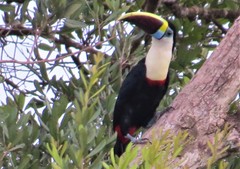
The white-throated toucan (Ramphastos tucanus) is a near-passerine bird in the family Ramphastidae found in South America throughout the Amazon Basin including the adjacent Tocantins and Araguaia River drainage. It prefers tropical humid forest, but also occurs in woodland and locally in riverine forest within cerrado.
The white-throated toucan was formally described by the Swedish naturalist Carl Linnaeus in 1758 in the tenth edition of his Systema Naturae. He placed it with the other toucans in the genus Ramphastos and coined the binomial name Ramphastos tucanus. Linnaeus specified the "habitat" as South America. The type locality was restricted to Suriname by the American ornithologists Ludlow Griscom and James Greenway in 1937. The genus name is from Ancient Greek ῥαμφηστης/rhamphēstēs meaning "snouted" (from ῥαμφη/rhampē meaning "bill"). The specific epithet tucanus is from the Guarani language and may mean "bonenose".
Three subspecies are recognized by the International Ornithological Committee (IOC), the South American Classification Committee of the American Ornithological Society, and the Clements taxonomy: BirdLife International's Handbook...