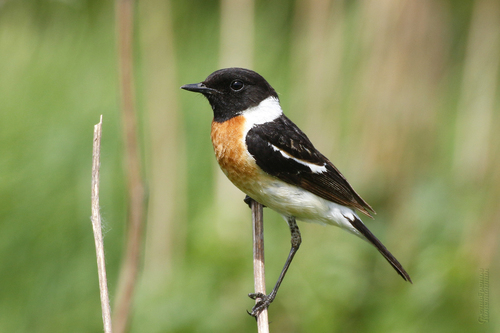
Striated Grassbird

Striated Grassbird

Megalurus palustris

Silhouette: Sheatherius · PhyloPic

LCLeast ConcernNTVUENCR
Daily sighting probability ~30% · Possible
at Manas National Park

In 3 days ~60% in a week ~90%

424 Verified sightings at Manas National Park From 2019 to 2026
1,189 In all 8 parks
February Best month
☀️ Diurnal When it's spotted

About the Striated Grassbird

The striated grassbird (Megalurus palustris) is an "Old World warbler" species in the family Locustellidae. It was formerly placed in the family Sylviidae. It is now the only species placed in the genus Megalurus. It is found in Bangladesh, Cambodia, China, India, Indonesia, Laos, Malaysia, Myanmar, Nepal, Pakistan, the Philippines, Thailand, and Vietnam.

Noisy and conspicuous, often sitting and calling exposed on tops of grasses, bushes and telephone wires. Note streaked crown and streaked upper breast. This species has an extremely large range, and hence does not approach the thresholds for Vulnerable under the range size criterion (Extent of Occurrence <20,000 km2 combined with a declining or fluctuating range size, habitat extent/quality, or population size and a small number of locations or severe fragmentation). The population trend is not known, but the population is not believed to be decreasing sufficiently rapidly to approach the thresholds under the population trend criterion (>30% decline over ten years or three generations). The population size has not been quantified, but it is not believed to approach the thresholds for Vulnerable under the population size criterion (<10,000 mature individuals with a continuing decline estimated to be >10% in ten years or three generations, or with a specified population structure). For these reasons the species is evaluated as Least Concern.

The genus Megalurus formerly included additional species. A comprehensive molecular phylogenetic study of the grassbird family Locustellidae published in 2018 found that Megalurus was non-monophyletic. In the resulting reorganization, five species were moved to the resurrected genus Poodytes and four species were moved to Cincloramphus, leaving only the striated grassbird in Megalurus. Wikipedia →

Sounds

Alarm call0:04

China · 2024

© Dave GUO · XC971696 · CC BY-NC-SA 4.0

Subsong0:24

Bangladesh · 2024

© Ding Li Yong · XC933275 · CC BY-NC-ND 4.0

Call0:21

Malaysia · 2023

© Lim Ying Hien · XC841135 · CC BY-NC-ND 4.0

Global Distribution

Parks Where Found

# Park Country Daily sighting probability
1 Kaziranga National Park 🇮🇳 India
~30%
2 Manas National Park 🇮🇳 India
~30%
3 Bali Barat National Park 🇮🇩 Indonesia
~10%
4 Namdapha National Park 🇮🇳 India
<5%
5 Kinabatangan Wildlife Sanctuary 🇲🇾 Malaysia
<5%
6 Kinabalu Park 🇲🇾 Malaysia
<5%
7 Royal Manas National Park 🇧🇹 Bhutan
<5%
8 Chitwan National Park 🇳🇵 Nepal
<5%

Cities Where Found

# City Country Daily sighting probability
1 Chattogram 🇧🇩 Bangladesh
~60%
2 Manila 🇵🇭 Philippines
~30%
3 Davao City 🇵🇭 Philippines
~20%
4 Cebu City 🇵🇭 Philippines
~20%
5 Savar 🇧🇩 Bangladesh
~10%
6 Dhaka 🇧🇩 Bangladesh
~10%
7 Kolkata 🇮🇳 India
~10%
8 Guwahati 🇮🇳 India
<5%
9 Phnom Penh 🇰🇭 Cambodia
<5%
10 New Delhi 🇮🇳 India
<5%

Before you go

What are the chances of seeing a Striated Grassbird in Manas National Park?

Possible

About 30% of wildlife watchers report a Striated Grassbird sighting in Manas National Park on a given day, based on 424 verified sightings from GBIF citizen-science data from 2019 to 2026. It is the 52nd most-seen of the 377 birds we can rate there. Over three days the chance rises to about 60%, and over a week to about 90%, if each day is a fresh chance.

When is the best time to see a Striated Grassbird in Manas National Park?

February to April

In those months about 30% of wildlife watchers report a Striated Grassbird in Manas National Park on a given day, against about 10% in July and September, the lowest months. Those are among Manas National Park's driest months, with about 150 mm of rain a month against 1070 mm in June.

What time of day is best to see a Striated Grassbird?

Between 7 and 10 am

Across all the parks we cover, that three-hour window holds the most Striated Grassbird sightings with a recorded time, and about 9 in 10 of them come between 6 am and 6 pm: it is a daytime animal.

Is Manas National Park the best place to see a Striated Grassbird?

Among the best

Of the 8 parks where we can rate Striated Grassbird sightings, Manas National Park ranks 2nd at about 30%, level with the leaders once rounded. The best odds are in Kaziranga National Park (India, about 30%).

Where does the Striated Grassbird sighting chance come from?

GBIF citizen-science records

It is estimated from how often the Striated Grassbird is recorded against all the birds logged in Manas National Park (424 verified sightings from 2019 to 2026), calibrated against known sighting rates. Figures are rounded to the nearest 10% because citizen-science data supports honest approximations, not decimals, and months with records from fewer than five people show "—". How it works.

← Back to Manas National Park