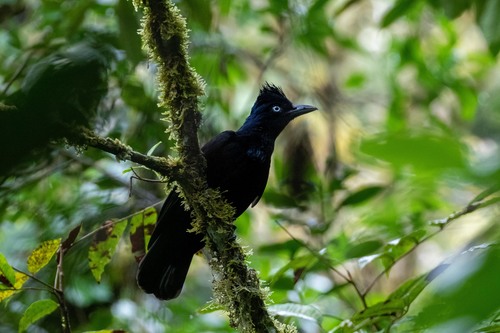
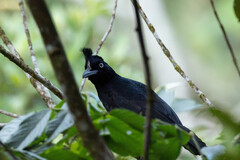
Amazonian Umbrellabird

Amazonian Umbrellabird

Cephalopterus ornatus

Silhouette: Steven Traver · PhyloPic

LCLeast ConcernNTVUENCR
Daily sighting probability <5% · Rare
at Manu National Park

In 3 days <5% in a week ~10%

33 Verified sightings at Manu National Park From 2019 to 2026
647 In all 8 parks
March Best month
☀️ Diurnal When it's spotted

About the Amazonian Umbrellabird

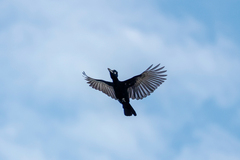
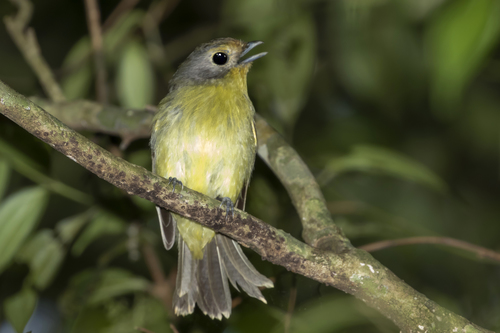
The Amazonian umbrellabird (Cephalopterus ornatus) is a species of bird in the family Cotingidae native to the Amazon basin with a separate population on the eastern slopes of the Andes. The male bird is entirely black, with a black crest and inflatable wattle on the throat, and at 48 to 55 cm (19 to 22 in), may be the largest passerine bird in South America. The female is slightly smaller. Both have an undulating flight, described as woodpecker-like, and the male has a loud, booming call.

The Amazonian umbrellabird feeds on fruit and berries, and may opportunistically take insects and spiders. It forages singly, in pairs or in small groups, in the forest canopy, hopping from branch to branch, but is a secretive species and is more often heard than seen.

Much larger than the female, the male Amazonian umbrellabird is likely the largest passerine in South America as well as the largest suboscine passerine in the world. The male Amazonian umbrellabird grows to a weight of 480–571 grams (1.06–1.26 lb) and a length of 48–55 centimetres (18.9–21.7 in). The female typically stands 41–44 centimetres (16.1–17.3 in) tall and weighs up to 380 grams (0.84 lb). As in the other... Wikipedia →

Sounds

Alarm call0:21

Ecuador · 2025

© Manuel Sánchez-Nivicela · XC1100887 · CC BY-NC-ND 4.0

Canto0:06

Brazil · 2018

© Caio Brito · XC556202 · CC BY-NC-SA 4.0

Song0:09

Ecuador · 1992

© John V. Moore · XC259082 · CC BY-NC-SA 4.0

Global Distribution

Parks Where Found

# Park Country Daily sighting probability
1 Podocarpus National Park 🇪🇨 Ecuador
~10%
2 Yasuní National Park 🇪🇨 Ecuador
~10%
3 Anavilhanas National Park 🇧🇷 Brazil
~10%
4 Sierra de la Macarena National Park 🇨🇴 Colombia
~10%
5 Amacayacu National Natural Park 🇨🇴 Colombia
<5%
6 Cuyabeno Wildlife Reserve 🇪🇨 Ecuador
<5%
7 Manu National Park 🇵🇪 Peru
<5%
8 Tambopata National Reserve 🇵🇪 Peru
<5%

Zoos & Centres Where Found

# Zoo / Centre Country
1 Dallas World Aquarium 🇺🇸 United States In captivity

Before you go

What are the chances of seeing an Amazonian Umbrellabird in Manu National Park?

Rare

Under 5% of wildlife watchers report an Amazonian Umbrellabird sighting in Manu National Park on a given day, based on 33 verified sightings from GBIF citizen-science data from 2019 to 2026. It is the 496th most-seen of the 641 birds we can rate there. Over three days the chance rises to under 5%, and over a week to about 10%, if each day is a fresh chance.

When is the best time to see an Amazonian Umbrellabird in Manu National Park?

Any time of year

In every month with enough records, under 5% of wildlife watchers report an Amazonian Umbrellabird in Manu National Park on a given day, so our monthly data shows no clear season.

What time of day is best to see an Amazonian Umbrellabird?

Between 6 and 9 am

Across all the parks we cover, that three-hour window holds the most Amazonian Umbrellabird sightings with a recorded time, and about 9 in 10 of them come between 6 am and 6 pm: it is a daytime animal.

Which relatives of the Amazonian Umbrellabird live in Manu National Park?

Same family: Cotingidae

The closest relatives of the Amazonian Umbrellabird that you can see in Manu National Park (family Cotingidae, Cotingas) are White-winged Becard (about 10%), Screaming Piha (about 10%) and Bare-necked Fruitcrow (about 10%), with each one's daily chance of a sighting.

Where does the Amazonian Umbrellabird sighting chance come from?

GBIF citizen-science records

It is estimated from how often the Amazonian Umbrellabird is recorded against all the birds logged in Manu National Park (33 verified sightings from 2019 to 2026), calibrated against known sighting rates. Figures are rounded to the nearest 10% because citizen-science data supports honest approximations, not decimals, and months with records from fewer than five people show "—". How it works.

← Back to Manu National Park