Moustached Wren

Moustached Wren

Pheugopedius genibarbis

Silhouette: Matt Wilkins · PhyloPic

LCLeast ConcernNTVUENCR
Daily sighting probability ~20% · Possible
at Manu National Park

In 3 days ~40% in a week ~70%

767 Verified sightings at Manu National Park From 2019 to 2026
1,844 In all 7 parks
April Best month
☀️ Diurnal When it's spotted

About the Moustached Wren

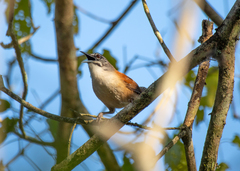
The moustached wren (Pheugopedius genibarbis) is a species of bird in the family Troglodytidae. It is found in Bolivia, Brazil, and Peru. The moustached wren was at one time treated as conspecific with the whiskered wren (Pheugopedius mystaclais). It has four subspecies:

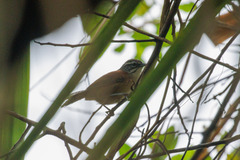
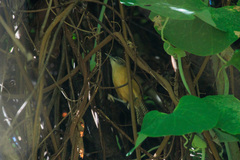
The nominate adult has an olivaceous gray-brown crown and nape, bright chestnut back and rump, and a dull brown tail with narrow blackish bars. It has a white supercilium and eyering, a black stripe through the eye, gray-black cheeks streaked with white, a white moustachial stripe, and a black malar stripe. Its throat and upper chest are white, its lower chest buffy, and its flanks and belly deeper brown. Compared to the adult, the juvenile's crown is browner, its back duller and less deeply chestnut, and it has less well defined facial markings and more diffuse bars on the tail.

P. g. juruanus is larger than the nominate and its underparts are paler. P.... Wikipedia →

Sounds

Begging call0:45

Brazil · 2026

© JAYRSON ARAUJO DE OLIVEIRA · XC1141904 · CC BY-NC-SA 4.0

Song0:15

Brazil · 2025

© Joost van Bruggen · XC1050513 · CC BY-NC-ND 4.0

Call0:22

Brazil · 2023

© Ricardo José Mitidieri · XC808570 · CC BY-NC-SA 4.0

Global Distribution

Parks Where Found

# Park Country Daily sighting probability
1 Amboró National Park 🇧🇴 Bolivia
~60%
2 Chapada Diamantina National Park 🇧🇷 Brazil
~40%
3 Manu National Park 🇵🇪 Peru
~20%
4 Tambopata National Reserve 🇵🇪 Peru
~10%
5 Chapada dos Guimarães National Park 🇧🇷 Brazil
~10%
6 Serra dos Órgãos National Park 🇧🇷 Brazil
<5%
7 Parque Estadual Encontro das Águas 🇧🇷 Brazil
<5%

Cities Where Found

# City Country Daily sighting probability
1 São Luís 🇧🇷 Brazil
~20%
2 Belém 🇧🇷 Brazil
~20%
3 Recife 🇧🇷 Brazil
~10%
4 Maceió 🇧🇷 Brazil
~10%
5 Rio de Janeiro 🇧🇷 Brazil
<5%
6 Goiânia 🇧🇷 Brazil
<5%
7 Vitória 🇧🇷 Brazil
<5%
8 Santa Cruz de la Sierra 🇧🇴 Bolivia
<5%
9 Salvador 🇧🇷 Brazil
<5%
10 Niterói 🇧🇷 Brazil
<5%

Before you go

What are the chances of seeing a Moustached Wren in Manu National Park?

Possible

About 20% of wildlife watchers report a Moustached Wren sighting in Manu National Park on a given day, based on 767 verified sightings from GBIF citizen-science data from 2019 to 2026. It is the 86th most-seen of the 641 birds we can rate there. Over three days the chance rises to about 40%, and over a week to about 70%, if each day is a fresh chance.

When is the best time to see a Moustached Wren in Manu National Park?

April

In that month about 30% of wildlife watchers report a Moustached Wren in Manu National Park on a given day, against about 10% in January–February and October, the lowest months.

What time of day is best to see a Moustached Wren?

Between 8 and 11 am

Across all the parks we cover, that three-hour window holds the most Moustached Wren sightings with a recorded time, and about 9 in 10 of them come between 6 am and 6 pm: it is a daytime animal.

Is Manu National Park the best place to see a Moustached Wren?

3rd of 7

Of the 7 parks where we can rate Moustached Wren sightings, Manu National Park ranks 3rd at about 20%. The best odds are in Amboró National Park (Bolivia, about 60%) and Chapada Diamantina National Park (Brazil, about 40%).

Which relatives of the Moustached Wren live in Manu National Park?

Same family: Troglodytidae

The closest relatives of the Moustached Wren that you can see in Manu National Park (family Troglodytidae, Wrens) are Southern House Wren (about 20%), Scaly-breasted Wren (about 10%) and Thrush-like Wren (about 10%), with each one's daily chance of a sighting.

Where does the Moustached Wren sighting chance come from?

GBIF citizen-science records

It is estimated from how often the Moustached Wren is recorded against all the birds logged in Manu National Park (767 verified sightings from 2019 to 2026), calibrated against known sighting rates. Figures are rounded to the nearest 10% because citizen-science data supports honest approximations, not decimals, and months with records from fewer than five people show "—". How it works.

← Back to Manu National Park