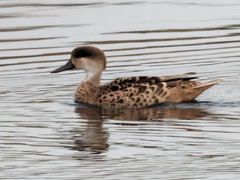
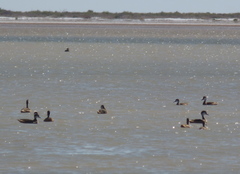
White-cheeked Pintail

White-cheeked Pintail

Anas bahamensis

Silhouette: Sheatherius · PhyloPic

LCLeast ConcernNTVUENCR
Daily sighting probability <5% · Rare
at Manu National Park

In 3 days <5% in a week ~10%

53 Verified sightings at Manu National Park From 2019 to 2026
4,351 In all 7 parks
July Best month
☀️ Diurnal When it's spotted

About the White-cheeked Pintail

The white-cheeked pintail (Anas bahamensis), also known as the Bahama pintail, Bahama duck, or Galápagos duck is a species of dabbling duck that is patchily distributed throughout South America and the Caribbean. It was first described by Carl Linnaeus in his landmark 1758 10th edition of Systema Naturae under its current scientific name.

The white-cheeked pintail was formally described in 1758 by the Swedish naturalist Carl Linnaeus in the tenth edition of his Systema Naturae under the current binomial name Anas bahamensis. Linnaeus based his account on the "Ilathera duck" that had been described and illustrated by the English naturalist Mark Catesby in the first volume of his book The Natural History of Carolina, Florida and the Bahama Islands that was published between 1729 and 1732.

Three subspecies are accepted: Wikipedia →

Sounds

Duet0:18

Chile · 2021

© Ignacio Escobar · XC691740 · CC BY-NC-SA 4.0

Flight call0:27

Brazil · 2020

© Ricardo José Mitidieri · XC602244 · CC BY-NC-SA 4.0

Call0:20

Ecuador · 2003

© John V. Moore · XC257283 · CC BY-NC-SA 4.0

Global Distribution

Parks Where Found

# Park Country Daily sighting probability
1 Galápagos Islands 🇪🇨 Ecuador
~40%
2 Jaragua National Park 🇩🇴 Dominican Republic
~20%
3 Lauca National Park 🇨🇱 Chile
<5%
4 Los Haitises National Park 🇩🇴 Dominican Republic
<5%
5 Caroni Swamp 🇹🇹 Trinidad and Tobago
<5%
6 Manu National Park 🇵🇪 Peru
<5%
7 Ciénaga de Zapata 🇨🇺 Cuba
<5%

Cities Where Found

# City Country Daily sighting probability
1 Cochabamba 🇧🇴 Bolivia
~40%
2 Lima 🇵🇪 Peru
~20%
3 Curitiba 🇧🇷 Brazil
~10%
4 Santa Cruz de la Sierra 🇧🇴 Bolivia
~10%
5 Santiago 🇨🇱 Chile
~10%
6 São Paulo 🇧🇷 Brazil
~10%
7 Quito 🇪🇨 Ecuador
<5%
8 Rio de Janeiro 🇧🇷 Brazil
<5%
9 Fortaleza 🇧🇷 Brazil
<5%
10 Santo Domingo 🇩🇴 Dominican Republic
<5%

Zoos & Centres Where Found

# Zoo / Centre Country
1 Disney's Animal Kingdom 🇺🇸 United States In captivity
2 SeaWorld Orlando 🇺🇸 United States In captivity
3 Moscow Zoo 🇷🇺 Russia In captivity
4 Prague Zoo 🇨🇿 Czechia In captivity
5 National Zoological Park 🇺🇸 United States In captivity
6 ZooParc de Beauval 🇫🇷 France In captivity
7 Dublin Zoo 🇮🇪 Ireland In captivity
8 Parque das Aves 🇧🇷 Brazil In captivity
9 Le Pal 🇫🇷 France In captivity
10 Réserve africaine de Sigean 🇫🇷 France In captivity
11 Parc des oiseaux 🇫🇷 France In captivity
12 Abilene Zoological Gardens 🇺🇸 United States In captivity
13 Zoo Miami 🇺🇸 United States In captivity
14 Kansas City Zoo 🇺🇸 United States In captivity
15 Sedgwick County Zoo 🇺🇸 United States In captivity
16 Omaha’s Henry Doorly Zoo and Aquarium 🇺🇸 United States In captivity
17 Wildlife World Zoo 🇺🇸 United States In captivity
18 São Paulo Zoo 🇧🇷 Brazil In captivity
19 Hellabrunn Zoo 🇩🇪 Germany In captivity
20 Diergaarde Blijdorp 🇳🇱 Netherlands In captivity
21 Parque Zoobotânico Arruda Câmara (BICA) 🇧🇷 Brazil In captivity
22 Zoo de La Flèche 🇫🇷 France In captivity
23 Karlsruhe Zoo 🇩🇪 Germany In captivity
24 Zoo Aquarium de Madrid 🇪🇸 Spain In captivity
25 Gembira Loka Zoo 🇮🇩 Indonesia In captivity
26 Cologne Zoological Garden 🇩🇪 Germany In captivity
27 Nikolaev Zoo 🇺🇦 Ukraine In captivity
28 Córdoba Zoo 🇦🇷 Argentina In captivity
29 Budapest Zoo & Botanical Garden 🇭🇺 Hungary In captivity
30 Ouwehands Dierenpark 🇳🇱 Netherlands In captivity
31 Cleres Zoological Park 🇫🇷 France In captivity
32 Le Cornelle 🇮🇹 Italy In captivity
33 The Abilene Zoo 🇺🇸 United States In captivity
34 Van Blanckendaell Park 🇳🇱 Netherlands In captivity
35 Buin Zoo 🇨🇱 Chile In captivity
36 Small Breeds Farm Park 🇬🇧 United Kingdom In captivity
37 St. Augustine Alligator Farm Zoological Park 🇺🇸 United States In captivity
38 Bioparc Fuengirola 🇪🇸 Spain In captivity
39 Tiergarten Falkenstein 🇩🇪 Germany In captivity
40 Agroflori Parque de las Aves 🇧🇴 Bolivia In captivity
41 Oceanium 🇳🇱 Netherlands In captivity
42 Golders Hill Park Zoo 🇬🇧 United Kingdom In captivity
43 Sobela Ocean Aquarium 🇺🇸 United States In captivity
44 Rákosův pavilon 🇨🇿 Czechia In captivity
45 Velemlokárium 🇨🇿 Czechia In captivity
46 Cologne Zoo Aquarium 🇩🇪 Germany In captivity
47 Margitszigeti Kisállatkert 🇭🇺 Hungary In captivity
48 Snakeroom Serpentarium 🇪🇸 Spain In captivity
49 Tierpark Bad Kösen 🇩🇪 Germany In captivity
50 Tierpark Schlichtweg 15 in München 🇩🇪 Germany In captivity

Before you go

What are the chances of seeing a White-cheeked Pintail in Manu National Park?

Rare

Under 5% of wildlife watchers report a White-cheeked Pintail sighting in Manu National Park on a given day, based on 53 verified sightings from GBIF citizen-science data from 2019 to 2026. It is the 481st most-seen of the 641 birds we can rate there. Over three days the chance rises to under 5%, and over a week to about 10%, if each day is a fresh chance.

When is the best time to see a White-cheeked Pintail in Manu National Park?

July

In that month about 10% of wildlife watchers report a White-cheeked Pintail in Manu National Park on a given day, against under 5% in August to June, the lowest months. That is one of Manu National Park's driest months, with about 70 mm of rain against 290 mm in February.

What time of day is best to see a White-cheeked Pintail?

Between 3 and 6 pm

Across all the parks we cover, that three-hour window holds the most White-cheeked Pintail sightings with a recorded time, and about 9 in 10 of them come between 6 am and 6 pm: it is a daytime animal.

Is Manu National Park the best place to see a White-cheeked Pintail?

6th of 7

Of the 7 parks where we can rate White-cheeked Pintail sightings, Manu National Park ranks 6th at under 5%. The best odds are in Galápagos Islands (Ecuador, about 40%), Jaragua National Park (Dominican Republic, about 20%) and Lauca National Park (Chile, under 5%).

Which relatives of the White-cheeked Pintail live in Manu National Park?

Same family: Anatidae

The closest relatives of the White-cheeked Pintail that you can see in Manu National Park (family Anatidae, Ducks, Geese, and Swans) are Brazilian Teal (about 10%) and Muscovy Duck (about 10%), with each one's daily chance of a sighting.

Where does the White-cheeked Pintail sighting chance come from?

GBIF citizen-science records

It is estimated from how often the White-cheeked Pintail is recorded against all the birds logged in Manu National Park (53 verified sightings from 2019 to 2026), calibrated against known sighting rates. Figures are rounded to the nearest 10% because citizen-science data supports honest approximations, not decimals, and months with records from fewer than five people show "—". How it works.

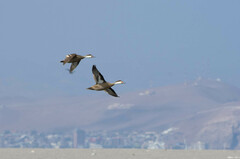
← Back to Manu National Park