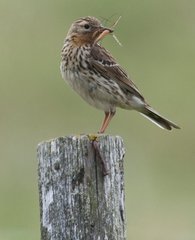
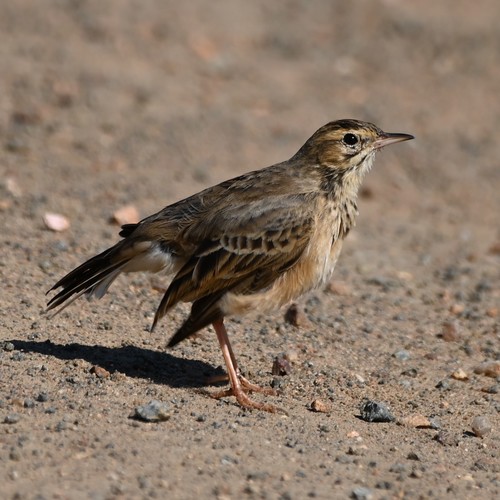
Red-throated Pipit

Red-throated Pipit

Anthus cervinus

Silhouette: Susan Murphy (original photograph), T. Michael Keesey (vectorization) · PhyloPic

LCLeast ConcernNTVUENCR
Daily sighting probability <5% · Rare
at Masai Mara National Reserve

In 3 days <5% in a week ~10%

29 Verified sightings at Masai Mara National Reserve From 2019 to 2026
334 In all 15 parks
December Best month
☀️ Diurnal When it's spotted

About the Red-throated Pipit

The red-throated pipit (Anthus cervinus) is a small passerine bird, which breeds in the far north of Europe and the Palearctic, with a foothold in northern Alaska. It is a long-distance migrant, wintering to Africa and South-East Asia and western Alaska in North America. It is vagrant to Western Europe.

The scientific name is from Latin. The generic name Anthus is the name for a small bird of grasslands, and the specific name cervinus means "stag-coloured", from cervus, "stag". This is a small pipit, with an adult easily identified in the breeding season by its brick-red face and throat. In other plumages, this is an undistinguished-looking species, heavily streaked brown above, with whitish mantle stripes, and with black markings on a white background below. It is very similar in appearance to the meadow pipit, and in the autumn, it much resembles the tree pipit, but has an altogether more striped appearance because of the larger numbers of streaks on the cap, back, flank, rump, and chest. The flight of the red-throated pipit is strong and direct, and it gives a characteristic psii call as it flies.

The red-throated pipit is native... Wikipedia →

Sounds

Call0:06

Sweden · 2026

© Kasper Wieck · XC1107253 · CC BY-NC-SA 4.0

Flight call0:08

Estonia · 2025

© Uku Paal · XC1039280 · CC BY-NC-SA 4.0

Alarm call0:21

Norway · 2024

© Frode Falkenberg · XC926072 · CC BY-NC-SA 4.0

Global Distribution

Parks Where Found

# Park Country Daily sighting probability
1 Bale Mountains National Park 🇪🇹 Ethiopia
~30%
2 Kiskunság National Park 🇭🇺 Hungary
~10%
3 Hortobágy National Park 🇭🇺 Hungary
<5%
4 Amboseli National Park 🇰🇪 Kenya
<5%
5 Nairobi National Park 🇰🇪 Kenya
<5%
6 Aberdare National Park 🇰🇪 Kenya
<5%
7 Tsavo East National Park 🇰🇪 Kenya
<5%
8 Masai Mara National Reserve 🇰🇪 Kenya
<5%
9 Biebrza National Park 🇵🇱 Poland
<5%
10 Camargue 🇫🇷 France
<5%
11 Taroko National Park 🇹🇼 Taiwan
<5%
12 Fertő-Hanság National Park 🇭🇺 Hungary
<5%
13 Khao Yai National Park 🇹🇭 Thailand
<5%
14 Ngorongoro Conservation Area 🇹🇿 Tanzania
<5%
15 Wadden Sea National Park 🇩🇪 Germany
<5%

Cities Where Found

# City Country Daily sighting probability
1 Novosibirsk 🇷🇺 Russia
~10%
2 Riyadh 🇸🇦 Saudi Arabia
~10%
3 Tel Aviv 🇮🇱 Israel
~10%
4 Luxor 🇪🇬 Egypt
~10%
5 Manama 🇧🇭 Bahrain
~10%
6 Yekaterinburg 🇷🇺 Russia
<5%
7 Kathmandu 🇳🇵 Nepal
<5%
8 Abu Dhabi 🇦🇪 United Arab Emirates
<5%
9 Jerusalem 🇮🇱 Israel
<5%
10 Beirut 🇱🇧 Lebanon
<5%

Before you go

What are the chances of seeing a Red-throated Pipit in Masai Mara National Reserve?

Rare

Under 5% of wildlife watchers report a Red-throated Pipit sighting in Masai Mara National Reserve on a given day, based on 29 verified sightings from GBIF citizen-science data from 2019 to 2026. It is the 305th most-seen of the 398 birds we can rate there. Over three days the chance rises to under 5%, and over a week to about 10%, if each day is a fresh chance.

When is the best time to see a Red-throated Pipit in Masai Mara National Reserve?

Any time of year

In every month with enough records, under 5% of wildlife watchers report a Red-throated Pipit in Masai Mara National Reserve on a given day, so our monthly data shows no clear season.

What time of day is best to see a Red-throated Pipit?

Between 8 and 11 am

Across all the parks we cover, that three-hour window holds the most Red-throated Pipit sightings with a recorded time, and nearly all of them come between 6 am and 6 pm: it is a daytime animal.

Which relatives of the Red-throated Pipit live in Masai Mara National Reserve?

Same genus: Anthus

The closest relatives of the Red-throated Pipit that you can see in Masai Mara National Reserve (genus Anthus, Pipits) are Plain-backed Pipit (about 30%), Grassveld Pipit (about 20%) and Long-billed Pipit (about 10%), with each one's daily chance of a sighting.

Where does the Red-throated Pipit sighting chance come from?

GBIF citizen-science records

It is estimated from how often the Red-throated Pipit is recorded against all the birds logged in Masai Mara National Reserve (29 verified sightings from 2019 to 2026), calibrated against known sighting rates. Figures are rounded to the nearest 10% because citizen-science data supports honest approximations, not decimals, and months with records from fewer than five people show "—". How it works.

← Back to Masai Mara National Reserve