African Yellow-Warbler

African Yellow-Warbler

Iduna natalensis

Silhouette: Sheatherius · PhyloPic

LCLeast ConcernNTVUENCR
Daily sighting probability ~20% · Possible
at Mkomazi National Park

In 3 days ~40% in a week ~70%

28 Verified sightings at Mkomazi National Park From 2019 to 2026
481 In all 14 parks
October Best month
☀️ Diurnal When it's spotted

About the African Yellow-Warbler

The African yellow warbler (Iduna natalensis), also known as Natal yellow warbler, dark-capped yellow warbler or yellow flycatcher-warbler, is a species of Acrocephalidae warblers; formerly, these were placed in the paraphyletic "Old World warblers".

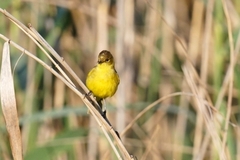
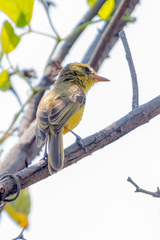
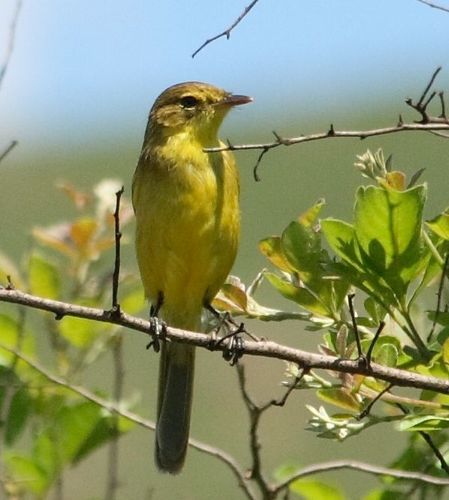
The African yellow warbler is a medium-sized warbler in which the whole of the upperparts and tail are yellowish-brown, with a slightly browner crown and yellower rump. The wings have brown feathers edged with yellow. The underparts are bright yellow with an olive wash on the sides of the breast, flanks and lower belly. The bill is pale on the upper mandible and blackish on the lower, and the legs are blackish. Females have duller underparts, and the juveniles are similar to the males but are buffier. The total length is 13 cm (5.1 in) and the birds weigh between 10 and 15 g (0.35 and 0.53 oz).

The song of the African yellow warbler is a rapid series of throaty and varied notes preceded by a few raspy notes, for example, "chip-chip-chip- whee-lee-wheeo". The alarm call is a sharp "tsk" or "chirr". The African yellow warbler is a bird of rank vegetation and occurs in reeds, overgrown waterside... Wikipedia →
Sounds

Song0:28

Zambia · 2017

© Peter Boesman · XC397966 · CC BY-NC-ND 4.0

Subsong0:10

Kenya · 2026

© Ding Li Yong · XC1180598 · CC BY-NC-ND 4.0

Call0:25

South Africa · 2017

© Dawie de Swardt · XC390679 · CC BY-NC-SA 4.0

Global Distribution

Parks Where Found

# Park Country Daily sighting probability
1 Mkomazi National Park 🇹🇿 Tanzania
~20%
2 Nairobi National Park 🇰🇪 Kenya
~10%
3 Arusha National Park 🇹🇿 Tanzania
~10%
4 Volcanoes National Park 🇷🇼 Rwanda
~10%
5 Gorongosa National Park 🇲🇿 Mozambique
<5%
6 Queen Elizabeth National Park 🇺🇬 Uganda
<5%
7 Virunga National Park 🇨🇩 Democratic Republic of the Congo
<5%
8 Aberdare National Park 🇰🇪 Kenya
<5%
9 Kibale National Park 🇺🇬 Uganda
<5%
10 Ngorongoro Conservation Area 🇹🇿 Tanzania
<5%
11 Bwindi Impenetrable National Park 🇺🇬 Uganda
<5%
12 Lake Mburo National Park 🇺🇬 Uganda
<5%
13 iSimangaliso Wetland Park 🇿🇦 South Africa
<5%
14 Kruger National Park 🇿🇦 South Africa
<5%

Cities Where Found

# City Country Daily sighting probability
1 Harare 🇿🇼 Zimbabwe
~10%
2 Nairobi 🇰🇪 Kenya
~10%
3 Addis Ababa 🇪🇹 Ethiopia
~10%
4 Kigali 🇷🇼 Rwanda
<5%
5 Durban 🇿🇦 South Africa
<5%

Before you go

What are the chances of seeing an African Yellow-Warbler in Mkomazi National Park?

Possible

About 20% of wildlife watchers report an African Yellow-Warbler sighting in Mkomazi National Park on a given day, based on 28 verified sightings from GBIF citizen-science data from 2019 to 2026. It is the 107th most-seen of the 272 birds we can rate there. Over three days the chance rises to about 40%, and over a week to about 70%, if each day is a fresh chance.

When is the best time to see an African Yellow-Warbler in Mkomazi National Park?

September to November

In those months about 30% of wildlife watchers report an African Yellow-Warbler in Mkomazi National Park on a given day, against about 10% in January, April and July–August, the lowest months. May has too few records to rate.

What time of day is best to see an African Yellow-Warbler?

Between 6 and 9 am

Across all the parks we cover, that three-hour window holds the most African Yellow-Warbler sightings with a recorded time, and about 9 in 10 of them come between 6 am and 6 pm: it is a daytime animal.

Is Mkomazi National Park the best place to see an African Yellow-Warbler?

Yes

Of the 14 parks where we can rate African Yellow-Warbler sightings, Mkomazi National Park has the highest daily chance: about 20%. Next come Nairobi National Park (Kenya, about 10%) and Arusha National Park (Tanzania, about 10%).

Where does the African Yellow-Warbler sighting chance come from?

GBIF citizen-science records

It is estimated from how often the African Yellow-Warbler is recorded against all the birds logged in Mkomazi National Park (28 verified sightings from 2019 to 2026), calibrated against known sighting rates. Figures are rounded to the nearest 10% because citizen-science data supports honest approximations, not decimals, and months with records from fewer than five people show "—". How it works.

← Back to Mkomazi National Park