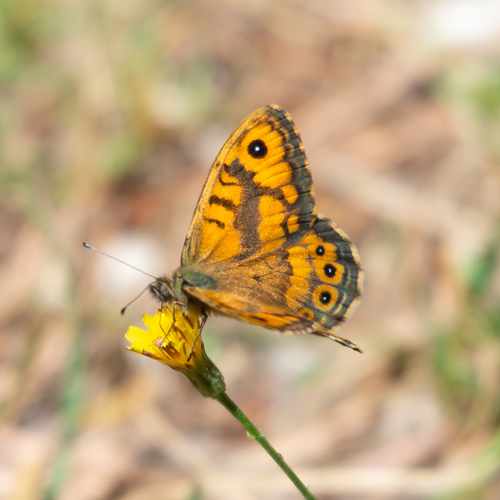
About the Cinnabar Moth
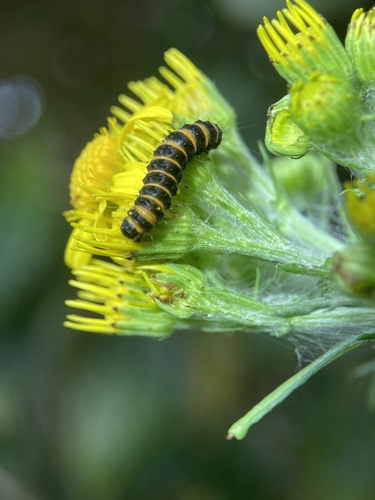
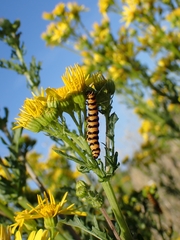
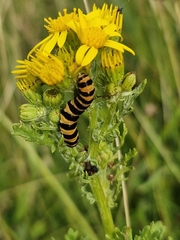
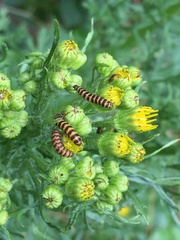
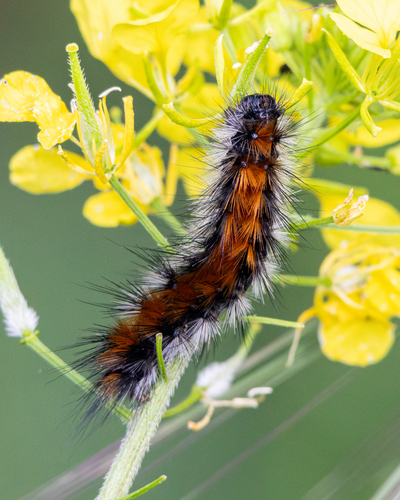
The cinnabar moth (Tyria jacobaeae) is a brightly coloured Arctiinae moth found as a native species in Europe and western and central Asia then east across the Palearctic to Siberia to China. It has been introduced into New Zealand, Australia and North America to control ragwort, on which its larvae feed, as a result of this diet the Cinnabar larvae and adult is poisonous to most of its natural predators, its red coloration acting to signal this to predators (Aposematism).
The moth is named after the red mineral cinnabar because of the red patches on its predominantly black wings. The species was first described by Carl Linnaeus in his 1758 10th edition of Systema Naturae. Cinnabar moths are about 20 mm (0.79 in) long and have a wingspan of 34–46 mm (1.3–1.8 in).
While generally nocturnal, the species is also often spotted in daylight hours. Cinnabar moths are day-flying insects with distinctive pinkish-red and black wings. There is little variation in patterning, although on rare occasions the red markings may be replaced with yellow, or the forewing is entirely red with a black border, or the wings are completely black. Like many other brightly coloured moths, it... Wikipedia →