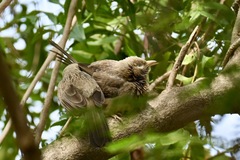
Yellow-billed Babbler

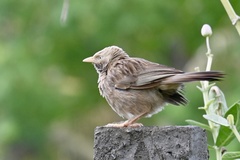
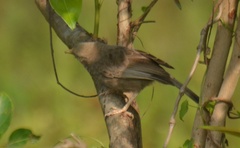
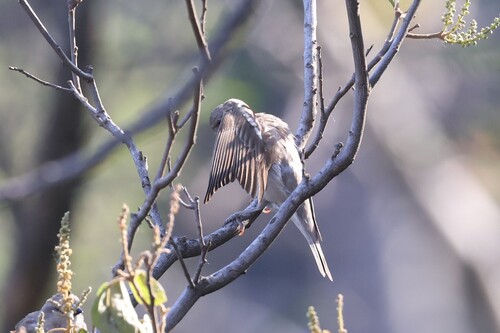
Yellow-billed Babbler

Turdoides affinis

Silhouette: Jiekun He · PhyloPic

Daily sighting probability ~30% · Possible
at Mudumalai National Park

In 3 days ~70% in a week ~90%

331 Verified sightings at Mudumalai National Park From 2019 to 2026
2,670 In all 11 parks
July Best month
🌅 Crepuscular When it's spotted

About the Yellow-billed Babbler

The yellow-billed babbler (Argya affinis) is a member of the family Leiothrichidae endemic to southern India and Sri Lanka. The yellow-billed babbler is a common resident breeding bird in Sri Lanka and southern India. Its habitat is scrub, cultivation and garden land. This species, like most babblers, is not migratory, and has short rounded wings and a weak flight and is usually seen calling and foraging in groups. It is often mistaken for the jungle babbler, whose range overlaps in parts of southern India, although it has a distinctive call and tends to be found in more vegetated habitats. Its name is also confused with Turdoides leucocephala, which is also known as white-headed babbler.

The yellow-billed babbler was formerly placed in the genus Turdoides but following the publication of a comprehensive molecular phylogenetic study in 2018, it was moved to the resurrected genus Argya. These birds have grey brown upperparts, a grey throat and breast with some mottling, and a pale buff belly. The head and nape are grey, and the eyes are bluish white. The nominate race, found in southern India, has a whitish crown and nape, with a darker mantle. The rump... Wikipedia →

Sounds

Recording0:23

India · 2025

© Krishnakumar S D · iNaturalist · CC BY-NC 4.0

Recording0:25

India · 2024

© brock · iNaturalist · CC BY-NC 4.0

Recording0:15

India · 2025

© Keertanaa K · iNaturalist · CC BY-NC 4.0

Global Distribution

Parks Where Found

# Park Country Daily sighting probability
1 Udawalawe National Park 🇱🇰 Sri Lanka
~70%
2 Yala National Park 🇱🇰 Sri Lanka
~60%
3 Wilpattu National Park 🇱🇰 Sri Lanka
~40%
4 Minneriya National Park 🇱🇰 Sri Lanka
~40%
5 Mudumalai National Park 🇮🇳 India
~30%
6 Sinharaja Forest Reserve 🇱🇰 Sri Lanka
~30%
7 Bandipur National Park 🇮🇳 India
~20%
8 Horton Plains National Park 🇱🇰 Sri Lanka
~10%
9 Nagarhole National Park 🇮🇳 India
~10%
10 Eravikulam National Park 🇮🇳 India
<5%
11 Periyar National Park 🇮🇳 India
<5%

Cities Where Found

# City Country Daily sighting probability
1 Tiruppur 🇮🇳 India
~90%
2 Madurai 🇮🇳 India
~80%
3 Coimbatore 🇮🇳 India
~70%
4 Colombo [Sri Jayawardenepura Kotte] 🇱🇰 Sri Lanka
~70%
5 Tiruchirappalli 🇮🇳 India
~60%
6 Thrissur 🇮🇳 India
~60%
7 Salem 🇮🇳 India
~60%
8 Chennai 🇮🇳 India
~40%
9 Visakhapatnam 🇮🇳 India
~40%
10 Hyderabad 🇮🇳 India
~30%

Before you go

What are the chances of seeing a Yellow-billed Babbler in Mudumalai National Park?

Possible

About 30% of wildlife watchers report a Yellow-billed Babbler sighting in Mudumalai National Park on a given day, based on 331 verified sightings from GBIF citizen-science data from 2019 to 2026. It is the 39th most-seen of the 233 birds we can rate there. Over three days the chance rises to about 70%, and over a week to about 90%, if each day is a fresh chance.

When is the best time to see a Yellow-billed Babbler in Mudumalai National Park?

July and November

In those months about 50% of wildlife watchers report a Yellow-billed Babbler in Mudumalai National Park on a given day, against about 20% in March, August and December, the lowest months. Those are among Mudumalai National Park's wettest months, with about 180 mm of rain a month against 10 mm in February.

What time of day is best to see a Yellow-billed Babbler?

Between 3 and 6 am

Across all the parks we cover, that three-hour window holds the most Yellow-billed Babbler sightings with a recorded time, and about 6 in 10 of them come between 6 am and 6 pm: it is most active around dawn and dusk.

Where does the Yellow-billed Babbler sighting chance come from?

GBIF citizen-science records

It is estimated from how often the Yellow-billed Babbler is recorded against all the birds logged in Mudumalai National Park (331 verified sightings from 2019 to 2026), calibrated against known sighting rates. Figures are rounded to the nearest 10% because citizen-science data supports honest approximations, not decimals, and months with records from fewer than five people show "—". How it works.

← Back to Mudumalai National Park