Australian Emperor

Australian Emperor

Anax papuensis

Daily sighting probability ~10% · With luck
at Ningaloo Marine Park

In 3 days ~30% in a week ~60%

6 Verified sightings at Ningaloo Marine Park From 2019 to 2026
91 In all 8 parks
May Best month
☀️ Diurnal When it's spotted

About the Australian Emperor

The Australian emperor dragonfly, also known as the yellow emperor dragonfly, the Baron Dragonfly in New Zealand, scientific name Anax papuensis, is a species of dragonfly in the Aeshnidae family. It is black with yellow dots along its tail.

The Australian emperor is a very large dragonfly, up to 70 mm long. Its abdomen is marked boldly in black and yellow. The thorax is greenish-grey. The head is yellow with a T-shaped mark on the forehead (frons). The eyes are yellow-green. The leading edges of the wings are yellow. The insect habitually hunts fairly slowly, patrolling up and down like other hawkers, with short bursts at high speed.

Their wingspan is 11 centimetres (4.3 in). Males and females are similar. The Australian emperor is found throughout Australia. In the state of Victoria, it has a split distribution: below about 600 metres in altitude, and above about 1200 metres, apparently because it avoids forested areas. It is also found in New Zealand, New Guinea, the Cocos-Keeling Islands, Java, Sumba and New Caledonia.

The Australian emperor is widespread and common on larger bodies of water with tall vegetation on the banks. Like... Wikipedia →
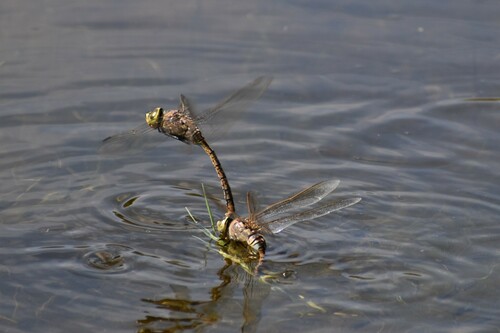
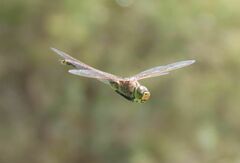
Global Distribution

Parks Where Found

# Park Country Daily sighting probability
1 Hattah-Kulkyne National Park 🇦🇺 Australia
~20%
2 Grampians National Park 🇦🇺 Australia
~10%
3 Ningaloo Marine Park 🇦🇺 Australia
~10%
4 Great Otway National Park 🇦🇺 Australia
~10%
5 Lamington National Park 🇦🇺 Australia
~10%
6 Blue Mountains National Park 🇦🇺 Australia
~10%
7 Royal National Park 🇦🇺 Australia
~10%
8 Springbrook National Park 🇦🇺 Australia
~10%

Cities Where Found

# City Country Daily sighting probability
1 Perth 🇦🇺 Australia
~20%
2 Melbourne 🇦🇺 Australia
~10%
3 Brisbane 🇦🇺 Australia
~10%
4 Sydney 🇦🇺 Australia
~10%
5 Auckland 🇳🇿 New Zealand
<5%

Before you go

What are the chances of seeing an Australian Emperor in Ningaloo Marine Park?

With luck

About 10% of wildlife watchers report an Australian Emperor sighting in Ningaloo Marine Park on a given day, based on 6 verified sightings from GBIF citizen-science data from 2019 to 2026. It is the 8th most-seen of the 13 insects we can rate there. Over three days the chance rises to about 30%, and over a week to about 60%, if each day is a fresh chance.

When is the best time to see an Australian Emperor in Ningaloo Marine Park?

May

In that month about 30% of wildlife watchers report an Australian Emperor in Ningaloo Marine Park on a given day, against under 5% in August to April, the lowest months. That is one of Ningaloo Marine Park's wettest months, with about 30 mm of rain against almost none in October.

What time of day is best to see an Australian Emperor?

Between 10 am and 1 pm

Across all the parks we cover, that three-hour window holds the most Australian Emperor sightings with a recorded time, and about 9 in 10 of them come between 6 am and 6 pm: it is a daytime animal.

Is Ningaloo Marine Park the best place to see an Australian Emperor?

3rd of 8

Of the 8 parks where we can rate Australian Emperor sightings, Ningaloo Marine Park ranks 3rd at about 10%. The best odds are in Hattah-Kulkyne National Park (Australia, about 20%) and Grampians National Park (Australia, about 10%).

Where does the Australian Emperor sighting chance come from?

GBIF citizen-science records

It is estimated from how often the Australian Emperor is recorded against all the insects logged in Ningaloo Marine Park (6 verified sightings from 2019 to 2026), calibrated against known sighting rates. Figures are rounded to the nearest 10% because citizen-science data supports honest approximations, not decimals, and months with records from fewer than five people show "—". How it works.

← Back to Ningaloo Marine Park