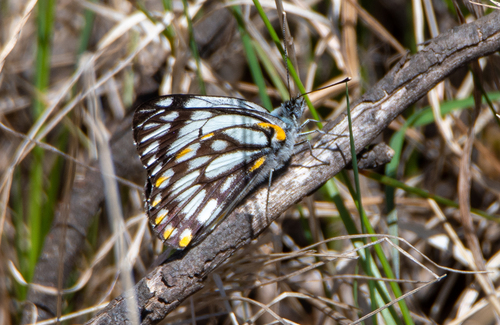
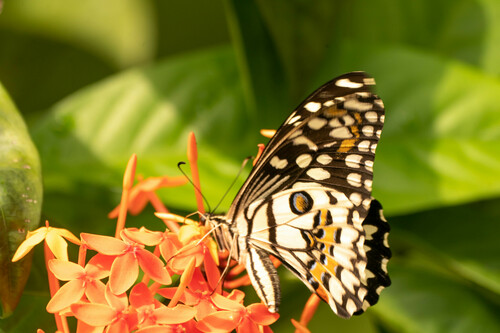

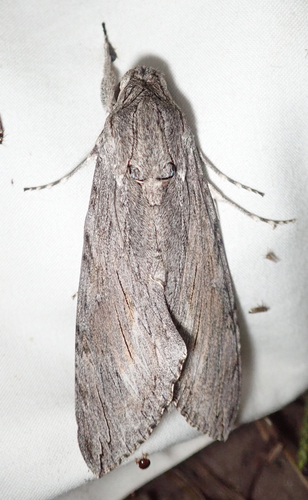
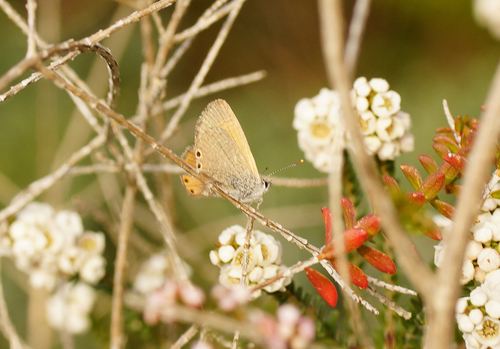
Southern Moon Moth

Southern Moon Moth

Dasypodia selenophora

Daily sighting probability ~10% · With luck
at Ningaloo Marine Park

In 3 days ~40% in a week ~60%

7 Verified sightings at Ningaloo Marine Park From 2019 to 2026
139 In all 9 parks
May Best month
☀️🌙 Day & Night When it's spotted

About the Southern Moon Moth

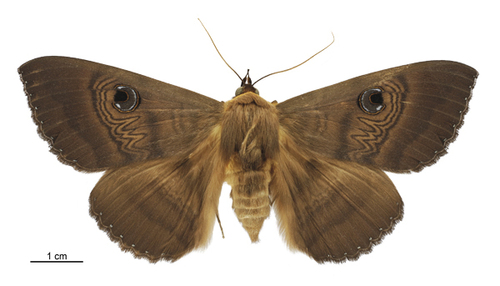
Dasypodia selenophora, the southern old lady moth, southern moon moth, or granny moth, is a moth of the family Noctuidae. The species was first described by Achille Guenée in 1852. It is found in the southern half of Australia, as well as Norfolk Island, New Zealand and Macquarie Island.

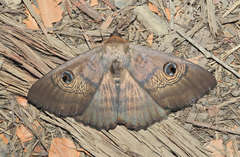
The adult may be a range of brown shades, with large black and blue eyespots on the centre of the forewings. The body is hairy. The wingspan is about 90 mm. The southern old lady moth is commonly observed during the day in dark areas of homes and other buildings.

The larvae have long brown stripes along the body and short stiff hairs. They feed on Acacia species, including Tan Wattle (Acacia decurrens), Cootamundra Wattle (Acacia baileyana), Golden Wattle (Acacia pycnantha), and Silver Wattle (Acacia dealbata). Wikipedia →

Global Distribution

Parks Where Found

# Park Country Daily sighting probability
1 Uluru-Kata Tjuta National Park 🇦🇺 Australia
~20%
2 Grampians National Park 🇦🇺 Australia
~20%
3 Flinders Ranges National Park 🇦🇺 Australia
~20%
4 Kosciuszko National Park 🇦🇺 Australia
~20%
5 Great Otway National Park 🇦🇺 Australia
~20%
6 Ningaloo Marine Park 🇦🇺 Australia
~10%
7 Hattah-Kulkyne National Park 🇦🇺 Australia
~10%
8 Booderee National Park 🇦🇺 Australia
~10%
9 Blue Mountains National Park 🇦🇺 Australia
~10%

Cities Where Found

# City Country Daily sighting probability
1 Perth 🇦🇺 Australia
~20%
2 Melbourne 🇦🇺 Australia
~10%
3 Sydney 🇦🇺 Australia
~10%
4 Auckland 🇳🇿 New Zealand
<5%

Before you go

What are the chances of seeing a Southern Moon Moth in Ningaloo Marine Park?

With luck

About 10% of wildlife watchers report a Southern Moon Moth sighting in Ningaloo Marine Park on a given day, based on 7 verified sightings from GBIF citizen-science data from 2019 to 2026. It is the 4th most-seen of the 13 insects we can rate there. Over three days the chance rises to about 40%, and over a week to about 60%, if each day is a fresh chance.

When is the best time to see a Southern Moon Moth in Ningaloo Marine Park?

May

In that month about 30% of wildlife watchers report a Southern Moon Moth in Ningaloo Marine Park on a given day, against under 5% in August to March, the lowest months. That is one of Ningaloo Marine Park's wettest months, with about 30 mm of rain against almost none in October.

What time of day is best to see a Southern Moon Moth?

Between 10 am and 1 pm

Across all the parks we cover, that three-hour window holds the most Southern Moon Moth sightings with a recorded time, and about 7 in 10 of them come between 6 am and 6 pm: it is seen both by day and at night.

Which relatives of the Southern Moon Moth live in Ningaloo Marine Park?

Same order: Lepidoptera

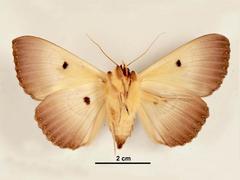
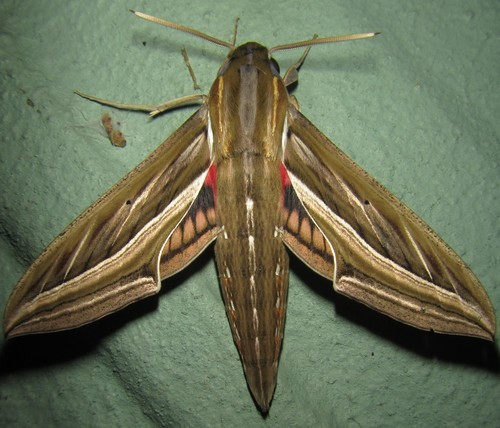
The closest relatives of the Southern Moon Moth that you can see in Ningaloo Marine Park (order Lepidoptera, Butterflies and Moths) are Vine Hawkmoth (about 30%), Caper White (about 20%) and Lime Swallowtail (about 20%), with each one's daily chance of a sighting.

Where does the Southern Moon Moth sighting chance come from?

GBIF citizen-science records

It is estimated from how often the Southern Moon Moth is recorded against all the insects logged in Ningaloo Marine Park (7 verified sightings from 2019 to 2026), calibrated against known sighting rates. Figures are rounded to the nearest 10% because citizen-science data supports honest approximations, not decimals, and months with records from fewer than five people show "—". How it works.

← Back to Ningaloo Marine Park