Purple-backed Fairywren

Purple-backed Fairywren

Malurus assimilis

Silhouette: Michael Scroggie · PhyloPic

LCLeast ConcernNTVUENCR Endemic
Daily sighting probability ~10% · With luck
at Ningaloo Marine Park

In 3 days ~20% in a week ~50%

39 Verified sightings at Ningaloo Marine Park From 2019 to 2026
581 In all 7 parks
May Best month
☀️ Diurnal When it's spotted

About the Purple-backed Fairywren

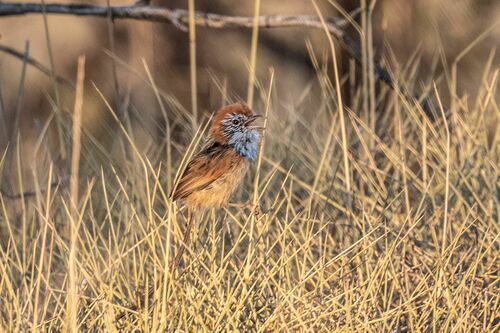
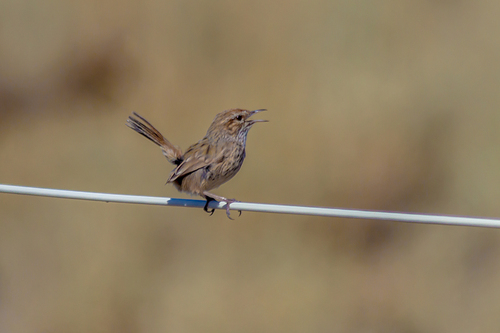
The purple-backed fairywren (Malurus assimilis) is a fairywren that is native to Australia. Described by Alfred John North in 1901, it has four recognised subspecies. In a species that exhibits sexual dimorphism, the brightly coloured breeding male has chestnut shoulders and azure crown and ear coverts, while non-breeding males, females and juveniles have predominantly grey-brown plumage, although females of two subspecies have mainly blue-grey plumage. Distributed over much of the Australian continent, the purple-backed fairywren is found in scrubland with plenty of vegetation providing dense cover.

Australian ornithologist Alfred John North described the purple-backed fairywren in 1901, proposing it be called the purple-backed superb warbler. He added that Edward Pierson Ramsay had noted that inland specimens differed from coastal specimens of the variegated fairywren around 25 years previously. However, Australian amateur ornithologist Gregory Mathews considered it a subspecies of the variegated fairywren.

Mathews went on to name subspecies mastersi from the Northern Territory on the basis of a paler blue colouring of the adult male's ear coverts, subspecies... Wikipedia →

Sounds

Call0:44

Australia · 2024

© Khristos Nizamis · XC918873 · CC BY-NC-ND 4.0

Song and call1:13

Australia · 2023

© Peter Boesman · XC859922 · CC BY-NC-ND 4.0

Song0:21

Australia · 2021

© Marc Anderson · XC687895 · CC BY-NC-ND 4.0

Global Distribution

Parks Where Found

# Park Country Daily sighting probability
1 Flinders Ranges National Park 🇦🇺 Australia
~40%
2 Uluru-Kata Tjuta National Park 🇦🇺 Australia
~30%
3 Ningaloo Marine Park 🇦🇺 Australia
~10%
4 Hattah-Kulkyne National Park 🇦🇺 Australia
~10%
5 Cape Range 🇦🇺 Australia
~10%
6 Kakadu National Park 🇦🇺 Australia
<5%
7 Nitmiluk National Park 🇦🇺 Australia
<5%

Cities Where Found

# City Country Daily sighting probability
1 Perth 🇦🇺 Australia
~10%

Zoos & Centres Where Found

# Zoo / Centre Country
1 Alice Springs Desert Park 🇦🇺 Australia In captivity

Before you go

What are the chances of seeing a Purple-backed Fairywren in Ningaloo Marine Park?

With luck

About 10% of wildlife watchers report a Purple-backed Fairywren sighting in Ningaloo Marine Park on a given day, based on 39 verified sightings from GBIF citizen-science data from 2019 to 2026. It is the 60th most-seen of the 102 birds we can rate there. Over three days the chance rises to about 20%, and over a week to about 50%, if each day is a fresh chance.

When is the best time to see a Purple-backed Fairywren in Ningaloo Marine Park?

May

In that month about 20% of wildlife watchers report a Purple-backed Fairywren in Ningaloo Marine Park on a given day, against under 5% in March and October, the lowest months. That is one of Ningaloo Marine Park's wettest months, with about 30 mm of rain against almost none in October.

What time of day is best to see a Purple-backed Fairywren?

Between 1 and 4 pm

Across all the parks we cover, that three-hour window holds the most Purple-backed Fairywren sightings with a recorded time, and about 9 in 10 of them come between 6 am and 6 pm: it is a daytime animal.

Is Ningaloo Marine Park the best place to see a Purple-backed Fairywren?

3rd of 7

Of the 7 parks where we can rate Purple-backed Fairywren sightings, Ningaloo Marine Park ranks 3rd at about 10%. The best odds are in Flinders Ranges National Park (Australia, about 40%) and Uluru-Kata Tjuta National Park (Australia, about 30%).

Where does the Purple-backed Fairywren sighting chance come from?

GBIF citizen-science records

It is estimated from how often the Purple-backed Fairywren is recorded against all the birds logged in Ningaloo Marine Park (39 verified sightings from 2019 to 2026), calibrated against known sighting rates. Figures are rounded to the nearest 10% because citizen-science data supports honest approximations, not decimals, and months with records from fewer than five people show "—". How it works.

← Back to Ningaloo Marine Park