
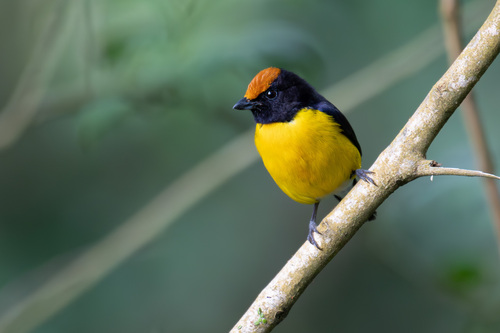
Golden-browed Chlorophonia

Golden-browed Chlorophonia

Chlorophonia callophrys

Silhouette: Sheatherius · PhyloPic

LCLeast ConcernNTVUENCR
Daily sighting probability ~10% · With luck
at Poás Volcano National Park

In 3 days ~30% in a week ~50%

330 Verified sightings at Poás Volcano National Park From 2019 to 2026
15,094 In all 12 parks
October Best month
☀️ Diurnal When it's spotted

About the Golden-browed Chlorophonia

The golden-browed chlorophonia (Chlorophonia callophrys) is a species of bird in the family Fringillidae, the finches and euphonias. It is found in Costa Rica and Panama. The golden-browed chlorophonia was originally described by Jean Cabanis in 1861 with the binomial Triglyphidia callophrys. Cabanis stated that the genus Triglyphidia "probably means 'with three small notches' ".

The golden-browed chlorophonia and the blue-crowned chlorophonia (Chlorophonia occipitalis) were for a time treated as conspecific and now form a superspecies. The genus Chlorophonia was long placed in the family Thraupidae, the "true" tanagers. Multiple studies in the late twentieth and early twenty-first centuries resulted in its being reassigned to its present place in the family Fringillidae.

The golden-browed chlorophonia is monotypic. The blue-crowned chlorophonia is a chunky, short-tailed, stubby-billed bird. It is about 13 cm (5.1 in) long and weighs about 24 g (0.85 oz). The species is sexually dimorphic. Adult males have pale violet-blue crown and nape, under the crown a golden-yellow forehead and wide supercilium, and a turquoise eye-ring. The rest... Wikipedia →

Sounds

Call0:32

Panama · 2015

© Peter Boesman · XC271154 · CC BY-NC-ND 4.0

Song0:25

Costa Rica · 2024

© Paul Driver · XC955618 · CC BY-NC-SA 4.0

Call0:15

Costa Rica · 2022

© Jerome Fischer · XC714790 · CC BY-NC-SA 4.0

Global Distribution

Parks Where Found

# Park Country Daily sighting probability
1 Los Quetzales National Park 🇨🇷 Costa Rica
~40%
2 Monteverde Cloud Forest Reserve 🇨🇷 Costa Rica
~40%
3 Tapantí-Macizo de la Muerte National Park 🇨🇷 Costa Rica
~30%
4 Volcán Barú National Park 🇵🇦 Panama
~30%
5 Braulio Carrillo National Park 🇨🇷 Costa Rica
~10%
6 La Amistad International Park (Panama) 🇵🇦 Panama
~10%
7 Poás Volcano National Park 🇨🇷 Costa Rica
~10%
8 Irazú Volcano National Park 🇨🇷 Costa Rica
~10%
9 Chirripó National Park 🇨🇷 Costa Rica
~10%
10 Arenal Volcano National Park 🇨🇷 Costa Rica
<5%
11 Tenorio Volcano National Park 🇨🇷 Costa Rica
<5%
12 Rincón de la Vieja National Park 🇨🇷 Costa Rica
<5%

Cities Where Found

# City Country Daily sighting probability
1 San José 🇨🇷 Costa Rica
<5%

Before you go

What are the chances of seeing a Golden-browed Chlorophonia in Poás Volcano National Park?

With luck

About 10% of wildlife watchers report a Golden-browed Chlorophonia sighting in Poás Volcano National Park on a given day, based on 330 verified sightings from GBIF citizen-science data from 2019 to 2026. It is the 66th most-seen of the 356 birds we can rate there. Over three days the chance rises to about 30%, and over a week to about 50%, if each day is a fresh chance.

When is the best time to see a Golden-browed Chlorophonia in Poás Volcano National Park?

May and October

In those months about 20% of wildlife watchers report a Golden-browed Chlorophonia in Poás Volcano National Park on a given day, against about 10% in June–September and November–April, the lowest months.

What time of day is best to see a Golden-browed Chlorophonia?

Between 9 am and noon

Across all the parks we cover, that three-hour window holds the most Golden-browed Chlorophonia sightings with a recorded time, and about 9 in 10 of them come between 6 am and 6 pm: it is a daytime animal.

Where does the Golden-browed Chlorophonia sighting chance come from?

GBIF citizen-science records

It is estimated from how often the Golden-browed Chlorophonia is recorded against all the birds logged in Poás Volcano National Park (330 verified sightings from 2019 to 2026), calibrated against known sighting rates. Figures are rounded to the nearest 10% because citizen-science data supports honest approximations, not decimals, and months with records from fewer than five people show "—". How it works.

← Back to Poás Volcano National Park