
Yellow-crowned Euphonia

Yellow-crowned Euphonia

Euphonia luteicapilla

Silhouette: Sheatherius · PhyloPic

LCLeast ConcernNTVUENCR
Daily sighting probability <5% · Rare
at Poás Volcano National Park

In 3 days <5% in a week ~10%

52 Verified sightings at Poás Volcano National Park From 2019 to 2026
14,381 In all 26 parks
October Best month
☀️ Diurnal When it's spotted

About the Yellow-crowned Euphonia

The yellow-crowned euphonia (Euphonia luteicapilla) is a species of bird in the family Fringillidae, the finches and euphonias. It is found in Costa Rica, Nicaragua, and Panama. The yellow-crowned euphonia was originally described in 1861 with the binomial Phonasca luteicapilla. It was eventually reassigned to genus Euphonia. The genus Euphonia had long placed in the family Thraupidae, the "true" tanagers. Multiple studies in the late twentieth and early twenty-first centuries resulted in its being reassigned to its present place in the family Fringillidae.

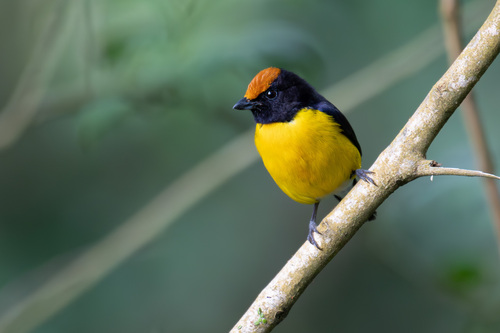
The yellow-crowned euphonia is monotypic. The yellow-crowned euphonia is about 9 to 10 cm (3.5 to 3.9 in) long and weighs 11.4 to 14.5 g (0.40 to 0.51 oz). It has a short stubby bill. The species is sexually dimorphic. Adult males have a large yellow forecrown and crown; the color extends well past the eye. The rest of their head, nape, and throat are glossy blue-black. Their upperparts, wings, and tail are also glossy blue-black. Their breast, belly, and undertail coverts are bright yellow. Adult females have an olive head, upperparts, wings, and tail with a yellowish tinge on the... Wikipedia →

Sounds

Song0:45

Costa Rica · 2024

© Johan Chaves · XC944740 · CC BY-NC-SA 4.0

Call0:31

Costa Rica · 2019

© GABRIEL LEITE · XC489538 · CC BY-NC-SA 4.0

Song0:06

Costa Rica · 2017

© Will Sweet · XC453871 · CC BY-NC-SA 4.0

Global Distribution

Parks Where Found

# Park Country Daily sighting probability
1 Chagres National Park 🇵🇦 Panama
~30%
2 Monteverde Cloud Forest Reserve 🇨🇷 Costa Rica
~30%
3 Braulio Carrillo National Park 🇨🇷 Costa Rica
~20%
4 Gandoca-Manzanillo Wildlife Refuge 🇨🇷 Costa Rica
~20%
5 Chirripó National Park 🇨🇷 Costa Rica
~20%
6 San Lorenzo Protected Forest 🇵🇦 Panama
~20%
7 Cahuita National Park 🇨🇷 Costa Rica
~20%
8 Tenorio Volcano National Park 🇨🇷 Costa Rica
~20%
9 Manuel Antonio National Park 🇨🇷 Costa Rica
~20%
10 Parque Natural Metropolitano 🇵🇦 Panama
~20%
11 La Amistad International Park (Panama) 🇵🇦 Panama
~10%
12 Carara National Park 🇨🇷 Costa Rica
~10%
13 Marino Ballena National Park 🇨🇷 Costa Rica
~10%
14 Arenal Volcano National Park 🇨🇷 Costa Rica
~10%
15 Soberanía National Park 🇵🇦 Panama
~10%
16 Corcovado National Park 🇨🇷 Costa Rica
~10%
17 Rincón de la Vieja National Park 🇨🇷 Costa Rica
~10%
18 Piedras Blancas National Park 🇨🇷 Costa Rica
~10%
19 Bastimentos Island National Marine Park 🇵🇦 Panama
~10%
20 Santa Rosa National Park 🇨🇷 Costa Rica
<5%
21 Tortuguero National Park 🇨🇷 Costa Rica
<5%
22 Volcán Barú National Park 🇵🇦 Panama
<5%
23 Palo Verde National Park 🇨🇷 Costa Rica
<5%
24 Tapantí-Macizo de la Muerte National Park 🇨🇷 Costa Rica
<5%
25 Las Baulas Marine National Park 🇨🇷 Costa Rica
<5%
26 Poás Volcano National Park 🇨🇷 Costa Rica
<5%

Cities Where Found

# City Country Daily sighting probability
1 Panama City 🇵🇦 Panama
~10%
2 San José 🇨🇷 Costa Rica
<5%

Before you go

What are the chances of seeing a Yellow-crowned Euphonia in Poás Volcano National Park?

Rare

Under 5% of wildlife watchers report a Yellow-crowned Euphonia sighting in Poás Volcano National Park on a given day, based on 52 verified sightings from GBIF citizen-science data from 2019 to 2026. It is the 178th most-seen of the 356 birds we can rate there. Over three days the chance rises to under 5%, and over a week to about 10%, if each day is a fresh chance.

When is the best time to see a Yellow-crowned Euphonia in Poás Volcano National Park?

October

In that month about 10% of wildlife watchers report a Yellow-crowned Euphonia in Poás Volcano National Park on a given day, against under 5% in November to September, the lowest months. That is one of Poás Volcano National Park's wettest months, with about 440 mm of rain against 95 mm in March.

What time of day is best to see a Yellow-crowned Euphonia?

Between 7 and 10 am

Across all the parks we cover, that three-hour window holds the most Yellow-crowned Euphonia sightings with a recorded time, and about 9 in 10 of them come between 6 am and 6 pm: it is a daytime animal.

Where does the Yellow-crowned Euphonia sighting chance come from?

GBIF citizen-science records

It is estimated from how often the Yellow-crowned Euphonia is recorded against all the birds logged in Poás Volcano National Park (52 verified sightings from 2019 to 2026), calibrated against known sighting rates. Figures are rounded to the nearest 10% because citizen-science data supports honest approximations, not decimals, and months with records from fewer than five people show "—". How it works.

← Back to Poás Volcano National Park