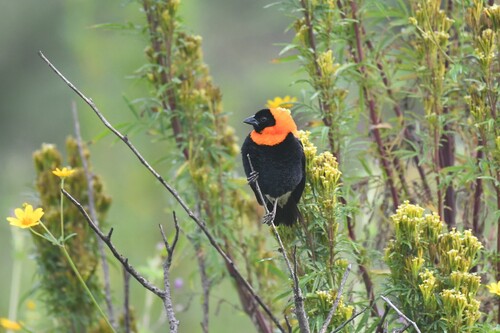
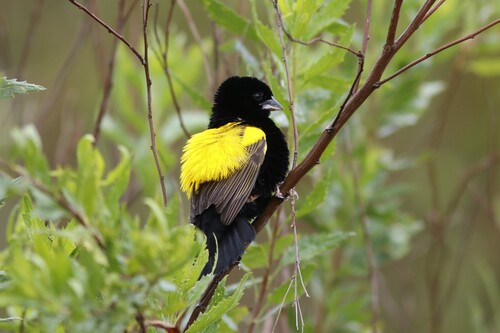
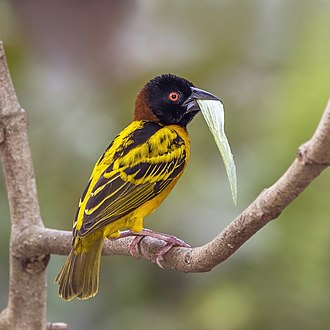
White-winged Widowbird

White-winged Widowbird

Euplectes albonotatus

Silhouette: Sheatherius · PhyloPic

LCLeast ConcernNTVUENCR
Daily sighting probability ~10% · With luck
at Queen Elizabeth National Park

In 3 days ~30% in a week ~50%

165 Verified sightings at Queen Elizabeth National Park From 2019 to 2026
3,512 In all 32 parks
December Best month
☀️ Diurnal When it's spotted

About the White-winged Widowbird

The white-winged widowbird (Euplectes albonotatus) is a species of passerine bird in the family Ploceidae native to Africa south of the Sahara. It is highly sexually dimorphic in its breeding season, during which the male's yellow plumage turns dark and he gains more white feathers, contrasting with the female's predominantly pale coloration. Three subspecies are recognised.

The white-winged widowbird was first described by the American ornithologist John Cassin in 1848. Hybrids with "red bishops", probably northern red bishop (E. franciscanus), have been reported in captivity. Non-captive interbreeding of race eques with nominate appears to occur in southern Tanzania, but they appear to stay segregated in Burundi and western Tanzania. A proposal has been made for race sassii, which is found along the northwestern shore of Lake Tanganyika. Alternate common names include: white-fronted/white-shouldered widowbird, white-winged/white-shouldered whydah, long-tailed black whydah. Wikipedia →

Sounds

Song0:09

South Africa · 2016

© Faansie Peacock · XC364551 · CC BY-NC-SA 4.0

Alarm call0:05

South Africa · 2020

© Tony Archer · XC533498 · CC BY-NC-SA 4.0

Call0:10

Tanzania · 2017

© Frank Lambert · XC430196 · CC BY-NC-ND 4.0

Global Distribution

Parks Where Found

# Park Country Daily sighting probability
1 Nairobi National Park 🇰🇪 Kenya
~30%
2 Mkomazi National Park 🇹🇿 Tanzania
~30%
3 uMkhuze Game Reserve 🇿🇦 South Africa
~20%
4 Tarangire National Park 🇹🇿 Tanzania
~20%
5 Tsavo West National Park 🇰🇪 Kenya
~10%
6 Akagera National Park 🇷🇼 Rwanda
~10%
7 Kruger National Park 🇿🇦 South Africa
~10%
8 Queen Elizabeth National Park 🇺🇬 Uganda
~10%
9 Serengeti National Park 🇹🇿 Tanzania
~10%
10 Pilanesberg National Park 🇿🇦 South Africa
~10%
11 Ruaha National Park 🇹🇿 Tanzania
~10%
12 Hluhluwe-Imfolozi Park 🇿🇦 South Africa
~10%
13 Tsavo East National Park 🇰🇪 Kenya
~10%
14 Samburu National Reserve 🇰🇪 Kenya
~10%
15 Gorongosa National Park 🇲🇿 Mozambique
~10%
16 Kidepo Valley National Park 🇺🇬 Uganda
~10%
17 Meru National Park 🇰🇪 Kenya
~10%
18 Amboseli National Park 🇰🇪 Kenya
~10%
19 Hwange National Park 🇿🇼 Zimbabwe
~10%
20 Kafue National Park 🇿🇲 Zambia
~10%
21 Masai Mara National Reserve 🇰🇪 Kenya
~10%
22 Gonarezhou National Park 🇿🇼 Zimbabwe
<5%
23 Mikumi National Park 🇹🇿 Tanzania
<5%
24 Lake Manyara National Park 🇹🇿 Tanzania
<5%
25 South Luangwa National Park 🇿🇲 Zambia
<5%
26 Ngorongoro Conservation Area 🇹🇿 Tanzania
<5%
27 Lake Mburo National Park 🇺🇬 Uganda
<5%
28 Mana Pools National Park 🇿🇼 Zimbabwe
<5%
29 Arusha National Park 🇹🇿 Tanzania
<5%
30 Lake Nakuru National Park 🇰🇪 Kenya
<5%
31 Chobe National Park 🇧🇼 Botswana
<5%
32 iSimangaliso Wetland Park 🇿🇦 South Africa
<5%

Cities Where Found

# City Country Daily sighting probability
1 Harare 🇿🇼 Zimbabwe
~10%
2 Pretoria 🇿🇦 South Africa
<5%
3 Nairobi 🇰🇪 Kenya
<5%

Before you go

What are the chances of seeing a White-winged Widowbird in Queen Elizabeth National Park?

With luck

About 10% of wildlife watchers report a White-winged Widowbird sighting in Queen Elizabeth National Park on a given day, based on 165 verified sightings from GBIF citizen-science data from 2019 to 2026. It is the 153rd most-seen of the 434 birds we can rate there. Over three days the chance rises to about 30%, and over a week to about 50%, if each day is a fresh chance.

When is the best time to see a White-winged Widowbird in Queen Elizabeth National Park?

November and December

In those months about 30% of wildlife watchers report a White-winged Widowbird in Queen Elizabeth National Park on a given day, against under 5% in February–June and October, the lowest months.

What time of day is best to see a White-winged Widowbird?

Between 7 and 10 am

Across all the parks we cover, that three-hour window holds the most White-winged Widowbird sightings with a recorded time, and about 9 in 10 of them come between 6 am and 6 pm: it is a daytime animal.

Is Queen Elizabeth National Park the best place to see a White-winged Widowbird?

8th of 32

Of the 32 parks where we can rate White-winged Widowbird sightings, Queen Elizabeth National Park ranks 8th at about 10%. The best odds are in Nairobi National Park (Kenya, about 30%), Mkomazi National Park (Tanzania, about 30%) and uMkhuze Game Reserve (South Africa, about 20%).

Which relatives of the White-winged Widowbird live in Queen Elizabeth National Park?

Same genus: Euplectes

The closest relatives of the White-winged Widowbird that you can see in Queen Elizabeth National Park (genus Euplectes, Bishops and Widowbirds) are Red Bishop (about 30%), Fan-tailed Widowbird (about 20%) and Red-collared Widowbird (about 10%), with each one's daily chance of a sighting.

Where does the White-winged Widowbird sighting chance come from?

GBIF citizen-science records

It is estimated from how often the White-winged Widowbird is recorded against all the birds logged in Queen Elizabeth National Park (165 verified sightings from 2019 to 2026), calibrated against known sighting rates. Figures are rounded to the nearest 10% because citizen-science data supports honest approximations, not decimals, and months with records from fewer than five people show "—". How it works.

← Back to Queen Elizabeth National Park