Brown-headed Barbet

Brown-headed Barbet

Psilopogon zeylanicus

Silhouette: Vijay Cavale (photo), John E. McCormack, Michael G. Harvey, Brant C. Faircloth, Nicholas G. Crawford, Travis C. Glenn, Robb T. Brumfield & T. Michael Keesey · PhyloPic

LCLeast ConcernNTVUENCR
Daily sighting probability <5% · Rare
at Ranthambore National Park

In 3 days ~10% in a week ~20%

40 Verified sightings at Ranthambore National Park From 2019 to 2026
19,923 In all 14 parks
March Best month
🌅 Crepuscular When it's spotted

About the Brown-headed Barbet

The brown-headed barbet (Psilopogon zeylanicus) is an Asian barbet species native to the Indian subcontinent, where it inhabits tropical and subtropical moist broadleaf forests. The brown-headed barbet was formally described in 1788 by the German naturalist Johann Friedrich Gmelin in his revised and expanded edition of Carl Linnaeus's Systema Naturae. He placed it with the puffbirds in the genus Bucco and coined the binomial name Bucco zeylanicus. Gmelin based his description on the "yellow cheeked barbet" that had been described and illustrated in 1776 by the naturalist Peter Brown from a specimen collected in Sri Lanka. The brown-headed barbet is now one of 32 barbets placed in the genus Psilopogon that was introduced in 1836 by Salomon Müller.

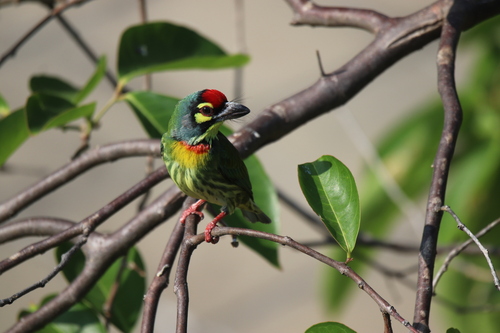
Three subspecies are recognised: Psilopogon zeylanicus inornatus (Walden, 1870) – west India Psilopogon zeylanicus caniceps (Franklin, 1831) – Nepal to central India Psilopogon zeylanicus zeylanicus (Gmelin, JF, 1788) – south India and Sri Lanka The adult has a streaked brown head, neck and breast, and a yellow eye patch. The rest of the plumage is green. It is 27 cm (11 in) long with a large head, short neck... Wikipedia →

Sounds

Call1:02

India · 2024

© Viral Patel &amp; Pankaj Maheria · XC1090891 · CC BY-NC-SA 4.0

Subsong0:11

India · 2026

© Ding Li Yong · XC1088162 · CC BY-NC-ND 4.0

Song0:35

India · 2023

© Sandeep Chakraborty · XC778576 · CC BY-NC-SA 4.0

Global Distribution

Parks Where Found

# Park Country Daily sighting probability
1 Kanha National Park 🇮🇳 India
~70%
2 Minneriya National Park 🇱🇰 Sri Lanka
~70%
3 Wilpattu National Park 🇱🇰 Sri Lanka
~60%
4 Udawalawe National Park 🇱🇰 Sri Lanka
~60%
5 Bandhavgarh National Park 🇮🇳 India
~50%
6 Yala National Park 🇱🇰 Sri Lanka
~50%
7 Royal Bardia National Park 🇳🇵 Nepal
~40%
8 Satpura National Park 🇮🇳 India
~40%
9 Keoladeo National Park 🇮🇳 India
~30%
10 Sinharaja Forest Reserve 🇱🇰 Sri Lanka
~20%
11 Jim Corbett National Park 🇮🇳 India
~20%
12 Ranthambore National Park 🇮🇳 India
<5%
13 Chitwan National Park 🇳🇵 Nepal
<5%
14 Bandipur National Park 🇮🇳 India
<5%

Cities Where Found

# City Country Daily sighting probability
1 Bhubaneshwar 🇮🇳 India
~70%
2 Colombo [Sri Jayawardenepura Kotte] 🇱🇰 Sri Lanka
~70%
3 Bareilly 🇮🇳 India
~60%
4 New Delhi 🇮🇳 India
~60%
5 Aligarh 🇮🇳 India
~60%
6 Chandigarh 🇮🇳 India
~50%
7 Varanasi 🇮🇳 India
~50%
8 Patna 🇮🇳 India
~50%
9 Dehradun 🇮🇳 India
~50%
10 Gwalior 🇮🇳 India
~40%

Before you go

What are the chances of seeing a Brown-headed Barbet in Ranthambore National Park?

Rare

Under 5% of wildlife watchers report a Brown-headed Barbet sighting in Ranthambore National Park on a given day, based on 40 verified sightings from GBIF citizen-science data from 2019 to 2026. It is the 167th most-seen of the 251 birds we can rate there. Over three days the chance rises to about 10%, and over a week to about 20%, if each day is a fresh chance.

When is the best time to see a Brown-headed Barbet in Ranthambore National Park?

March, May, August and December

In those months about 10% of wildlife watchers report a Brown-headed Barbet in Ranthambore National Park on a given day, against under 5% in January–February, April, June–July and September–November, the lowest months.

What time of day is best to see a Brown-headed Barbet?

Between 3 and 6 am

Across all the parks we cover, that three-hour window holds the most Brown-headed Barbet sightings with a recorded time, and about half of them come between 6 pm and 6 am: it is most active around dawn and dusk.

Where does the Brown-headed Barbet sighting chance come from?

GBIF citizen-science records

It is estimated from how often the Brown-headed Barbet is recorded against all the birds logged in Ranthambore National Park (40 verified sightings from 2019 to 2026), calibrated against known sighting rates. Figures are rounded to the nearest 10% because citizen-science data supports honest approximations, not decimals, and months with records from fewer than five people show "—". How it works.

← Back to Ranthambore National Park