

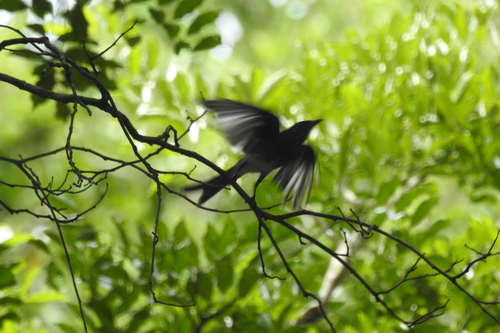
White-browed Bulbul

White-browed Bulbul

Pycnonotus luteolus

Silhouette: Andy Wilson · PhyloPic

LCLeast ConcernNTVUENCR
Daily sighting probability <5% · Rare
at Satpura National Park

In 3 days ~10% in a week ~20%

30 Verified sightings at Satpura National Park From 2019 to 2026
2,543 In all 14 parks
April Best month
🌅 Crepuscular When it's spotted

About the White-browed Bulbul

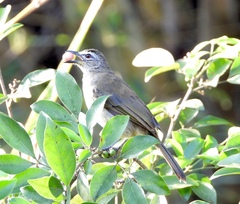
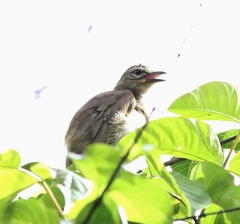
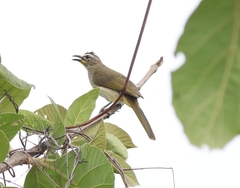
The white-browed bulbul (Pycnonotus luteolus) is a member of the bulbul family of passerine birds. It is a resident breeder in Sri Lanka and peninsular India. Largely olive coloured above with whitish underparts, it has a pale supercilium and a yellow vent. They are found in dense scrub habitats, where they skulk within vegetation and can be difficult to see although their loud and distinct burst of calls is distinctive.

It has olive-grey upperparts and whitish underparts. This species is identifiable by the white supercilium, white crescent below the eye, and dark eyestripe and moustachial stripe. The vent is yellowish and there is some yellow on the chin and moustache. The throat is, however, largely whitish unlike in the similar looking and sounding yellow-throated bulbul, which is found in rockier habitats. Three or four hair-like filoplumes are... Wikipedia →

Sounds

Call0:39

India · 2022

© Sathyan Meppayur · XC741608 · CC BY-NC-SA 4.0

Uncertain0:19

India · 2019

© Sandip das · XC633433 · CC BY-NC-SA 4.0

Song0:13

Sri Lanka · 2015

© Simon Elliott · XC595464 · CC BY-NC-ND 4.0

Global Distribution

Parks Where Found

# Park Country Daily sighting probability
1 Yala National Park 🇱🇰 Sri Lanka
~50%
2 Wilpattu National Park 🇱🇰 Sri Lanka
~50%
3 Minneriya National Park 🇱🇰 Sri Lanka
~40%
4 Udawalawe National Park 🇱🇰 Sri Lanka
~30%
5 Sinharaja Forest Reserve 🇱🇰 Sri Lanka
~30%
6 Bandipur National Park 🇮🇳 India
~20%
7 Mudumalai National Park 🇮🇳 India
~20%
8 Nagarhole National Park 🇮🇳 India
~10%
9 Satpura National Park 🇮🇳 India
<5%
10 Eravikulam National Park 🇮🇳 India
<5%
11 Bandhavgarh National Park 🇮🇳 India
<5%
12 Kanha National Park 🇮🇳 India
<5%
13 Horton Plains National Park 🇱🇰 Sri Lanka
<5%
14 Periyar National Park 🇮🇳 India
<5%

Cities Where Found

# City Country Daily sighting probability
1 Thrissur 🇮🇳 India
~50%
2 Mysuru 🇮🇳 India
~30%
3 Bhubaneshwar 🇮🇳 India
~20%
4 Bengaluru 🇮🇳 India
~20%
5 Chennai 🇮🇳 India
~20%
6 Colombo [Sri Jayawardenepura Kotte] 🇱🇰 Sri Lanka
~10%
7 Vasai-Virar 🇮🇳 India
~10%
8 Puducherry 🇮🇳 India
~10%
9 Nagpur 🇮🇳 India
~10%
10 Mumbai 🇮🇳 India
~10%

Before you go

What are the chances of seeing a White-browed Bulbul in Satpura National Park?

Rare

Under 5% of wildlife watchers report a White-browed Bulbul sighting in Satpura National Park on a given day, based on 30 verified sightings from GBIF citizen-science data from 2019 to 2026. It is the 176th most-seen of the 259 birds we can rate there. Over three days the chance rises to about 10%, and over a week to about 20%, if each day is a fresh chance.

When is the best time to see a White-browed Bulbul in Satpura National Park?

April, June and November–December

In those months about 10% of wildlife watchers report a White-browed Bulbul in Satpura National Park on a given day, against under 5% in January–March, May and July–October, the lowest months. Those are among Satpura National Park's driest months, with about 60 mm of rain a month against 690 mm in July.

What time of day is best to see a White-browed Bulbul?

Between 3 and 6 am

Across all the parks we cover, that three-hour window holds the most White-browed Bulbul sightings with a recorded time, and about 6 in 10 of them come between 6 pm and 6 am: it is most active around dawn and dusk.

Where does the White-browed Bulbul sighting chance come from?

GBIF citizen-science records

It is estimated from how often the White-browed Bulbul is recorded against all the birds logged in Satpura National Park (30 verified sightings from 2019 to 2026), calibrated against known sighting rates. Figures are rounded to the nearest 10% because citizen-science data supports honest approximations, not decimals, and months with records from fewer than five people show "—". How it works.

← Back to Satpura National Park