Cassin's Vireo

Cassin's Vireo

Vireo cassinii

Silhouette: Caleb Gordon · PhyloPic

LCLeast ConcernNTVUENCR
Daily sighting probability ~10% · With luck
at Sequoia and Kings Canyon National Parks

In 3 days ~20% in a week ~40%

124 Verified sightings at Sequoia and Kings Canyon National Parks From 2019 to 2026
2,510 In all 19 parks
August Best month
☀️ Diurnal When it's spotted

About the Cassin's Vireo

Cassin's vireo (Vireo cassinii) is a small North American songbird, ranging from southern British Columbia in Canada through the western coastal states of the United States, including California, Oregon, and Washington. The Cassin's Vireo moves down Western United States forests in its migration. During its migration in early spring and late fall, it spends the winter in regions from southern Arizona (the Sonoran Desert) to southern Mexico, including parts of Baja California and the Pacific coast of Mexico.

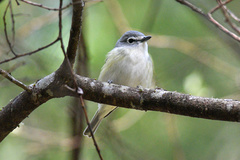
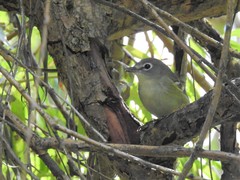
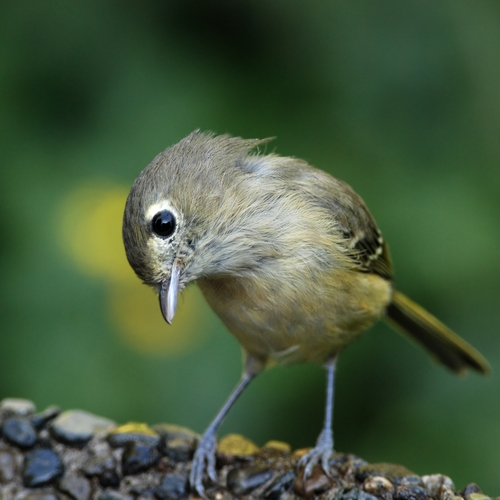
The vireo is 11–14 cm (4–6 inches) long. It has a grayish olive head, back, and flanks, with whitish underparts. One of its distinctive features is the solid white "spectacles" around its eyes, along with white wing bars. These markings set it apart from other similar species like the plumbeous vireo and the blue-headed vireo.

Cassin's vireo is known for its persistent song, which consists of short, rough-whistled phrases of several notes.These phrases are 2 seconds apart and often alternate between ending on high and low notes, creating a "question-and-answer" pattern. The Cassin's Vireo is known to sing for an extensive duration of time. Hearing... Wikipedia →

Sounds

Song0:31

United States · 2026

© Scott Olmstead · XC1080752 · CC BY-NC-SA 4.0

Call1:02

Canada · 2014

© Andrew Spencer · XC189308 · CC BY-NC-SA 4.0

Duet1:25

Mexico · 2006

© Richard E Webster · XC72262 · CC BY-NC-ND 2.5

Global Distribution

Parks Where Found

# Park Country Daily sighting probability
1 Yosemite National Park 🇺🇸 United States
~30%
2 Glacier National Park 🇺🇸 United States
~20%
3 Jasper National Park 🇨🇦 Canada
~10%
4 Sequoia and Kings Canyon National Parks 🇺🇸 United States
~10%
5 Banff National Park 🇨🇦 Canada
<5%
6 Death Valley National Park 🇺🇸 United States
<5%
7 Zion National Park 🇺🇸 United States
<5%
8 Big Bend National Park 🇺🇸 United States
<5%
9 Cumbres de Monterrey National Park 🇲🇽 Mexico
<5%
10 Saguaro National Park 🇺🇸 United States
<5%
11 Guadalupe Mountains National Park 🇺🇸 United States
<5%
12 Redwood National Park 🇺🇸 United States
<5%
13 Grand Canyon National Park 🇺🇸 United States
<5%
14 Joshua Tree National Park 🇺🇸 United States
<5%
15 Great Bear Rainforest 🇨🇦 Canada
<5%
16 Olympic National Park 🇺🇸 United States
<5%
17 Grand Teton National Park 🇺🇸 United States
<5%
18 Rocky Mountain National Park 🇺🇸 United States
<5%
19 Channel Islands National Park 🇺🇸 United States
<5%

Cities Where Found

# City Country Daily sighting probability
1 Toluca 🇲🇽 México
~10%
2 Mexico City 🇲🇽 México
~10%
3 Guadalajara 🇲🇽 México
<5%
4 Puebla 🇲🇽 México
<5%
5 Sacramento 🇺🇸 United States
<5%
6 Monterrey 🇲🇽 México
<5%
7 Portland 🇺🇸 United States
<5%
8 Las Vegas 🇺🇸 United States
<5%
9 Mesa 🇺🇸 United States
<5%
10 Los Angeles 🇺🇸 United States
<5%

Before you go

What are the chances of seeing a Cassin's Vireo in Sequoia and Kings Canyon National Parks?

With luck

About 10% of wildlife watchers report a Cassin's Vireo sighting in Sequoia and Kings Canyon National Parks on a given day, based on 124 verified sightings from GBIF citizen-science data from 2019 to 2026. It is the 82nd most-seen of the 152 birds we can rate there. Over three days the chance rises to about 20%, and over a week to about 40%, if each day is a fresh chance.

When is the best time to see a Cassin's Vireo in Sequoia and Kings Canyon National Parks?

April to September

In those months about 10% of wildlife watchers report a Cassin's Vireo in Sequoia and Kings Canyon National Parks on a given day, against under 5% in October to March, the lowest months. Those are among Sequoia and Kings Canyon National Parks's driest months, with about 30 mm of rain a month against 190 mm in January.

What time of day is best to see a Cassin's Vireo?

Between 9 am and noon

Across all the parks we cover, that three-hour window holds the most Cassin's Vireo sightings with a recorded time, and about 9 in 10 of them come between 6 am and 6 pm: it is a daytime animal.

Is Sequoia and Kings Canyon National Parks the best place to see a Cassin's Vireo?

4th of 19

Of the 19 parks where we can rate Cassin's Vireo sightings, Sequoia and Kings Canyon National Parks ranks 4th at about 10%. The best odds are in Yosemite National Park (United States, about 30%), Glacier National Park (United States, about 20%) and Jasper National Park (Canada, about 10%).

Which relatives of the Cassin's Vireo live in Sequoia and Kings Canyon National Parks?

Same genus: Vireo

The closest relatives of the Cassin's Vireo that you can see in Sequoia and Kings Canyon National Parks (genus Vireo, Vireos) are Warbling Vireo (about 20%) and Hutton's Vireo (about 10%), with each one's daily chance of a sighting.

Where does the Cassin's Vireo sighting chance come from?

GBIF citizen-science records

It is estimated from how often the Cassin's Vireo is recorded against all the birds logged in Sequoia and Kings Canyon National Parks (124 verified sightings from 2019 to 2026), calibrated against known sighting rates. Figures are rounded to the nearest 10% because citizen-science data supports honest approximations, not decimals, and months with records from fewer than five people show "—". How it works.

← Back to Sequoia and Kings Canyon National Parks