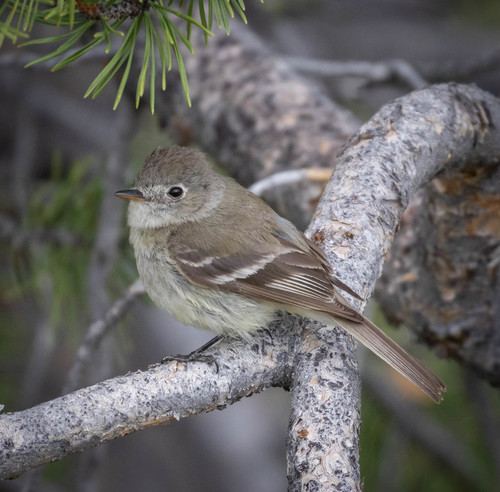
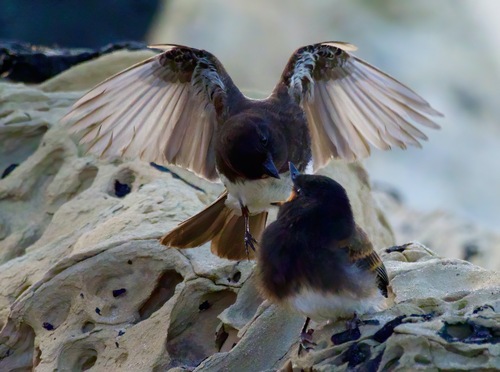
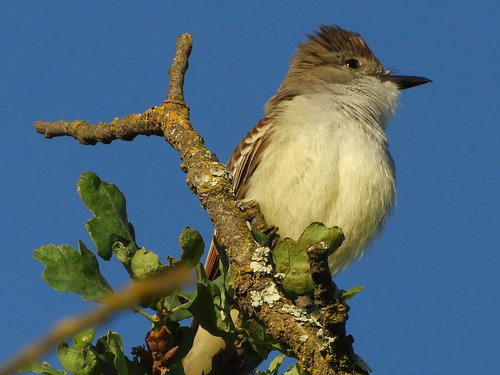
Pacific-slope Flycatcher

Pacific-slope Flycatcher

Empidonax difficilis

Silhouette: Emily Willoughby · PhyloPic

LCLeast ConcernNTVUENCR
Daily sighting probability ~20% · Possible
at Sequoia and Kings Canyon National Parks

In 3 days ~40% in a week ~70%

284 Verified sightings at Sequoia and Kings Canyon National Parks From 2019 to 2026
9,317 In all 25 parks
May Best month
☀️ Diurnal When it's spotted

About the Pacific-slope Flycatcher

The western flycatcher (Empidonax difficilis) is a small insectivorous bird in the family Tyrannidae. It is native to western North America, where it breeds in the Rocky Mountains and Pacific Coast forests and mountain ranges from California to Alaska and south to central Mexico; northern populations migrate south to Mexico for the winter.

The western flycatcher was recognized as a single species until 1989, when the American Ornithologists' Union split it into two different species: the Pacific-slope flycatcher (E. difficilis) of coastal western North America and parts of the western Rocky Mountains, and the Cordilleran flycatcher (E. occidentalis) of the interior Rocky Mountains, with both species wintering in Mexico. Both species looked virtually identical to one another, with the split being based on differing breeding habitats and apparent differences in songs and calls. The split was recognized until 2023, when the American Ornithologists' Union and International Ornithological Congress again lumped both species due to a lack of consistent vocal, genetic, morphological differences and extensive hybridization across much of their range.

There are... Wikipedia →

Sounds

Call0:51

Canada · 2024

© Brian Cox · XC939232 · CC BY-NC-SA 4.0

Song0:20

Canada · 2022

© Sunny Tseng · XC753150 · CC BY-NC-SA 4.0

Begging call0:52

United States · 2020

© Paul Marvin · XC581877 · CC BY-NC-SA 4.0

Global Distribution

Parks Where Found

# Park Country Daily sighting probability
1 Redwood National Park 🇺🇸 United States
~20%
2 Pacific Rim National Park Reserve 🇨🇦 Canada
~20%
3 Olympic National Park 🇺🇸 United States
~20%
4 Yosemite National Park 🇺🇸 United States
~20%
5 Great Bear Rainforest 🇨🇦 Canada
~20%
6 Rocky Mountain National Park 🇺🇸 United States
~20%
7 Sequoia and Kings Canyon National Parks 🇺🇸 United States
~20%
8 Reserva de la Biosfera Mariposa Monarca 🇲🇽 Mexico
~10%
9 Channel Islands National Park 🇺🇸 United States
~10%
10 Guadalupe Mountains National Park 🇺🇸 United States
~10%
11 Cabo Pulmo National Park 🇲🇽 Mexico
~10%
12 El Vizcaíno Biosphere Reserve 🇲🇽 Mexico
~10%
13 Glacier National Park 🇺🇸 United States
~10%
14 Big Bend National Park 🇺🇸 United States
~10%
15 Cumbres de Monterrey National Park 🇲🇽 Mexico
~10%
16 Zion National Park 🇺🇸 United States
~10%
17 Joshua Tree National Park 🇺🇸 United States
<5%
18 Jasper National Park 🇨🇦 Canada
<5%
19 Banff National Park 🇨🇦 Canada
<5%
20 Bahía de Loreto National Park 🇲🇽 Mexico
<5%
21 Death Valley National Park 🇺🇸 United States
<5%
22 Yellowstone National Park 🇺🇸 United States
<5%
23 Grand Teton National Park 🇺🇸 United States
<5%
24 Grand Canyon National Park 🇺🇸 United States
<5%
25 Saguaro National Park 🇺🇸 United States
<5%

Cities Where Found

# City Country Daily sighting probability
1 Tijuana 🇲🇽 México
~30%
2 Vancouver 🇨🇦 Canada
~10%
3 San Diego 🇺🇸 United States
~10%
4 Toluca 🇲🇽 México
~10%
5 Los Angeles 🇺🇸 United States
~10%
6 San Francisco 🇺🇸 United States
~10%
7 Seattle 🇺🇸 United States
~10%
8 Guadalajara 🇲🇽 México
<5%
9 Portland 🇺🇸 United States
<5%
10 Mexico City 🇲🇽 México
<5%

Before you go

What are the chances of seeing a Pacific-slope Flycatcher in Sequoia and Kings Canyon National Parks?

Possible

About 20% of wildlife watchers report a Pacific-slope Flycatcher sighting in Sequoia and Kings Canyon National Parks on a given day, based on 284 verified sightings from GBIF citizen-science data from 2019 to 2026. It is the 47th most-seen of the 152 birds we can rate there. Over three days the chance rises to about 40%, and over a week to about 70%, if each day is a fresh chance.

When is the best time to see a Pacific-slope Flycatcher in Sequoia and Kings Canyon National Parks?

May

In that month about 30% of wildlife watchers report a Pacific-slope Flycatcher in Sequoia and Kings Canyon National Parks on a given day, against under 5% in September to March, the lowest months.

What time of day is best to see a Pacific-slope Flycatcher?

Between 9 am and noon

Across all the parks we cover, that three-hour window holds the most Pacific-slope Flycatcher sightings with a recorded time, and about 9 in 10 of them come between 6 am and 6 pm: it is a daytime animal.

Is Sequoia and Kings Canyon National Parks the best place to see a Pacific-slope Flycatcher?

Among the best

Of the 25 parks where we can rate Pacific-slope Flycatcher sightings, Sequoia and Kings Canyon National Parks ranks 7th at about 20%, level with the leaders once rounded. The best odds are in Redwood National Park (United States, about 20%), Pacific Rim National Park Reserve (Canada, about 20%) and Olympic National Park (United States, about 20%).

Which relatives of the Pacific-slope Flycatcher live in Sequoia and Kings Canyon National Parks?

Same genus: Empidonax

The closest relatives of the Pacific-slope Flycatcher that you can see in Sequoia and Kings Canyon National Parks (genus Empidonax, Empidonax Flycatchers) are Dusky Flycatcher (about 20%) and Hammond's Flycatcher (about 10%), with each one's daily chance of a sighting.

Where does the Pacific-slope Flycatcher sighting chance come from?

GBIF citizen-science records

It is estimated from how often the Pacific-slope Flycatcher is recorded against all the birds logged in Sequoia and Kings Canyon National Parks (284 verified sightings from 2019 to 2026), calibrated against known sighting rates. Figures are rounded to the nearest 10% because citizen-science data supports honest approximations, not decimals, and months with records from fewer than five people show "—". How it works.

← Back to Sequoia and Kings Canyon National Parks