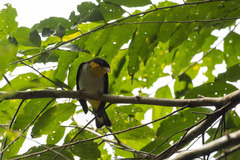
Yellow-backed Tanager

Yellow-backed Tanager

Hemithraupis flavicollis

Silhouette: Sheatherius · PhyloPic

LCLeast ConcernNTVUENCR
Daily sighting probability ~50% · Likely
at Serra dos Órgãos National Park

In 3 days ~90% in a week >90%

337 Verified sightings at Serra dos Órgãos National Park From 2019 to 2026
719 In all 8 parks
July Best month
☀️ Diurnal When it's spotted

About the Yellow-backed Tanager

The yellow-backed tanager (Hemithraupis flavicollis) is a species of bird in the family Thraupidae, the tanagers and allies. It is found in Panama and every mainland South American country except Argentina, Chile, Paraguay, and Uruguay.

The yellow-backed tanager was formally described in 1818 by Louis Pierre Vieillot with the binomial Nemosia flavicollis. By 1912 it had been reassigned to its current genus Hemithraupis. The genus name Hemithraupis combines the Ancient Greek words hēmi, meaning "half" or "small" and thraupis, which refers to an unidentified small bird mentioned by Aristotle. In ornithology, it is typically used to refer to tanagers. The specific epithet flavicollis is derived from Latin, meaning "yellow-necked".

The yellow-backed tanager has these 11 subspecies: The yellow-backed tanager is about 13 cm (5.1 in) long and weighs 11 to 15 g (0.39 to 0.53 oz). It is a smallish tanager with a relatively slender bill. The species is sexually dimorphic. Adult males of the nominate subspecies H. f. flavicollis have a mostly brownish black head and upper back. Their lower back and rump are bright yellow. Their uppertail coverts... Wikipedia →

Sounds

Call0:10

Brazil · 2025

© JAYRSON ARAUJO DE OLIVEIRA · XC995251 · CC BY-NC-SA 4.0

Song0:14

Ecuador · 1992

© John V. Moore · XC259556 · CC BY-NC-SA 4.0

Call0:32

Brazil · 2020

© Daniel Mello · XC588818 · CC BY-NC-ND 4.0

Global Distribution

Parks Where Found

# Park Country Daily sighting probability
1 Serra dos Órgãos National Park 🇧🇷 Brazil
~50%
2 Darién National Park 🇵🇦 Panama
~10%
3 Sierra de la Macarena National Park 🇨🇴 Colombia
~10%
4 Yasuní National Park 🇪🇨 Ecuador
<5%
5 Tijuca National Park 🇧🇷 Brazil
<5%
6 Tambopata National Reserve 🇵🇪 Peru
<5%
7 Anavilhanas National Park 🇧🇷 Brazil
<5%
8 Manu National Park 🇵🇪 Peru
<5%

Cities Where Found

# City Country Daily sighting probability
1 Niterói 🇧🇷 Brazil
<5%
2 Rio de Janeiro 🇧🇷 Brazil
<5%

Before you go

What are the chances of seeing a Yellow-backed Tanager in Serra dos Órgãos National Park?

Likely

About 50% of wildlife watchers report a Yellow-backed Tanager sighting in Serra dos Órgãos National Park on a given day, based on 337 verified sightings from GBIF citizen-science data from 2019 to 2026. It is the 27th most-seen of the 336 birds we can rate there. Over three days the chance rises to about 90%, and over a week to over 90%, if each day is a fresh chance.

When is the best time to see a Yellow-backed Tanager in Serra dos Órgãos National Park?

July

In that month about 80% of wildlife watchers report a Yellow-backed Tanager in Serra dos Órgãos National Park on a given day, against about 30% in November, the lowest month. That is one of Serra dos Órgãos National Park's driest months, with about 50 mm of rain against 310 mm in November.

What time of day is best to see a Yellow-backed Tanager?

Between 7 and 10 am

Across all the parks we cover, that three-hour window holds the most Yellow-backed Tanager sightings with a recorded time, and about 9 in 10 of them come between 6 am and 6 pm: it is a daytime animal.

Is Serra dos Órgãos National Park the best place to see a Yellow-backed Tanager?

Yes

Of the 8 parks where we can rate Yellow-backed Tanager sightings, Serra dos Órgãos National Park has the highest daily chance: about 50%. Next come Darién National Park (Panama, about 10%) and Sierra de la Macarena National Park (Colombia, about 10%).

Where does the Yellow-backed Tanager sighting chance come from?

GBIF citizen-science records

It is estimated from how often the Yellow-backed Tanager is recorded against all the birds logged in Serra dos Órgãos National Park (337 verified sightings from 2019 to 2026), calibrated against known sighting rates. Figures are rounded to the nearest 10% because citizen-science data supports honest approximations, not decimals, and months with records from fewer than five people show "—". How it works.

← Back to Serra dos Órgãos National Park