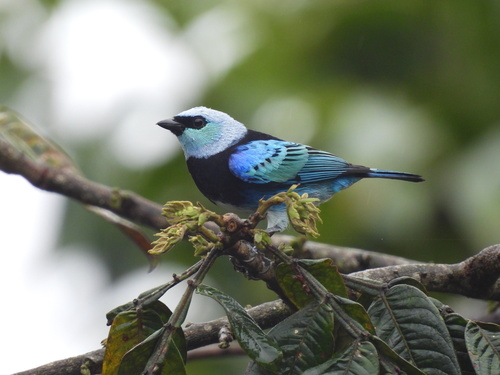
Purple Honeycreeper

Purple Honeycreeper

Cyanerpes caeruleus

Silhouette: Sheatherius · PhyloPic

LCLeast ConcernNTVUENCR
Daily sighting probability ~30% · Possible
at Sierra de la Macarena National Park

In 3 days ~70% in a week ~90%

374 Verified sightings at Sierra de la Macarena National Park From 2019 to 2026
2,267 In all 14 parks
August Best month
☀️ Diurnal When it's spotted

About the Purple Honeycreeper

The purple honeycreeper (Cyanerpes caeruleus) is a small Neotropical bird in the family Thraupidae, the tanagers and allies. It is found in Panama, on Trinidad, and in every mainland South American country except Argentina, Chile, Paraguay, and Uruguay.

The purple honeycreeper was formally described by the Swedish naturalist Carl Linnaeus in 1758 in the tenth edition of his Systema Naturae with the binomial Certhia caerulea. Linnaeus based his description on "The Blue Creeper" that had been described and illustrated in 1743 by the English naturalist George Edwards from specimens collected in Suriname. The specimens had been mounted in glass cases and were owned by the Duke of Richmond. The purple honeycreeper was reassigned to the genus Cyanerpes by the American ornithologist Harry C. Oberholser

when he erected the genus in 1899. The specific epithet caeruleus is Latin for "dark blue". The purple honeycreeper has these five subspecies: Wikipedia →

Sounds

Call0:23

Brazil · 2026

© JAYRSON ARAUJO DE OLIVEIRA · XC1183891 · CC BY-NC-SA 4.0

Song?1:29

Colombia · 2011

© Andrew Spencer · XC81831 · CC BY-NC-ND 2.5

Call1:03

Ecuador · 2025

© Manuel Sánchez-Nivicela · XC1104062 · CC BY-NC-ND 4.0

Global Distribution

Parks Where Found

# Park Country Daily sighting probability
1 Brownsberg Nature Park 🇸🇷 Suriname
~70%
2 Sierra de la Macarena National Park 🇨🇴 Colombia
~30%
3 Utría National Natural Park 🇨🇴 Colombia
~20%
4 Yasuní National Park 🇪🇨 Ecuador
~20%
5 Amacayacu National Natural Park 🇨🇴 Colombia
~20%
6 Manu National Park 🇵🇪 Peru
~10%
7 Cuyabeno Wildlife Reserve 🇪🇨 Ecuador
~10%
8 Henri Pittier National Park 🇻🇪 Venezuela
~10%
9 Farallones de Cali National Natural Park 🇨🇴 Colombia
~10%
10 Tambopata National Reserve 🇵🇪 Peru
<5%
11 Darién National Park 🇵🇦 Panama
<5%
12 Tayrona National Natural Park 🇨🇴 Colombia
<5%
13 Anavilhanas National Park 🇧🇷 Brazil
<5%
14 Chingaza National Natural Park 🇨🇴 Colombia
<5%

Cities Where Found

# City Country Daily sighting probability
1 Belém 🇧🇷 Brazil
<5%
2 Caracas 🇻🇪 Venezuela
<5%

Zoos & Centres Where Found

# Zoo / Centre Country
1 San Diego Zoo 🇺🇸 United States In captivity
2 San Diego Zoo Safari Park 🇺🇸 United States In captivity
3 Key West Butterfly and Nature Conservatory 🇺🇸 United States In captivity
4 Butterfly World 🇺🇸 United States In captivity

Before you go

What are the chances of seeing a Purple Honeycreeper in Sierra de la Macarena National Park?

Possible

About 30% of wildlife watchers report a Purple Honeycreeper sighting in Sierra de la Macarena National Park on a given day, based on 374 verified sightings from GBIF citizen-science data from 2019 to 2026. It is the 19th most-seen of the 418 birds we can rate there. Over three days the chance rises to about 70%, and over a week to about 90%, if each day is a fresh chance.

When is the best time to see a Purple Honeycreeper in Sierra de la Macarena National Park?

August

In that month about 60% of wildlife watchers report a Purple Honeycreeper in Sierra de la Macarena National Park on a given day, against about 20% in February–March, July, September and November–December, the lowest months.

What time of day is best to see a Purple Honeycreeper?

Between 10 am and 1 pm

Across all the parks we cover, that three-hour window holds the most Purple Honeycreeper sightings with a recorded time, and about 9 in 10 of them come between 6 am and 6 pm: it is a daytime animal.

Is Sierra de la Macarena National Park the best place to see a Purple Honeycreeper?

2nd of 14

Of the 14 parks where we can rate Purple Honeycreeper sightings, Sierra de la Macarena National Park ranks 2nd at about 30%. The best odds are in Brownsberg Nature Park (Suriname, about 70%). All parks ranked.

Where does the Purple Honeycreeper sighting chance come from?

GBIF citizen-science records

It is estimated from how often the Purple Honeycreeper is recorded against all the birds logged in Sierra de la Macarena National Park (374 verified sightings from 2019 to 2026), calibrated against known sighting rates. Figures are rounded to the nearest 10% because citizen-science data supports honest approximations, not decimals, and months with records from fewer than five people show "—". How it works.

← Back to Sierra de la Macarena National Park