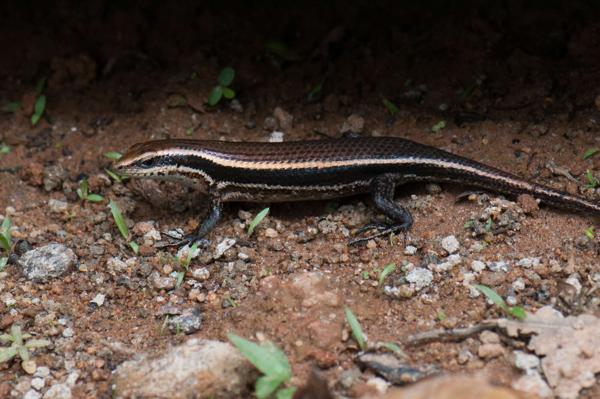
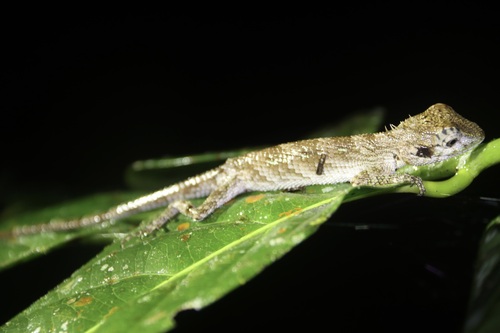
Ceylonese Cylinder Snake

Ceylonese Cylinder Snake

Cylindrophis maculatus

Silhouette: SeismicShrimp · PhyloPic

LCNTVUVulnerableENCR Endemic
Daily sighting probability ~20% · Possible
at Sinharaja Forest Reserve

In 3 days ~40% in a week ~70%

7 Verified sightings at Sinharaja Forest Reserve From 2019 to 2026
7 In 1 park
July Best month
☀️🌙 Day & Night When it's spotted

About the Ceylonese Cylinder Snake

The Ceylonese cylinder snake (Cylindrophis maculatus) is a species of snake in the family Cylindrophiidae endemic to Sri Lanka. It is known from plains up to 1000m, localities include Gampola, Peradeniya, Kandy, Pallekele, and Elahera in the central hills and Nikaweratiya in the north-western part of the island.

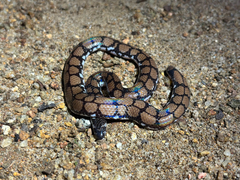
Known as දෙපත් නයා (depath naya) and වටඋල්ලා (wataulla) in Sinhala, it is the first reptile discovered and documented by Sri Lanka. Its defense response consists of flattening posterior half of the body and curling posterior quarter of the body and tail forwards, with head usually concealed under body during this display.

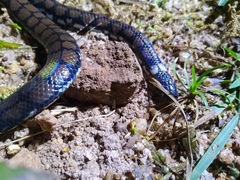
C. maculatus has two series of large reddish-brown spots along the back, which are enclosed by a black network. The belly is white, variegated with black. The dorsal scales are smooth, arranged in 19 or 21 rows. Ventrals number 189-212, and are almost twice as large as the contiguous dorsal scales; the anal scale is divided; the subcaudals number 4-6.

Adults may reach 35 cm (14 in) in total length. A sub-fossorial, nocturnal snake, it rests under stones, decaying logs, amongst rocks and in leaf litter by day, emerging at night... Wikipedia →

Global Distribution

Parks Where Found

# Park Country Daily sighting probability
1 Sinharaja Forest Reserve 🇱🇰 Sri Lanka
~20%

More parks will be added in future updates.

Cities Where Found

# City Country Daily sighting probability
1 Colombo [Sri Jayawardenepura Kotte] 🇱🇰 Sri Lanka
~10%

Closest Relatives at Sinharaja Forest Reserve

No species of the same family or order lives in Sinharaja Forest Reserve, so these are its closest relatives here: other reptiles.

Before you go

What are the chances of seeing a Ceylonese Cylinder Snake in Sinharaja Forest Reserve?

Possible

About 20% of wildlife watchers report a Ceylonese Cylinder Snake sighting in Sinharaja Forest Reserve on a given day, based on 7 verified sightings from GBIF citizen-science data from 2019 to 2026. It is the 24th most-seen of the 32 reptiles we can rate there. Over three days the chance rises to about 40%, and over a week to about 70%, if each day is a fresh chance.

When is the best time to see a Ceylonese Cylinder Snake in Sinharaja Forest Reserve?

February and July

In those months about 30% of wildlife watchers report a Ceylonese Cylinder Snake in Sinharaja Forest Reserve on a given day, against under 5% in March–June and August–November, the lowest months.

What time of day is best to see a Ceylonese Cylinder Snake?

Between noon and 3 pm

Across all the parks we cover, that three-hour window holds the most Ceylonese Cylinder Snake sightings with a recorded time, and about 6 in 10 of them come between 6 am and 6 pm: it is seen both by day and at night.

Where else can you see a Ceylonese Cylinder Snake?

Only Sinharaja Forest Reserve, in our data

Sinharaja Forest Reserve is the only park on Wallace's Line with enough records to rate Ceylonese Cylinder Snake sightings: about 20% of wildlife watchers there report one on a given day.

Where does the Ceylonese Cylinder Snake sighting chance come from?

GBIF citizen-science records

It is estimated from how often the Ceylonese Cylinder Snake is recorded against all the reptiles logged in Sinharaja Forest Reserve (7 verified sightings from 2019 to 2026), calibrated against known sighting rates. Figures are rounded to the nearest 10% because citizen-science data supports honest approximations, not decimals, and months with records from fewer than five people show "—". How it works.

← Back to Sinharaja Forest Reserve