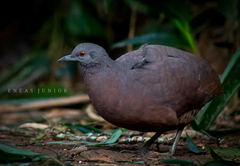
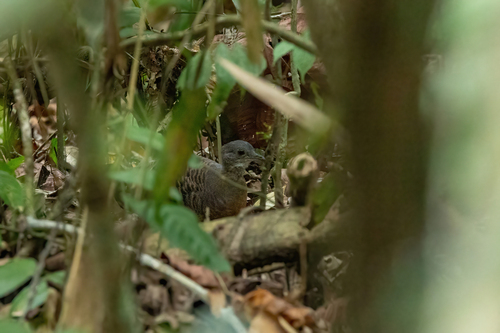
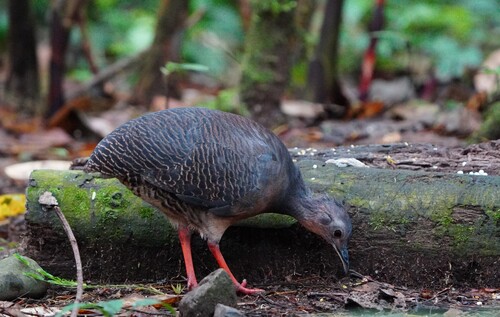
Brown Tinamou

Brown Tinamou

Crypturellus obsoletus

Silhouette: J. N. Wiegers · PhyloPic

LCLeast ConcernNTVUENCR
Daily sighting probability <5% · Rare
at Tambopata National Reserve

In 3 days <5%

18 Verified sightings at Tambopata National Reserve From 2019 to 2026
1,952 In all 8 parks
November Best month
☀️ Diurnal When it's spotted

About the Brown Tinamou

The brown tinamou (Crypturellus obsoletus) is a brownish ground bird found in humid lowland and montane forest in tropical and subtropical South America. All tinamous are usually treated in a single family (Tinamidae) and, contrary to traditional classifications, they are embedded within the group known as ratites, most closely related to the extinct moa of New Zealand. However, unlike ratites (ostriches, rheas, moa, kiwis, emus, cassowaries & elephantbirds), tinamous are capable of flight, although in general, they are not strong fliers. Different ratite lineages evolved separately from ancient flying birds, and tinamous are thought to most closely resemble these ancestral ratites.

Its distribution is highly disjunct and the subspecies, which quite probably represent more than one species, are distributed as follows: C. o. obsoletus, the nominate race, occurs in the Atlantic forest in southeastern Brazil, eastern Paraguay and Misiones, Argentina.

C. o. griseiventris occurs throughout the valley of Rio Tapajós, Brazil; southwestern Pará, southeastern Amazonas, and central Mato Grosso. C. o. hypochraceus occurs in upper Rio Madeira valley in central... Wikipedia →

Sounds

Song0:16

Brazil · 2021

© Marllus Rafael · XC1175233 · CC BY-NC-SA 4.0

Call0:46

Argentina · 2026

© Marcos E. Sosa · XC1135509 · CC BY-NC-SA 4.0

Uncertain0:26

Peru · 2021

© David F. Belmonte · XC707842 · CC BY-NC-SA 4.0

Global Distribution

Parks Where Found

# Park Country Daily sighting probability
1 Amboró National Park 🇧🇴 Bolivia
~50%
2 Serra dos Órgãos National Park 🇧🇷 Brazil
~40%
3 Itatiaia National Park 🇧🇷 Brazil
~20%
4 Iguazú National Park 🇦🇷 Argentina
~10%
5 Iguaçu National Park 🇧🇷 Brazil
~10%
6 Henri Pittier National Park 🇻🇪 Venezuela
<5%
7 Manu National Park 🇵🇪 Peru
<5%
8 Tambopata National Reserve 🇵🇪 Peru
<5%

Cities Where Found

# City Country Daily sighting probability
1 Curitiba 🇧🇷 Brazil
<5%
2 Belo Horizonte 🇧🇷 Brazil
<5%
3 São Paulo 🇧🇷 Brazil
<5%
4 Caracas 🇻🇪 Venezuela
<5%

Zoos & Centres Where Found

# Zoo / Centre Country
1 Zoo das Aves 🇧🇷 Brazil In captivity

Before you go

What are the chances of seeing a Brown Tinamou in Tambopata National Reserve?

Rare

Under 5% of wildlife watchers report a Brown Tinamou sighting in Tambopata National Reserve on a given day, based on 18 verified sightings from GBIF citizen-science data from 2019 to 2026. It is the 466th most-seen of the 550 birds we can rate there. Over three days the chance rises to under 5%, if each day is a fresh chance.

When is the best time to see a Brown Tinamou in Tambopata National Reserve?

Any time of year

In every month with enough records, under 5% of wildlife watchers report a Brown Tinamou in Tambopata National Reserve on a given day, so our monthly data shows no clear season.

What time of day is best to see a Brown Tinamou?

Between 7 and 10 am

Across all the parks we cover, that three-hour window holds the most Brown Tinamou sightings with a recorded time, and about 9 in 10 of them come between 6 am and 6 pm: it is a daytime animal.

Which relatives of the Brown Tinamou live in Tambopata National Reserve?

Same genus: Crypturellus

The closest relatives of the Brown Tinamou that you can see in Tambopata National Reserve (genus Crypturellus, Crypturellus Tinamous) are Undulated Tinamou (about 40%), Cinereous Tinamou (about 10%) and Little Tinamou (about 10%), with each one's daily chance of a sighting.

Where does the Brown Tinamou sighting chance come from?

GBIF citizen-science records

It is estimated from how often the Brown Tinamou is recorded against all the birds logged in Tambopata National Reserve (18 verified sightings from 2019 to 2026), calibrated against known sighting rates. Figures are rounded to the nearest 10% because citizen-science data supports honest approximations, not decimals, and months with records from fewer than five people show "—". How it works.

← Back to Tambopata National Reserve