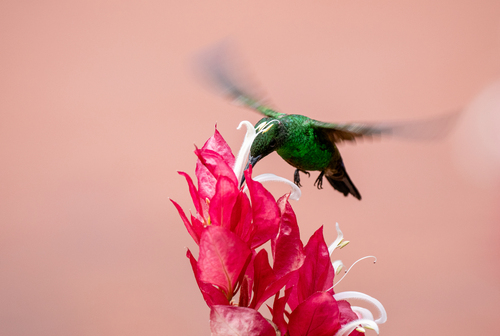
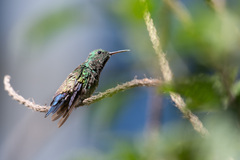
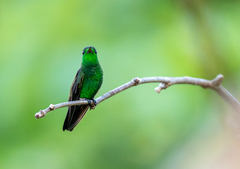
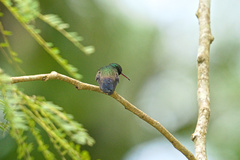

Blue-vented Hummingbird

Blue-vented Hummingbird

Saucerottia hoffmanni

Silhouette: Ferran Sayol · PhyloPic

Daily sighting probability <5% · Rare
at Tapantí-Macizo de la Muerte National Park

In 3 days <5%

61 Verified sightings at Tapantí-Macizo de la Muerte National Park From 2019 to 2026
6,726 In all 16 parks
October Best month
☀️ Diurnal When it's spotted

About the Blue-vented Hummingbird

The blue-vented hummingbird (Saucerottia hoffmanni) is a species of hummingbird in the "emeralds", tribe Trochilini of subfamily Trochilinae. It is found in Costa Rica and Nicaragua. The blue-vented hummingbird was formerly placed in the genus Amazilia as a subspecies of the steely-vented hummingbird (then Amazilia saucerottei, now Saucerottia saucerottei). A molecular phylogenetic study published in 2014 found that the genus Amazilia was polyphyletic. In the revised classification to create monophyletic genera, most taxonomic systems accepted the blue-vented hummingbird as a separate species and moved it to the resurrected genus Saucerottia. However, BirdLife International's Handbook of the Birds of the World (HBW) retains it as the steely-vented subspecies Amazilia saucerottei hoffmanni.

The blue-vented hummingbird is monotypic. The blue-vented hummingbird is 8 to 11 cm (3.1 to 4.3 in) long and weighs an average of 4.45 g (0.16 oz). Both sexes have a straight bill with a blackish maxilla and a coral-red mandible with a dark tip. Adult males have golden-green upperparts with coppery to purplish rump and uppertail coverts. Their underparts... Wikipedia →

Sounds

Call0:32

Costa Rica · 2013

© Paul Driver · XC774033 · CC BY-NC-SA 4.0

?0:11

Costa Rica · 2006

© David Bradley · XC6392 · CC BY-NC-ND 2.5

Flight call0:13

Costa Rica · 2017

© Albert Lastukhin · XC894637 · CC BY-NC-ND 4.0

Global Distribution

Parks Where Found

# Park Country Daily sighting probability
1 Monteverde Cloud Forest Reserve 🇨🇷 Costa Rica
~20%
2 Rincón de la Vieja National Park 🇨🇷 Costa Rica
~20%
3 Santa Rosa National Park 🇨🇷 Costa Rica
~20%
4 Carara National Park 🇨🇷 Costa Rica
~20%
5 Tenorio Volcano National Park 🇨🇷 Costa Rica
~10%
6 Ostional Wildlife Refuge 🇨🇷 Costa Rica
~10%
7 Las Baulas Marine National Park 🇨🇷 Costa Rica
~10%
8 Cabo Blanco Absolute Nature Reserve 🇨🇷 Costa Rica
~10%
9 Palo Verde National Park 🇨🇷 Costa Rica
~10%
10 Arenal Volcano National Park 🇨🇷 Costa Rica
~10%
11 Poás Volcano National Park 🇨🇷 Costa Rica
<5%
12 Braulio Carrillo National Park 🇨🇷 Costa Rica
<5%
13 Masaya Volcano National Park 🇳🇮 Nicaragua
<5%
14 Tapantí-Macizo de la Muerte National Park 🇨🇷 Costa Rica
<5%
15 Manuel Antonio National Park 🇨🇷 Costa Rica
<5%
16 Los Quetzales National Park 🇨🇷 Costa Rica
<5%

Cities Where Found

# City Country Daily sighting probability
1 San José 🇨🇷 Costa Rica
~10%

Before you go

What are the chances of seeing a Blue-vented Hummingbird in Tapantí-Macizo de la Muerte National Park?

Rare

Under 5% of wildlife watchers report a Blue-vented Hummingbird sighting in Tapantí-Macizo de la Muerte National Park on a given day, based on 61 verified sightings from GBIF citizen-science data from 2019 to 2026. It is the 346th most-seen of the 467 birds we can rate there. Over three days the chance rises to under 5%, if each day is a fresh chance.

When is the best time to see a Blue-vented Hummingbird in Tapantí-Macizo de la Muerte National Park?

Any time of year

In every month with enough records, under 5% of wildlife watchers report a Blue-vented Hummingbird in Tapantí-Macizo de la Muerte National Park on a given day, so our monthly data shows no clear season.

What time of day is best to see a Blue-vented Hummingbird?

Between 6 and 9 am

Across all the parks we cover, that three-hour window holds the most Blue-vented Hummingbird sightings with a recorded time, and about 9 in 10 of them come between 6 am and 6 pm: it is a daytime animal.

Where does the Blue-vented Hummingbird sighting chance come from?

GBIF citizen-science records

It is estimated from how often the Blue-vented Hummingbird is recorded against all the birds logged in Tapantí-Macizo de la Muerte National Park (61 verified sightings from 2019 to 2026), calibrated against known sighting rates. Figures are rounded to the nearest 10% because citizen-science data supports honest approximations, not decimals, and months with records from fewer than five people show "—". How it works.

← Back to Tapantí-Macizo de la Muerte National Park