Monk Snake

Monk Snake

Suta monachus

Silhouette: SeismicShrimp · PhyloPic

LCLeast ConcernNTVUENCR Endemic
Daily sighting probability ~20% · Possible
at Uluru-Kata Tjuta National Park

In 3 days ~50% in a week ~80%

6 Verified sightings at Uluru-Kata Tjuta National Park From 2019 to 2026
6 In 1 park
February Best month
☀️ Diurnal When it's spotted

About the Monk Snake

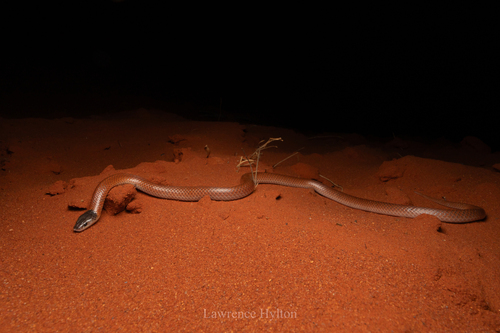
The monk snake (Suta monachus), also known commonly as the hooded snake, is a species of venomous snake in the family Elapidae. The species is native to central and western Australia. Within Australia, S. monachus is found in the states and territories of Northern Territory, South Australia, and Western Australia.

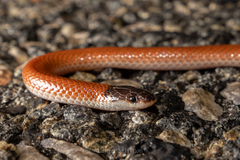
The preferred natural habitats of S. monachus are savanna and shrubland. The average snout-to-vent length (SVL) of adults of S. monachus is 27 cm (11 in), and the length of the tail is about 13% SVL. The maximum recorded SVL is 46 centimetres (18 in). The top of the head is solid glossy black, without any pale markings. On average, this black "hood" extends on the nape to the fourth vertebral scale, but may extend only to the first or as far as the sixth. The body and tail are brick red dorsally, and white ventrally. The upper labials are white also. There is only one posterior temporal scale.

S. monachus preys upon lizards. S. monachus is viviparous. Although S. monachus is venomous, its bite is considered to be of lesser medical significance. A life-threatening envenomation is... Wikipedia →
Global Distribution

Parks Where Found

# Park Country Daily sighting probability
1 Uluru-Kata Tjuta National Park 🇦🇺 Australia
~20%

More parks will be added in future updates.

Before you go

What are the chances of seeing a Monk Snake in Uluru-Kata Tjuta National Park?

Possible

About 20% of wildlife watchers report a Monk Snake sighting in Uluru-Kata Tjuta National Park on a given day, based on 6 verified sightings from GBIF citizen-science data from 2019 to 2026. It is the 14th most-seen of the 25 reptiles we can rate there. Over three days the chance rises to about 50%, and over a week to about 80%, if each day is a fresh chance.

When is the best time to see a Monk Snake in Uluru-Kata Tjuta National Park?

February

In that month about 50% of wildlife watchers report a Monk Snake in Uluru-Kata Tjuta National Park on a given day, against under 5% in March–May, July–August, October and December–January, the lowest months. That is one of Uluru-Kata Tjuta National Park's driest months, with about 10 mm of rain against 65 mm in January.

What time of day is best to see a Monk Snake?

Between noon and 3 pm

Across all the parks we cover, that three-hour window holds the most Monk Snake sightings with a recorded time, and about 9 in 10 of them come between 6 am and 6 pm: it is a daytime animal.

Where else can you see a Monk Snake?

Only Uluru-Kata Tjuta National Park, in our data

Uluru-Kata Tjuta National Park is the only park on Wallace's Line with enough records to rate Monk Snake sightings: about 20% of wildlife watchers there report one on a given day.

Which relatives of the Monk Snake live in Uluru-Kata Tjuta National Park?

Same family: Elapidae

The closest relatives of the Monk Snake that you can see in Uluru-Kata Tjuta National Park (family Elapidae, Elapid Snakes) are Mulga Snake (about 20%) and Ringed Brown Snake (about 20%), with each one's daily chance of a sighting.

Where does the Monk Snake sighting chance come from?

GBIF citizen-science records

It is estimated from how often the Monk Snake is recorded against all the reptiles logged in Uluru-Kata Tjuta National Park (6 verified sightings from 2019 to 2026), calibrated against known sighting rates. Figures are rounded to the nearest 10% because citizen-science data supports honest approximations, not decimals, and months with records from fewer than five people show "—". How it works.

← Back to Uluru-Kata Tjuta National Park