Ringed Brown Snake

Ringed Brown Snake

Pseudonaja modesta

Silhouette: SeismicShrimp · PhyloPic

LCLeast ConcernNTVUENCR Endemic
Daily sighting probability ~20% · Possible
at Uluru-Kata Tjuta National Park

In 3 days ~40% in a week ~70%

5 Verified sightings at Uluru-Kata Tjuta National Park From 2019 to 2026
5 In 1 park
March Best month
🌅 Crepuscular When it's spotted

About the Ringed Brown Snake

The ringed brown snake (Pseudonaja modesta) is a species of venomous elapid snake native to a broad swathe of inland Australia, from western New South Wales and Queensland to Western Australia. Albert Günther described it as Cacophis modesta in 1872, from specimens collected in northwestern Australia. The specific name modesta is the Latin adjective "unassuming", "orderly", or "well-behaved", regarded as apt by toxicologist Struan Sutherland, as the snake generally does not bite people. Meanwhile, Charles Walter De Vis described Brachysoma sutherlandi from Carl Creek, Norman River in northwestern Queensland in 1884, and William Macleay described Furina ramsayi, naming it after Edward Pierson Ramsay, in 1885 from a collection from Milparinka in northwestern New South Wales. All three are the same species.

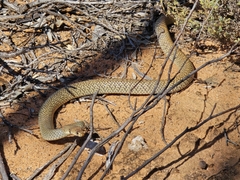
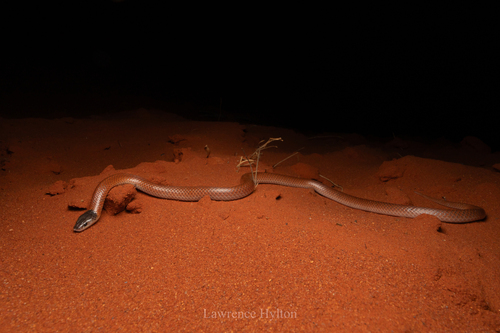
Reaching around 50 cm (20 in) in length, the ringed brown snake has grey-brown to red-brown upperparts with a black head and neck split by a cream band, as well as four to seven black bands with cream margins at regular intervals down the length of its body. Its underparts are cream to yellow splotched with orange. The upper dark bands may fade markedly with age. Its colour and markings, particularly its black head and neck band, resemble the juvenile eastern brown snake.

The ringed brown snake is found in arid regions across inland Australia (except Victoria). It lives in arid shrubland or grassland, where it hides in spinifex or under fallen timber. A girl bitten by this species in 1987 suffered mild systemic symptoms. No coagulopathy was recorded. Wikipedia →

Global Distribution

Parks Where Found

# Park Country Daily sighting probability
1 Uluru-Kata Tjuta National Park 🇦🇺 Australia
~20%

More parks will be added in future updates.

Before you go

What are the chances of seeing a Ringed Brown Snake in Uluru-Kata Tjuta National Park?

Possible

About 20% of wildlife watchers report a Ringed Brown Snake sighting in Uluru-Kata Tjuta National Park on a given day, based on 5 verified sightings from GBIF citizen-science data from 2019 to 2026. It is the 19th most-seen of the 25 reptiles we can rate there. Over three days the chance rises to about 40%, and over a week to about 70%, if each day is a fresh chance.

When is the best time to see a Ringed Brown Snake in Uluru-Kata Tjuta National Park?

March

In that month about 40% of wildlife watchers report a Ringed Brown Snake in Uluru-Kata Tjuta National Park on a given day, against under 5% in January–February, April–August and October–November, the lowest months.

What time of day is best to see a Ringed Brown Snake?

Between 1 and 4 am

Across all the parks we cover, that three-hour window holds the most Ringed Brown Snake sightings with a recorded time, and about half of them come between 6 am and 6 pm: it is most active around dawn and dusk.

Where else can you see a Ringed Brown Snake?

Only Uluru-Kata Tjuta National Park, in our data

Uluru-Kata Tjuta National Park is the only park on Wallace's Line with enough records to rate Ringed Brown Snake sightings: about 20% of wildlife watchers there report one on a given day.

Which relatives of the Ringed Brown Snake live in Uluru-Kata Tjuta National Park?

Same family: Elapidae

The closest relatives of the Ringed Brown Snake that you can see in Uluru-Kata Tjuta National Park (family Elapidae, Elapid Snakes) are Mulga Snake (about 20%) and Monk Snake (about 20%), with each one's daily chance of a sighting.

Where does the Ringed Brown Snake sighting chance come from?

GBIF citizen-science records

It is estimated from how often the Ringed Brown Snake is recorded against all the reptiles logged in Uluru-Kata Tjuta National Park (5 verified sightings from 2019 to 2026), calibrated against known sighting rates. Figures are rounded to the nearest 10% because citizen-science data supports honest approximations, not decimals, and months with records from fewer than five people show "—". How it works.

← Back to Uluru-Kata Tjuta National Park