Costa Rican Pygmy-Owl

Costa Rican Pygmy-Owl

Glaucidium costaricanum

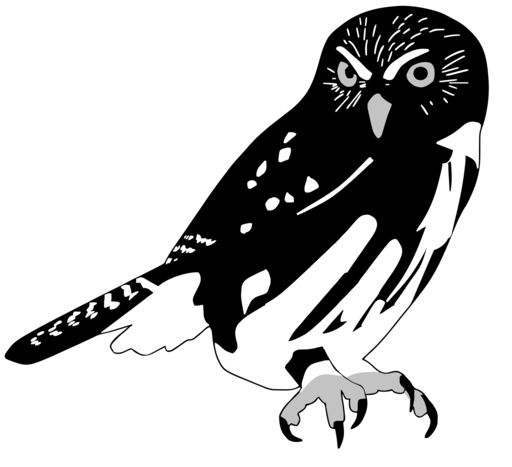
Silhouette: Edwin Price · PhyloPic

LCLeast ConcernNTVUENCR
Daily sighting probability ~10% · With luck
at Volcán Barú National Park

In 3 days ~30% in a week ~50%

169 Verified sightings at Volcán Barú National Park From 2019 to 2026
1,636 In all 10 parks
April Best month
☀️ Diurnal When it's spotted

About the Costa Rican Pygmy-Owl

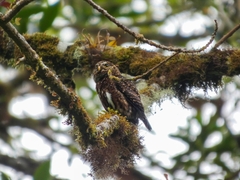
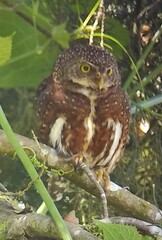
The Costa Rican pygmy owl (Glaucidium costaricanum) is a small "typical owl" in subfamily Surniinae. It is found in Costa Rica and Panama. Initially, the Costa Rican pygmy owl was described as a subspecies of the Andean pygmy owl (G. jardinii); in 2000, the North American Classification Committee (NACC), of what was then the American Ornithologists' Union (now the American Ornithological Society), accepted it as a separate species, with other taxonomic systems following-suit. The Costa Rican pygmy owl is more closely related to the northern pygmy owl complex (G. gnoma sensu lato) than to the Andean. The species is monotypic.

The Costa Rican pygmy owl is around 14.5 to 17 cm (5.7 to 6.7 in) long, with males weighing about 53 to 70 g (1.9 to 2.5 oz), while the larger females weigh as much as 99 g (3.5 oz). Adults have two color morphs; one is mostly brown and the other is rufous. The head and upper body parts are a basal color with lighter, paler spots; the tail is the same color, with four white bands and a white tip. The nape has a pair of blackish spots with pale borders that resemble "eyes" on the back of the head. The breast and belly... Wikipedia →

Sounds

Song1:03

Costa Rica · 2019

© Hans Matheve · XC517721 · CC BY-NC-ND 4.0

Call0:19

Panama · 2019

© Guy Kirwan · XC498910 · CC BY-NC-SA 4.0

Song1:17

Panama · 2017

© Kent Livezey · XC367575 · CC BY-NC-SA 4.0

Global Distribution

Parks Where Found

# Park Country Daily sighting probability
1 Volcán Barú National Park 🇵🇦 Panama
~10%
2 Los Quetzales National Park 🇨🇷 Costa Rica
~10%
3 Irazú Volcano National Park 🇨🇷 Costa Rica
~10%
4 Tapantí-Macizo de la Muerte National Park 🇨🇷 Costa Rica
<5%
5 La Amistad International Park (Panama) 🇵🇦 Panama
<5%
6 Chirripó National Park 🇨🇷 Costa Rica
<5%
7 Poás Volcano National Park 🇨🇷 Costa Rica
<5%
8 Arenal Volcano National Park 🇨🇷 Costa Rica
<5%
9 Braulio Carrillo National Park 🇨🇷 Costa Rica
<5%
10 Monteverde Cloud Forest Reserve 🇨🇷 Costa Rica
<5%

Before you go

What are the chances of seeing a Costa Rican Pygmy-Owl in Volcán Barú National Park?

With luck

About 10% of wildlife watchers report a Costa Rican Pygmy-Owl sighting in Volcán Barú National Park on a given day, based on 169 verified sightings from GBIF citizen-science data from 2019 to 2026. It is the 109th most-seen of the 296 birds we can rate there. Over three days the chance rises to about 30%, and over a week to about 50%, if each day is a fresh chance.

When is the best time to see a Costa Rican Pygmy-Owl in Volcán Barú National Park?

July to April

In those months about 10% of wildlife watchers report a Costa Rican Pygmy-Owl in Volcán Barú National Park on a given day, against under 5% in May and June, the lowest months.

What time of day is best to see a Costa Rican Pygmy-Owl?

Between 7 and 10 am

Across all the parks we cover, that three-hour window holds the most Costa Rican Pygmy-Owl sightings with a recorded time, and about 9 in 10 of them come between 6 am and 6 pm: it is a daytime animal.

Is Volcán Barú National Park the best place to see a Costa Rican Pygmy-Owl?

Yes

Of the 10 parks where we can rate Costa Rican Pygmy-Owl sightings, Volcán Barú National Park has the highest daily chance: about 10%. Next come Los Quetzales National Park (Costa Rica, about 10%) and Irazú Volcano National Park (Costa Rica, about 10%).

Where does the Costa Rican Pygmy-Owl sighting chance come from?

GBIF citizen-science records

It is estimated from how often the Costa Rican Pygmy-Owl is recorded against all the birds logged in Volcán Barú National Park (169 verified sightings from 2019 to 2026), calibrated against known sighting rates. Figures are rounded to the nearest 10% because citizen-science data supports honest approximations, not decimals, and months with records from fewer than five people show "—". How it works.

← Back to Volcán Barú National Park