Ochraceous Wren

Ochraceous Wren

Troglodytes ochraceus

Silhouette: T. Michael Keesey · PhyloPic

LCLeast ConcernNTVUENCR
Daily sighting probability ~40% · Likely
at Volcán Barú National Park

In 3 days ~80% in a week >90%

715 Verified sightings at Volcán Barú National Park From 2019 to 2026
9,307 In all 11 parks
August Best month
☀️ Diurnal When it's spotted

About the Ochraceous Wren

The ochraceous wren (Troglodytes ochraceus) is a small songbird of the wren family. It is a resident breeding species in Costa Rica, Panama, and Colombia. The ochraceous wren was previously considered to be a subspecies of mountain wren (Troglodytes solstitialis). The International Ornithological Committee (IOC) recognizes two subspecies, the nominate Troglodytes ochraceus ochraceus and T. o. festinus. The Cornell Lab of Ornithology's Birds of the World and the Clements taxonomy split T. o. ligea from the nominate subspecies.

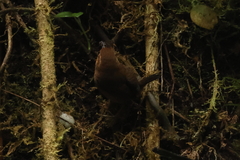
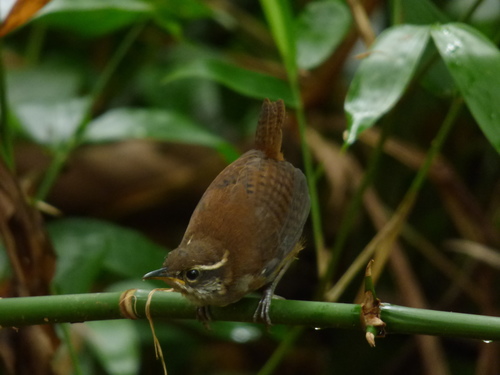
The adult ochraceous wren is 9.5 to 10 cm (3.7 to 3.9 in) long and weighs 8 to 10 g (0.28 to 0.35 oz). The nominate subspecies sensu stricto has a rich medium brown crown and back with a rufous cast to the rump. The tail is brown with blackish bars. It has a bold yellowish buff supercilium that extends to the nape. Wikipedia →

Sounds

Song0:28

Panama · 2025

© Sue Riffe · XC1072986 · CC BY-NC-SA 4.0

Call0:14

Costa Rica · 2019

© GABRIEL LEITE · XC489992 · CC BY-NC-SA 4.0

Song0:24

Panama · 2016

© Hans Matheve · XC360332 · CC BY-NC-ND 4.0

Global Distribution

Parks Where Found

# Park Country Daily sighting probability
1 Volcán Barú National Park 🇵🇦 Panama
~40%
2 Irazú Volcano National Park 🇨🇷 Costa Rica
~30%
3 Los Quetzales National Park 🇨🇷 Costa Rica
~20%
4 Monteverde Cloud Forest Reserve 🇨🇷 Costa Rica
~20%
5 Tapantí-Macizo de la Muerte National Park 🇨🇷 Costa Rica
~10%
6 La Amistad International Park (Panama) 🇵🇦 Panama
~10%
7 Poás Volcano National Park 🇨🇷 Costa Rica
~10%
8 Braulio Carrillo National Park 🇨🇷 Costa Rica
~10%
9 Chirripó National Park 🇨🇷 Costa Rica
<5%
10 Arenal Volcano National Park 🇨🇷 Costa Rica
<5%
11 Darién National Park 🇵🇦 Panama
<5%

Cities Where Found

# City Country Daily sighting probability
1 San José 🇨🇷 Costa Rica
<5%

Before you go

What are the chances of seeing an Ochraceous Wren in Volcán Barú National Park?

Likely

About 40% of wildlife watchers report an Ochraceous Wren sighting in Volcán Barú National Park on a given day, based on 715 verified sightings from GBIF citizen-science data from 2019 to 2026. It is the 28th most-seen of the 296 birds we can rate there. Over three days the chance rises to about 80%, and over a week to over 90%, if each day is a fresh chance.

When is the best time to see an Ochraceous Wren in Volcán Barú National Park?

June and August

In those months about 60% of wildlife watchers report an Ochraceous Wren in Volcán Barú National Park on a given day, against about 30% in March–May and November–December, the lowest months.

What time of day is best to see an Ochraceous Wren?

Between 8 and 11 am

Across all the parks we cover, that three-hour window holds the most Ochraceous Wren sightings with a recorded time, and about 9 in 10 of them come between 6 am and 6 pm: it is a daytime animal.

Is Volcán Barú National Park the best place to see an Ochraceous Wren?

Yes

Of the 11 parks where we can rate Ochraceous Wren sightings, Volcán Barú National Park has the highest daily chance: about 40%. Next come Irazú Volcano National Park (Costa Rica, about 30%) and Los Quetzales National Park (Costa Rica, about 20%).

Where does the Ochraceous Wren sighting chance come from?

GBIF citizen-science records

It is estimated from how often the Ochraceous Wren is recorded against all the birds logged in Volcán Barú National Park (715 verified sightings from 2019 to 2026), calibrated against known sighting rates. Figures are rounded to the nearest 10% because citizen-science data supports honest approximations, not decimals, and months with records from fewer than five people show "—". How it works.

← Back to Volcán Barú National Park