Dusky Turtle Dove

Dusky Turtle Dove

Streptopelia lugens

Silhouette: Andy Wilson · PhyloPic

LCLeast ConcernNTVUENCR
Daily sighting probability ~30% · Possible
at Volcanoes National Park

In 3 days ~70% in a week ~90%

165 Verified sightings at Volcanoes National Park From 2019 to 2026
1,969 In all 20 parks
December Best month
☀️ Diurnal When it's spotted

About the Dusky Turtle Dove

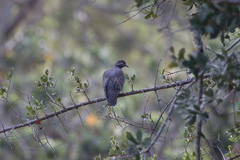
The dusky turtle dove or pink-breasted turtle dove (Streptopelia lugens) is a species of bird in the family Columbidae. The dusky turtle dove is a very dark or slaty-grey dove, generally 28–30 centimetres long, and weighs 120–205 g; the males (140–205 g) slightly heavier than the females (120–190 g).

It has a grey face slightly paler than the body, conspicuous black patches on sides of the neck, and wing coverts and tertials with pale brown or rufous edges. Its eye is orange or orange-yellow with a purplish eye-ring. Its bill is purplish slate-grey. Its legs are red. Juvenile birds are paler and browner than adults.

Dusky turtle dove is monotypic, with no subspecies described. Its closest relative is the Adamawa turtle dove S. hypopyrrha, which replaces it in West Africa; that species is slightly larger (30–31 cm) with a paler silvery-grey head and orange-toned belly; the two were formerly often considered conspecific. These two together are then most closely related to the European turtle dove S. turtur, which breeds much further north but winters in the same area; that species is much paler and more orange-toned overall. Wikipedia →

Sounds

Song1:17

Ethiopia · 2014

© Andrew Spencer · XC276761 · CC BY-NC-ND 4.0

Call0:47

Tanzania · 2011

© Martin St-Michel · XC94563 · CC BY-NC-ND 2.5

Song0:19

Saudi Arabia · 2022

© David Darrell-Lambert · XC746509 · CC BY-NC-SA 4.0

Global Distribution

Parks Where Found

# Park Country Daily sighting probability
1 Nairobi National Park 🇰🇪 Kenya
~40%
2 Bale Mountains National Park 🇪🇹 Ethiopia
~30%
3 Volcanoes National Park 🇷🇼 Rwanda
~30%
4 Nyungwe National Park 🇷🇼 Rwanda
~20%
5 Ngorongoro Conservation Area 🇹🇿 Tanzania
~20%
6 Virunga National Park 🇨🇩 Democratic Republic of the Congo
~10%
7 Awash National Park 🇪🇹 Ethiopia
~10%
8 Aberdare National Park 🇰🇪 Kenya
~10%
9 Masai Mara National Reserve 🇰🇪 Kenya
~10%
10 Mkomazi National Park 🇹🇿 Tanzania
~10%
11 Arusha National Park 🇹🇿 Tanzania
<5%
12 Bwindi Impenetrable National Park 🇺🇬 Uganda
<5%
13 Kidepo Valley National Park 🇺🇬 Uganda
<5%
14 Akagera National Park 🇷🇼 Rwanda
<5%
15 Samburu National Reserve 🇰🇪 Kenya
<5%
16 Lake Manyara National Park 🇹🇿 Tanzania
<5%
17 Lake Nakuru National Park 🇰🇪 Kenya
<5%
18 Serengeti National Park 🇹🇿 Tanzania
<5%
19 Queen Elizabeth National Park 🇺🇬 Uganda
<5%
20 Tarangire National Park 🇹🇿 Tanzania
<5%

Cities Where Found

# City Country Daily sighting probability
1 Addis Ababa 🇪🇹 Ethiopia
~70%
2 Nairobi 🇰🇪 Kenya
~10%

Before you go

What are the chances of seeing a Dusky Turtle Dove in Volcanoes National Park?

Possible

About 30% of wildlife watchers report a Dusky Turtle Dove sighting in Volcanoes National Park on a given day, based on 165 verified sightings from GBIF citizen-science data from 2019 to 2026. It is the 26th most-seen of the 156 birds we can rate there. Over three days the chance rises to about 70%, and over a week to about 90%, if each day is a fresh chance.

When is the best time to see a Dusky Turtle Dove in Volcanoes National Park?

December

In that month about 60% of wildlife watchers report a Dusky Turtle Dove in Volcanoes National Park on a given day, against about 10% in March and September–October, the lowest months. That is one of Volcanoes National Park's wettest months, with about 250 mm of rain against 20 mm in July.

What time of day is best to see a Dusky Turtle Dove?

Between 6 and 9 am

Across all the parks we cover, that three-hour window holds the most Dusky Turtle Dove sightings with a recorded time, and about 8 in 10 of them come between 6 am and 6 pm: it is a daytime animal.

Is Volcanoes National Park the best place to see a Dusky Turtle Dove?

3rd of 20

Of the 20 parks where we can rate Dusky Turtle Dove sightings, Volcanoes National Park ranks 3rd at about 30%. The best odds are in Nairobi National Park (Kenya, about 40%) and Bale Mountains National Park (Ethiopia, about 30%).

Which relatives of the Dusky Turtle Dove live in Volcanoes National Park?

Same genus: Streptopelia

The closest relatives of the Dusky Turtle Dove that you can see in Volcanoes National Park (genus Streptopelia, Turtle-Doves and Collared-Doves) are Red-eyed Dove (about 60%) and Cape Turtle Dove (about 10%), with each one's daily chance of a sighting.

Where does the Dusky Turtle Dove sighting chance come from?

GBIF citizen-science records

It is estimated from how often the Dusky Turtle Dove is recorded against all the birds logged in Volcanoes National Park (165 verified sightings from 2019 to 2026), calibrated against known sighting rates. Figures are rounded to the nearest 10% because citizen-science data supports honest approximations, not decimals, and months with records from fewer than five people show "—". How it works.

← Back to Volcanoes National Park