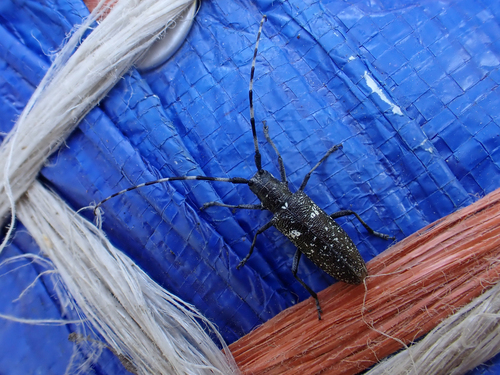
White-Spotted Sawyer

White-Spotted Sawyer

Monochamus scutellatus

Daily sighting probability ~30% · Possible
at Wrangell-St. Elias National Park

In 3 days ~60% in a week ~90%

8 Verified sightings at Wrangell-St. Elias National Park From 2019 to 2026
1,260 In all 22 parks
June Best month
☀️ Diurnal When it's spotted

About the White-Spotted Sawyer

Monochamus scutellatus, commonly known as the white-spotted sawyer or spruce sawyer or spruce bug or a hair-eater, is a common wood-boring beetle found throughout North America. It is a species native to North America. Adults are large-bodied and black, with very long antennae; in males, they can be up to twice the body length, but in females they are only slightly longer than body length. Both sexes have a white spot on the base of the wings, and may have white spots covering the wings. Both males and females also have a spine on the side of the prothorax. Most research done on M. scutellatus focuses on their relationship with burned forests and the logging industry, with interest also being shown in their mating behaviours.

Adults feed preferentially on members of the pine and spruce families for up to seven days after emerging between mid-June and mid-August. After mating, females chew small egg niches into dead or dying trees or logs, into which they deposit one egg each. Both sexes mate repeatedly with different partners, and females have been found to lay between 15 and 20 eggs on average per lifetime. Once the larvae hatch, they burrow into the phloem and... Wikipedia →
Global Distribution

Parks Where Found

# Park Country Daily sighting probability
1 Sequoia and Kings Canyon National Parks 🇺🇸 United States
~40%
2 Grand Teton National Park 🇺🇸 United States
~30%
3 Cape Breton Highlands National Park 🇨🇦 Canada
~30%
4 Glacier National Park 🇺🇸 United States
~30%
5 Banff National Park 🇨🇦 Canada
~30%
6 Voyageurs National Park 🇺🇸 United States
~30%
7 Wrangell-St. Elias National Park 🇺🇸 United States
~30%
8 Rocky Mountain National Park 🇺🇸 United States
~30%
9 Jasper National Park 🇨🇦 Canada
~30%
10 Isle Royale National Park 🇺🇸 United States
~20%
11 Yellowstone National Park 🇺🇸 United States
~20%
12 Kluane National Park 🇨🇦 Canada
~20%
13 Denali National Park 🇺🇸 United States
~20%
14 Elk Island National Park 🇨🇦 Canada
~20%
15 Acadia National Park 🇺🇸 United States
~20%
16 Yosemite National Park 🇺🇸 United States
~10%
17 Riding Mountain National Park 🇨🇦 Canada
~10%
18 Olympic National Park 🇺🇸 United States
~10%
19 Great Smoky Mountains National Park 🇺🇸 United States
~10%
20 Grand Canyon National Park 🇺🇸 United States
~10%
21 Great Bear Rainforest 🇨🇦 Canada
~10%
22 Shenandoah National Park 🇺🇸 United States
~10%

Cities Where Found

# City Country Daily sighting probability
1 Calgary 🇨🇦 Canada
<5%
2 Montreal 🇨🇦 Canada
<5%
3 Minneapolis [Saint Paul] 🇺🇸 United States
<5%
4 Toronto 🇨🇦 Canada
<5%

Before you go

What are the chances of seeing a White-Spotted Sawyer in Wrangell-St. Elias National Park?

Possible

About 30% of wildlife watchers report a White-Spotted Sawyer sighting in Wrangell-St. Elias National Park on a given day, based on 8 verified sightings from GBIF citizen-science data from 2019 to 2026. It is the 17th most-seen of the 27 insects we can rate there. Over three days the chance rises to about 60%, and over a week to about 90%, if each day is a fresh chance.

When is the best time to see a White-Spotted Sawyer in Wrangell-St. Elias National Park?

June

In that month about 40% of wildlife watchers report a White-Spotted Sawyer in Wrangell-St. Elias National Park on a given day, against under 5% in May and September, the lowest months. October to March have too few records to rate.

What time of day is best to see a White-Spotted Sawyer?

Between noon and 3 pm

Across all the parks we cover, that three-hour window holds the most White-Spotted Sawyer sightings with a recorded time, and about 9 in 10 of them come between 6 am and 6 pm: it is a daytime animal.

Where does the White-Spotted Sawyer sighting chance come from?

GBIF citizen-science records

It is estimated from how often the White-Spotted Sawyer is recorded against all the insects logged in Wrangell-St. Elias National Park (8 verified sightings from 2019 to 2026), calibrated against known sighting rates. Figures are rounded to the nearest 10% because citizen-science data supports honest approximations, not decimals, and months with records from fewer than five people show "—". How it works.

← Back to Wrangell-St. Elias National Park