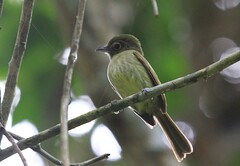
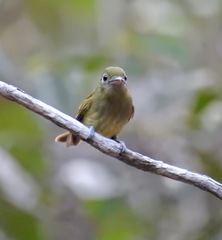
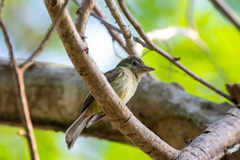
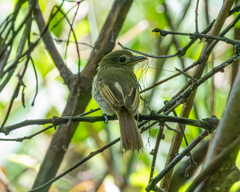

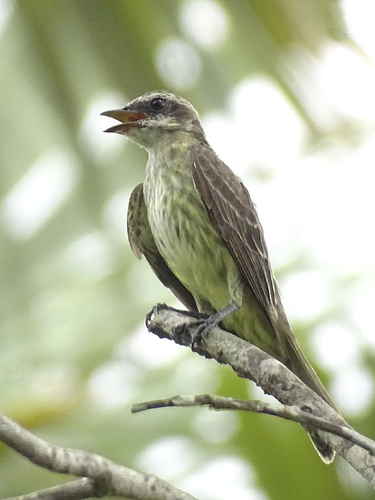
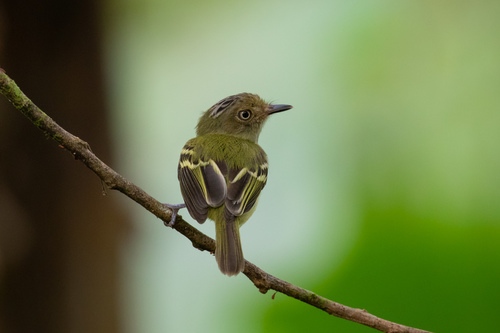
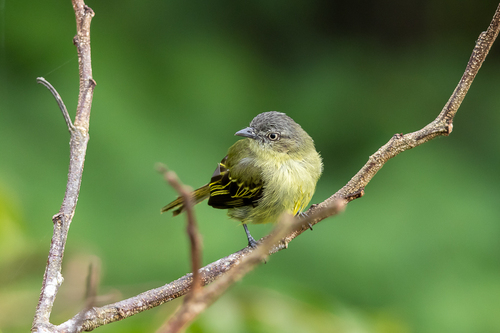
Olivaceous Flatbill

Olivaceous Flatbill

Rhynchocyclus olivaceus

Silhouette: Emily Willoughby · PhyloPic

LCLeast ConcernNTVUENCR
Daily sighting probability <5% · Rare
at Amacayacu National Natural Park

In 3 days ~10% in a week ~20%

27 Verified sightings at Amacayacu National Natural Park From 2019 to 2026
2,155 In all 9 parks
October Best month
☀️ Diurnal When it's spotted

About the Olivaceous Flatbill

The eastern olivaceous flatbill (Rhynchocyclus olivaceus) is a species of bird in the family Tyrannidae, the tyrant flycatchers. It is found in Brazil, French Guiana, Guyana, Suriname, and Venezuela. The eastern olivaceous flatbill was formally described and illustrated in 1820 by the Dutch zoologist Coenraad Jacob Temminck under the binomial name Platyrhynchos olivaceus. Temminck specified the type locality as Brazil but this was restricted to Rio de Janeiro by Olivério Pinto in 1944. The eastern olivaceous flatbill is now one of five flatbills placed in the genus Rhynchocyclus that was introduced in 1836 by Jean Cabanis.

Three subspecies are recognised: The many subspecies of what is now the western olivaceous flatbill (R. aequinoctialis) were previously treated as additional subspecies; the larger species was called the olivaceous flatbill. Following a paper published in 2016 several taxonomic authorities split the olivaceous flatbill into western... Wikipedia →

Sounds

Song0:07

Brazil · 2023

© JAYRSON ARAUJO DE OLIVEIRA · XC830886 · CC BY-NC-SA 4.0

Call0:57

Panama · 2022

© Teus Luijendijk · XC712315 · CC BY-NC-ND 4.0

Canto0:33

Brazil · 2014

© Caio Brito · XC427905 · CC BY-NC-SA 4.0

Global Distribution

Parks Where Found

# Park Country Daily sighting probability
1 Soberanía National Park 🇵🇦 Panama
~20%
2 Darién National Park 🇵🇦 Panama
~20%
3 San Lorenzo Protected Forest 🇵🇦 Panama
~10%
4 Amacayacu National Natural Park 🇨🇴 Colombia
<5%
5 Yasuní National Park 🇪🇨 Ecuador
<5%
6 Tambopata National Reserve 🇵🇪 Peru
<5%
7 Chagres National Park 🇵🇦 Panama
<5%
8 Parque Natural Metropolitano 🇵🇦 Panama
<5%
9 Manu National Park 🇵🇪 Peru
<5%

Before you go

What are the chances of seeing an Olivaceous Flatbill in Amacayacu National Natural Park?

Rare

Under 5% of wildlife watchers report an Olivaceous Flatbill sighting in Amacayacu National Natural Park on a given day, based on 27 verified sightings from GBIF citizen-science data from 2019 to 2026. It is the 289th most-seen of the 436 birds we can rate there. Over three days the chance rises to about 10%, and over a week to about 20%, if each day is a fresh chance.

When is the best time to see an Olivaceous Flatbill in Amacayacu National Natural Park?

August–October and December

In those months about 10% of wildlife watchers report an Olivaceous Flatbill in Amacayacu National Natural Park on a given day, against under 5% in January–July and November, the lowest months.

What time of day is best to see an Olivaceous Flatbill?

Between 7 and 10 am

Across all the parks we cover, that three-hour window holds the most Olivaceous Flatbill sightings with a recorded time, and about 9 in 10 of them come between 6 am and 6 pm: it is a daytime animal.

Is Amacayacu National Natural Park the best place to see an Olivaceous Flatbill?

4th of 9

Of the 9 parks where we can rate Olivaceous Flatbill sightings, Amacayacu National Natural Park ranks 4th at under 5%. The best odds are in Soberanía National Park (Panama, about 20%), Darién National Park (Panama, about 20%) and San Lorenzo Protected Forest (Panama, about 10%).

Which relatives of the Olivaceous Flatbill live in Amacayacu National Natural Park?

Same family: Tyrannidae

The closest relatives of the Olivaceous Flatbill that you can see in Amacayacu National Natural Park (family Tyrannidae, Tyrant Flycatchers) are Tropical Kingbird (about 40%), Great Kiskadee (about 40%) and Yellow-crowned Tyrannulet (about 30%), with each one's daily chance of a sighting.

Where does the Olivaceous Flatbill sighting chance come from?

GBIF citizen-science records

It is estimated from how often the Olivaceous Flatbill is recorded against all the birds logged in Amacayacu National Natural Park (27 verified sightings from 2019 to 2026), calibrated against known sighting rates. Figures are rounded to the nearest 10% because citizen-science data supports honest approximations, not decimals, and months with records from fewer than five people show "—". How it works.

← Back to Amacayacu National Natural Park