African Hawk-Eagle

African Hawk-Eagle

Aquila spilogaster

Silhouette: Shyamal · PhyloPic

LCLeast ConcernNTVUENCR
Daily sighting probability ~10% · With luck
at Amboseli National Park

In 3 days ~20% in a week ~30%

57 Verified sightings at Amboseli National Park From 2019 to 2026
3,762 In all 37 parks
September Best month
☀️ Diurnal When it's spotted

About the African Hawk-Eagle

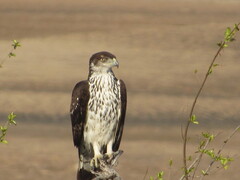
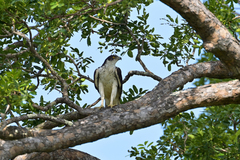
The African hawk-eagle (Aquila spilogaster) is a large bird of prey. Like all eagles, it belongs to the family Accipitridae. This species' feathered legs mark it as a member of the Aquilinae subfamily. The African hawk-eagle breeds in tropical Sub-Saharan Africa. It is a bird of assorted woodland, including both savanna and hilly areas, but they tend to occur in woodland that is typically dry. The species tends to be rare in areas where their preferred habitat type is absent. This species builds a stick nest of around 1 m (3.3 ft) across in a large tree. The clutch is generally one or two eggs. The African hawk-eagle is powerfully built and hunts small to medium-sized mammals and birds predominantly, occasionally taking reptiles and other prey as well. The call is a shrill kluu-kluu-kluu. The African hawk-eagle is listed as Least Concern by the IUCN, but a study in 2024 showed that this species is experiencing a severe population decline of ~91%, suggesting it be listed as critically endangered.

The African eagle is a member of the Aquilinae or booted eagles. This is a rather monophyletic subfamily of approximately 38 species are classified in the subfamily, all bearing... Wikipedia →

Sounds

Call0:49

Ethiopia · 2015

© Andrew Spencer · XC267752 · CC BY-NC-SA 4.0

Call0:06

Tanzania · 2014

© Thibaut Chansac · XC194777 · CC BY-NC-SA 4.0

Recording0:41

South Africa · 2026

© Sascha Schumann · iNaturalist · CC BY-NC 4.0

Global Distribution

Parks Where Found

# Park Country Daily sighting probability
1 Waterberg Plateau Park 🇳🇦 Namibia
~30%
2 Gonarezhou National Park 🇿🇼 Zimbabwe
~30%
3 Niokolo-Koba National Park 🇸🇳 Senegal
~30%
4 Ruaha National Park 🇹🇿 Tanzania
~20%
5 Hwange National Park 🇿🇼 Zimbabwe
~20%
6 Mana Pools National Park 🇿🇼 Zimbabwe
~20%
7 Tsavo West National Park 🇰🇪 Kenya
~20%
8 Meru National Park 🇰🇪 Kenya
~20%
9 Tarangire National Park 🇹🇿 Tanzania
~20%
10 Liwonde National Park 🇲🇼 Malawi
~20%
11 Moremi Game Reserve 🇧🇼 Botswana
~20%
12 Lower Zambezi National Park 🇿🇲 Zambia
~10%
13 Kruger National Park 🇿🇦 South Africa
~10%
14 Samburu National Reserve 🇰🇪 Kenya
~10%
15 Tsavo East National Park 🇰🇪 Kenya
~10%
16 Lake Manyara National Park 🇹🇿 Tanzania
~10%
17 Chobe National Park 🇧🇼 Botswana
~10%
18 South Luangwa National Park 🇿🇲 Zambia
~10%
19 Kafue National Park 🇿🇲 Zambia
~10%
20 Kidepo Valley National Park 🇺🇬 Uganda
~10%
21 Mkomazi National Park 🇹🇿 Tanzania
~10%
22 Lake Nakuru National Park 🇰🇪 Kenya
~10%
23 Amboseli National Park 🇰🇪 Kenya
~10%
24 Mikumi National Park 🇹🇿 Tanzania
~10%
25 Arusha National Park 🇹🇿 Tanzania
<5%
26 Etosha National Park 🇳🇦 Namibia
<5%
27 Akagera National Park 🇷🇼 Rwanda
<5%
28 Ngorongoro Conservation Area 🇹🇿 Tanzania
<5%
29 Serengeti National Park 🇹🇿 Tanzania
<5%
30 Pilanesberg National Park 🇿🇦 South Africa
<5%
31 Nairobi National Park 🇰🇪 Kenya
<5%
32 Masai Mara National Reserve 🇰🇪 Kenya
<5%
33 Queen Elizabeth National Park 🇺🇬 Uganda
<5%
34 Murchison Falls National Park 🇺🇬 Uganda
<5%
35 Lake Mburo National Park 🇺🇬 Uganda
<5%
36 Kibale National Park 🇺🇬 Uganda
<5%
37 Bwindi Impenetrable National Park 🇺🇬 Uganda
<5%

Cities Where Found

# City Country Daily sighting probability
1 Kampala 🇺🇬 Uganda
<5%

Zoos & Centres Where Found

# Zoo / Centre Country
1 Dullstroom Bird Of Prey & Rehabilitation Centre 🇿🇦 South Africa In captivity

Before you go

What are the chances of seeing an African Hawk-Eagle in Amboseli National Park?

With luck

About 10% of wildlife watchers report an African Hawk-Eagle sighting in Amboseli National Park on a given day, based on 57 verified sightings from GBIF citizen-science data from 2019 to 2026. It is the 191st most-seen of the 362 birds we can rate there. Over three days the chance rises to about 20%, and over a week to about 30%, if each day is a fresh chance.

When is the best time to see an African Hawk-Eagle in Amboseli National Park?

March–April, June, August–September and November–December

In those months about 10% of wildlife watchers report an African Hawk-Eagle in Amboseli National Park on a given day, against under 5% in January–February, May, July and October, the lowest months.

What time of day is best to see an African Hawk-Eagle?

Between 8 and 11 am

Across all the parks we cover, that three-hour window holds the most African Hawk-Eagle sightings with a recorded time, and about 9 in 10 of them come between 6 am and 6 pm: it is a daytime animal.

Where does the African Hawk-Eagle sighting chance come from?

GBIF citizen-science records

It is estimated from how often the African Hawk-Eagle is recorded against all the birds logged in Amboseli National Park (57 verified sightings from 2019 to 2026), calibrated against known sighting rates. Figures are rounded to the nearest 10% because citizen-science data supports honest approximations, not decimals, and months with records from fewer than five people show "—". How it works.

← Back to Amboseli National Park